
Food Truck Insurance Requirements: food truck insurance requirements Guide
So, you're diving into the food truck world. It’s an exciting venture, but let's talk about something that’s as crucial as your star ingredient: insurance. Skipping out on the right insurance is like building a truck with no engine—you’re not going anywhere fast. The right food truck insurance requirements aren't just a legal hoop to jump through; they're the safety net that keeps your dream from turning into a financial nightmare.
Why Insurance Is Your Most Important Ingredient
You’ve poured your passion, time, and a whole lot of cash into launching your food truck. But a single slip-up—a customer tripping on a cord, a flash fire in the fryer, or a fender bender on the way to a festival—could wipe out everything. This is where insurance stops being an expense and becomes your most valuable asset. It’s the shield that protects your mobile business.
Too many new owners see insurance as just another box to check off to get a permit. But it's so much more than that. It’s the financial muscle you need to handle a lawsuit, replace a busted generator, or cover medical bills. It ensures one bad day doesn't mean closing your window for good.
More Than Just a Legal Requirement
Sure, your city and state have rules that say you need certain coverages. But the real power of insurance is in managing risk. A solid policy is your silent partner, helping you build a business that can weather any storm. It's about protecting your livelihood, your crew, and your customers.
Think of a good insurance plan as doing three critical jobs:
- Financial Protection: It steps in to pay for costly claims and lawsuits that could otherwise empty your bank accounts.
- Business Continuity: After an accident, the right policy helps you repair your truck and replace equipment quickly, so you're not sidelined losing money.
- Legal Compliance: It keeps you in the clear by meeting all food truck insurance requirements for permits, health department licenses, and event contracts.
The food truck scene is exploding. The global food truck insurance market is expected to hit $1,800 million by 2035, a huge leap from $845.5 million in 2024. With over 92,000 food truck businesses now operating in the US, most cities won't even look at your permit application without proof of at least $1 million in general liability coverage.
Getting the right insurance isn’t just about covering your bases. It’s about building trust. It shows customers and event coordinators that you’re a professional who takes safety and quality seriously.
Building a Long-Term Business Strategy
A protected business is a business that's free to grow. Beyond just the essentials, thinking about the long game means using smart tools to build a loyal following. For instance, leveraging loyalty applications for small business success can create a dedicated customer base that keeps coming back. When you pair smart business tools with a rock-solid insurance plan, you've got a recipe for lasting success.
Building Your Food Truck Insurance Foundation
Think of your insurance as a recipe with four absolute must-have ingredients. Each one plays a critical role in building a rock-solid safety net for your business. If you skip one, you're leaving a massive gap that could end up costing you everything. These core policies are the non-negotiables you'll encounter when looking into food truck insurance requirements.
This diagram shows how having the right coverage is about more than just checking a box—it's about creating a business that can actually withstand the unexpected.
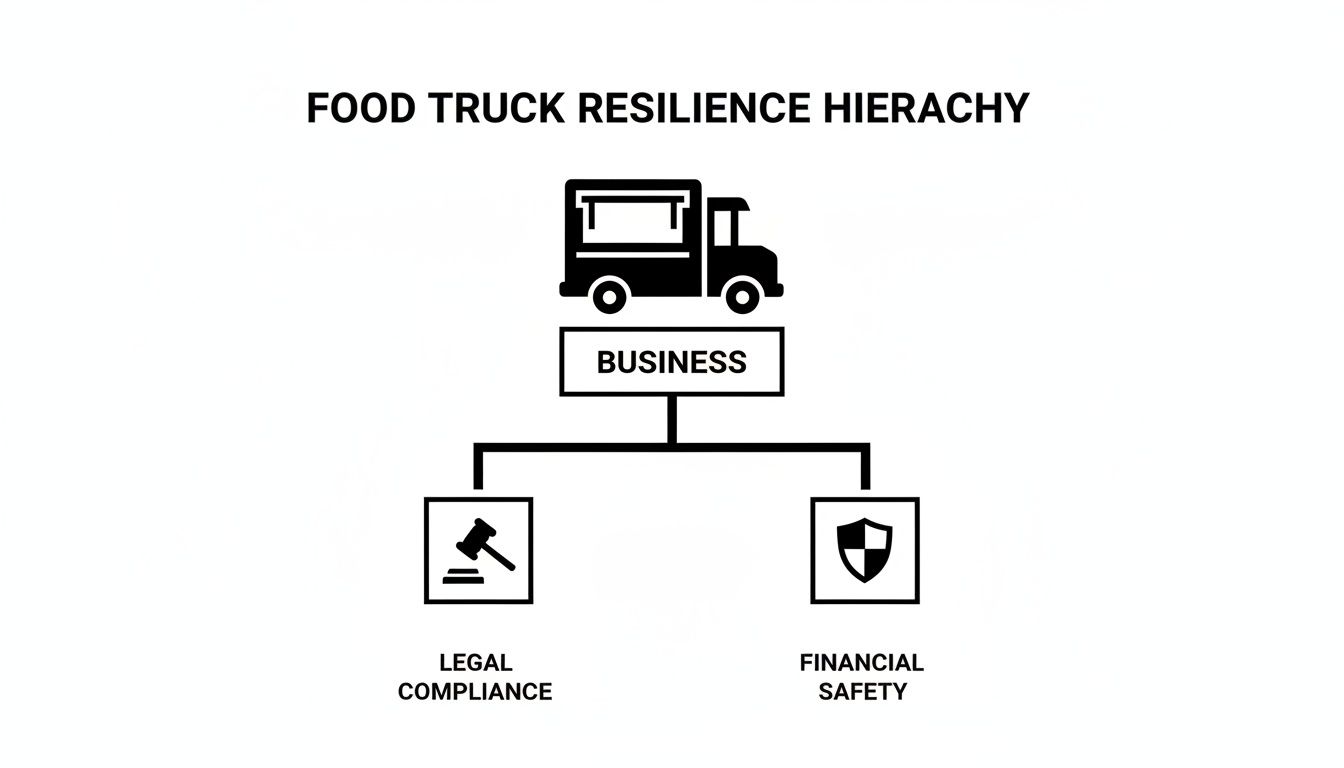
As you can see, success isn't just about slinging amazing tacos; it's built on a foundation of legal compliance and financial protection. Let’s break down the four policies that create this foundation, starting with the one that shields you from the public.
To make things even clearer, here’s a quick rundown of these essential policies and how they protect you in the real world.
The Four Essential Food Truck Insurance Policies
| Insurance Type | What It Protects | Example Scenario |
|---|---|---|
| General Liability | Third-party claims of injury or property damage not related to driving. | A customer trips on your generator's power cord and breaks their arm, leading to medical bills and a potential lawsuit. |
| Commercial Auto | Your truck as a vehicle (accidents, theft) and accidents that happen while driving. | You accidentally back into a catering van while parking at a food festival, causing significant damage to their vehicle. |
| Inland Marine | The expensive equipment inside your truck while it's in transit or on-site. | Your truck is broken into overnight, and your commercial-grade grill, fryer, and POS system are stolen. |
| Workers' Compensation | Your employees for on-the-job injuries, covering their medical bills and lost wages. | Your line cook gets a severe burn from hot oil spatter and needs immediate medical attention and time off to recover. |
Each of these policies plugs a specific hole, and together, they form a comprehensive shield. Now let's dig into each one a bit more.
General Liability Insurance: The Public-Facing Shield
General Liability is your first line of defense against claims from anyone who isn't you or an employee—think customers, bystanders, or even other vendors. It covers things like bodily injury and property damage that happen because of your operations, but not while your truck is actually in motion.
Picture this: a customer trips over a loose mat you put down and breaks their wrist. Or a sudden gust of wind sends your A-frame sign flying into a nearby parked car, leaving a nasty dent. This is exactly what general liability is for. It steps in to handle the medical bills, repair costs, and any legal fees if things get ugly.
Without it, you're paying for all of that straight out of your own pocket. Most event organizers and city permit offices won't even talk to you without a Certificate of Insurance (COI) showing you have this coverage, typically requiring a minimum of $1 million per occurrence.
Commercial Auto Insurance: Protecting Your Business on Wheels
This is a classic rookie mistake: assuming your personal auto policy has you covered. It doesn't. Not even a little. The second you start using that truck for business—driving to a gig, serving food, anything—you need a Commercial Auto Insurance policy.
It's legally required in pretty much every state. This policy is a hybrid that protects your truck from accidents, theft, and damage while also covering liability when you're on the road. If you rear-end someone on the way to a farmer's market, commercial auto is what pays for the damages.
This isn't just a slightly different version of your personal policy. It's built from the ground up to account for the much higher risks and liability that come with running a commercial kitchen on wheels. Trying to rely on personal insurance is a surefire way to get a claim denied right when you need it most.
Inland Marine Insurance: The Unsung Hero for Your Gear
Okay, so commercial auto covers the truck itself. But what about the thousands of dollars of equipment inside it? Your commercial-grade griddles, refrigerators, and custom prep tables are not covered by a standard auto policy. For that, you need something called Inland Marine Insurance.
Don't let the weird name fool you. This policy protects your business property while it's on the move. If your truck gets stolen, vandalized, or wrecked in an accident, inland marine coverage is what helps you replace all that expensive gear. It covers everything from your point-of-sale system to the specialized stainless steel surfaces you rely on. The best food truck layouts are useless without the equipment, making this coverage absolutely vital.
Workers' Compensation Insurance: A Must for Any Team
If you have employees—even just one part-timer—the law in most states says you must have Workers' Compensation insurance. It's a fundamental agreement: this policy pays for medical bills, lost wages, and recovery costs if a team member gets hurt or sick on the job.
For instance, if a cook burns their hand on the deep fryer or an employee throws out their back lifting a case of supplies, workers' comp takes care of them. In return for this guaranteed coverage, the employee generally gives up their right to sue your business over the injury. It’s a system designed to protect both your people and your business from devastating lawsuits.
To properly protect your food truck, it's crucial to understand the different types of business insurance for contractors and how they apply to your mobile operation. These four policies are the pillars that hold everything up, creating a safety net that lets you focus on what you do best: making great food.
Protecting Your Kitchen on Wheels
Your food truck's kitchen is its heart and soul, crammed with thousands of dollars in specialized equipment. Protecting that investment isn't just smart—it's absolutely essential to your business's survival and a core part of your food truck insurance requirements. While your Commercial Auto policy covers the truck, all that expensive gear inside needs its own shield.
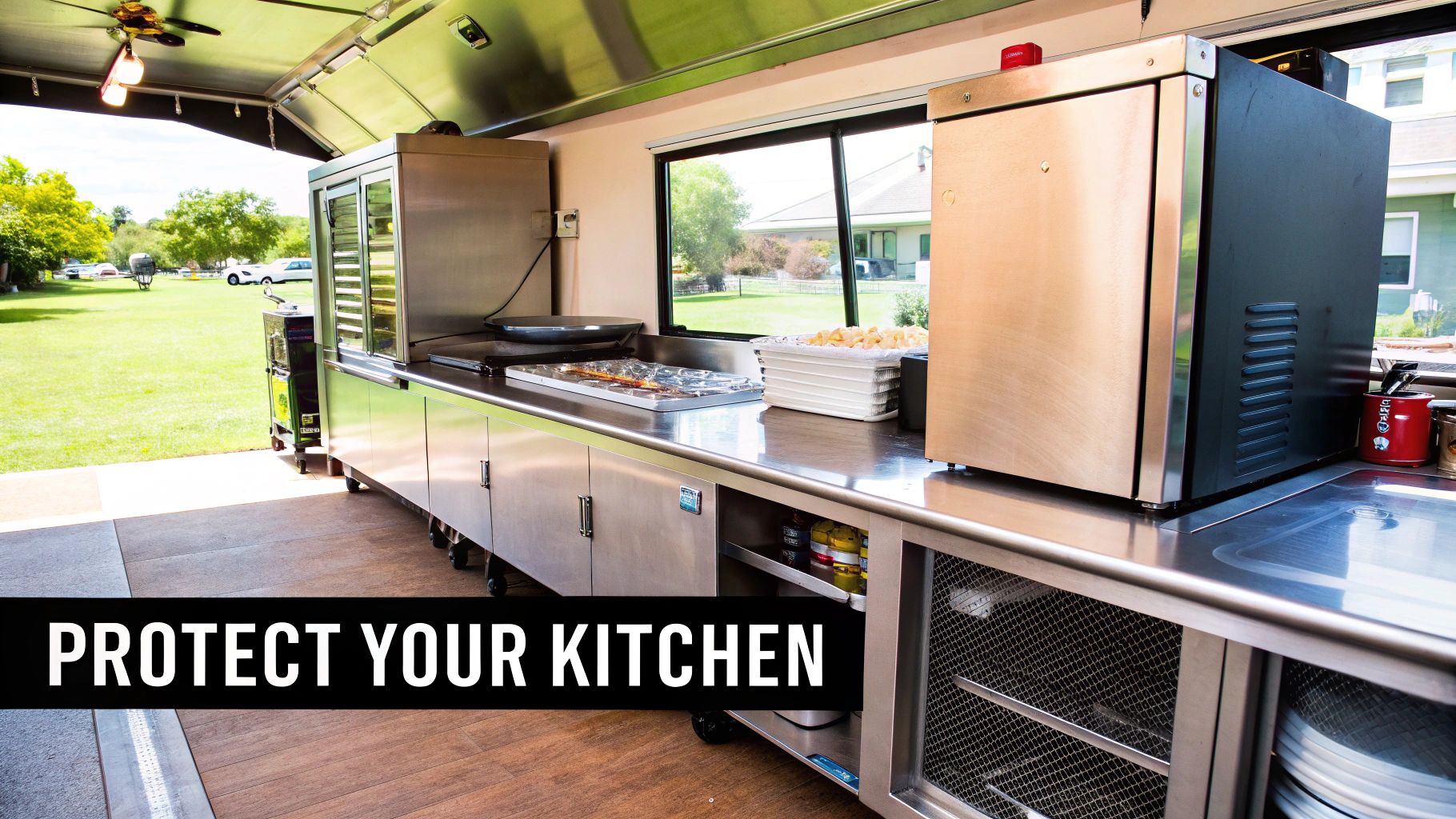
This is where a policy called Inland Marine coverage becomes your best friend. It’s built specifically to protect your business property—think grills, fryers, refrigerators, and prep tables—from things like theft, fire, or damage. It doesn't matter if you're parked, driving to a festival, or set up at an event. Without it, one bad day could force you to shut down while you try to figure out how to pay for replacements out of pocket.
Understanding Your Most Valuable Assets
The real engine of any food truck's operation is the prep area, and that’s usually dominated by stainless steel prep tables. These are much more than just surfaces; they are the workstations that define your entire workflow and your ability to meet health and safety standards. Choosing the right ones and making sure they're insured is fundamental.
Your best friend when it comes to insurance is proper documentation. Before anything goes wrong, take the time to create a detailed inventory of every single piece of equipment. Be sure to include:
- Make, model, and serial numbers
- Purchase receipts or some other proof of value
- Clear photos from several different angles
This simple step is a game-changer when you need to file a claim. It also helps you make sure your Inland Marine coverage limit is high enough to replace everything without touching your profits.
The Different Types of Stainless Steel Prep Tables
Not all prep tables are created equal, and knowing the differences is key for both your operations and your insurance coverage. The type you choose depends heavily on your menu and workflow.
- Standard Flat-Top Tables: These are the versatile workhorses of any kitchen. They provide a simple, durable, and easy-to-clean surface for chopping, mixing, assembling, and plating. They often come with an undershelf for extra storage.
- Tables with Backsplashes: A simple but crucial feature, a backsplash is a raised edge at the back of the table. It prevents ingredients and liquids from splashing onto the truck's walls, making cleanup faster and helping maintain hygiene standards.
- Tables with Integrated Sinks: Combining prep space with a sink, these units are vital for meeting health department regulations for handwashing or food prep. They streamline your workflow and are a non-negotiable for many food truck concepts.
Think of your kitchen equipment as your professional toolkit. Just as a carpenter insures their saws and drills, you must insure your griddles and prep tables. Failing to do so means you're operating without the tools you need to succeed after a loss.
Specialized Prep Tables for Peak Efficiency
Beyond the basics, specialized prep tables with built-in refrigeration are designed to make specific jobs faster, safer, and more efficient. These units are a significant financial investment, making it critical to include them accurately in your insurance inventory.
- Sandwich Prep Tables: Essential for any sandwich, salad, or burrito-focused truck, these refrigerated tables feature cold wells (or "pans") on top to keep ingredients like meats, cheeses, and vegetables at safe, cool temperatures. This setup keeps everything within arm's reach, speeding up assembly and ensuring food safety.
- Pizza Prep Tables: Similar in concept to sandwich tables, pizza prep tables have refrigerated rails for toppings and a wide, flat surface—often made of marble or refrigerated steel—perfect for stretching and working with dough. This design ensures every ingredient stays fresh from start to finish.
For a deeper look at outfitting your mobile kitchen, you can explore a comprehensive guide to essential food truck kitchen equipment to ensure you have everything covered.
By understanding the specific roles and replacement costs of each piece of equipment, especially your high-value prep tables, you can set accurate coverage limits for your Inland Marine policy. This proactive approach ensures that a catastrophe for your equipment doesn't become a catastrophe for your business.
How Location Shapes Your Insurance Needs and Costs
When it comes to your food truck insurance requirements, where you operate is everything. It's not just a backdrop for your Instagram photos—it’s the single biggest factor driving what coverage you need and how much you’ll pay for it. Insurance isn't a one-size-fits-all product; the rules and risks can change dramatically just by crossing a state line or even a county border.
Think about it. Slinging gourmet grilled cheese in downtown Los Angeles is a completely different ballgame than serving brisket in a sleepy Texas suburb. L.A. means navigating dense crowds, nightmarish traffic, and a mountain of local event regulations. In Texas, you might be more worried about a freak hailstorm taking your truck out of commission for a week. Insurance companies have this all down to a science, and they price these regional risks accordingly.
Why Your Zip Code Dictates Your Policy
Insurers crunch an insane amount of location-specific data to come up with your premium. They’re looking at local traffic patterns, crime statistics, weather history, and even how lawsuit-happy the area is. A food truck in a state known for expensive litigation or an area prone to hurricanes will always pay more than one in a lower-risk region. It’s just a fact of the business.
This geographical lottery also extends to the minimum coverage limits required by law. States, cities, and counties all have their own rulebooks for liability and commercial auto insurance. What gets you a permit in one town might not even get you in the door in the next. To stay legal, you have to know the local playbook.
A Look at State-by-State Insurance Costs
The price difference from one state to another can be a real eye-opener. While food truck insurance costs in 2025 generally hover between $250 to $400 per month, that average hides some serious regional swings. For example, California’s booming food truck scene comes with higher premiums; liability coverage alone averages $900-$980 annually, thanks to earthquake risks and the sheer number of huge events. New York isn’t far behind at $820-$1,020, driven by urban density and relentless traffic.
Meanwhile, a truck in Texas might find lower liability costs, around $560-$840, while Florida’s premiums of $600-$890 have the constant threat of hurricane season baked right in. Rolling the dice without the right coverage is a fool's game. Fines can hit $10,000, and you could lose your permit—a blow that cripples an estimated 20% of uninsured food truck startups every year. You can dig deeper into these food truck insurance cost breakdowns on Insuranceopedia.com.
These numbers prove one thing: don't budget based on national averages. Get quotes specifically for where you plan to park and sell.
Navigating Local Rules and Regulations
On top of state laws, cities and counties love to add their own layers of red tape. These local ordinances are almost always tied directly to getting your business and health permits.
You'll run into specific local rules for things like:
- Commissary Kitchens: Many cities, especially in Texas and California, require you to prep food and clean your truck at a licensed commissary. Your insurance will often need to meet that commissary's own liability standards.
- Fire Safety Permits: The local fire department will want to inspect your truck. They might demand a specific type of fire suppression system, which can definitely affect your insurance rates.
- Event-Specific Coverage: Working a festival, farmer's market, or private party? They will almost certainly require you to name them as an "additional insured" on your policy. This isn’t a DIY task; your insurance agent has to handle it.
Understanding the local permit process is mission-critical. Your insurance policy is the key that unlocks many of these doors. Without the right Certificate of Insurance (COI), your permit applications will be dead on arrival.
The Permit Process and Your Insurance
Getting all the right permits is easily one of the most frustrating parts of launching a food truck. And for nearly every single one—from your health department certificate to your mobile food facility license—you'll need to show proof of insurance. Your policy documents become your passport to operating legally.
For instance, to get a Mobile Food Facility Permit in most California counties, the first thing they'll ask for is a valid COI that meets their minimum liability limits. It's the same story in Texas, where you can't get your seller's permit or local health permits without it. We break down how all these documents fit together in our guide on food truck permits and licenses.
At the end of the day, your location is woven into every thread of your insurance plan. From the premium you pay to the special endorsements you need for local events, where you park is what defines your coverage. Researching local food truck insurance requirements early is one of the smartest things you can do to guarantee a smooth and successful launch.
A Step-By-Step Guide to Getting Insured
Nailing down the right insurance is one of the biggest—and most important—first steps you'll take. Let's walk through it so the whole process feels a lot less intimidating. We'll start with a checklist of what you'll need to have handy, like your business registration info, your truck's VIN, driver details, and a full list of your kitchen equipment.
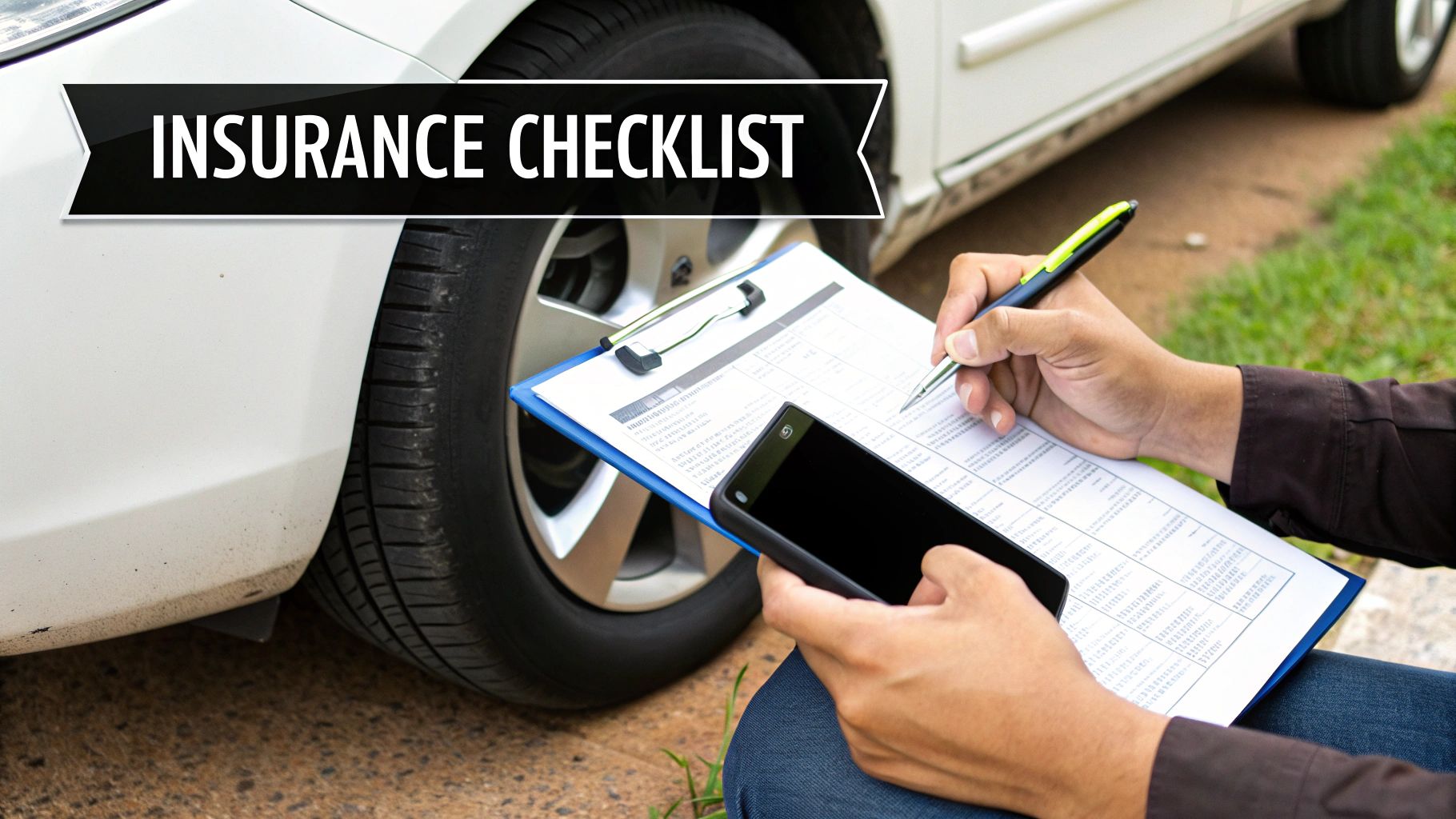
After that, I'll show you how to find agents who actually get the food truck business and what to ask them so you're comparing apples to apples. The goal here is simple: get the coverage you really need without wasting money on extras. This will clear up the application process and get you properly covered, so you can get back to focusing on your launch.
Why Your Prep Tables Matter for Insurance
Before you can even think about getting an accurate quote, you need to know exactly what you own. Your kitchen gear, especially your prep tables, is a huge investment and a central piece of your Inland Marine (or equipment) coverage. Knowing what you have and what it would cost to replace it is critical.
Stainless steel prep tables are the backbone of any mobile kitchen. They come in a few different flavors, and your insurer needs to know which ones you have.
- Standard Flat-Top Tables: These are your all-purpose workhorses for chopping, mixing, and plating. They're simple, durable, and their value is easy to calculate.
- Tables with Integrated Sinks: These units pull double duty, giving you workspace and the handwashing or cleaning stations health departments demand. They're more complex, which means they're pricier to replace.
- Tables with Backsplashes: That small metal lip on the back might seem minor, but it protects your walls, makes cleanup a breeze, and helps you keep everything sanitary.
Getting these details right ensures your coverage limits are high enough to get you back on your feet if something happens.
Specialized Prep Tables and Their Insurance Impact
Once you move beyond the basics, you get into high-value assets that really move the needle on your insurance needs. Refrigerated prep tables are game-changers for efficiency and food safety, and they need to be covered properly.
Sandwich Prep Tables
You’ve seen these everywhere. They're the refrigerated units with cold wells right on top for meats, cheeses, and all your toppings. This setup keeps everything organized, speeds up your line, and meets strict health code food truck insurance requirements for keeping food cold.
Pizza Prep Tables
These are similar, with refrigerated rails for toppings, but they often have a wide, chilled surface (sometimes marble) that’s perfect for working with dough. Because of their specific function and built-in refrigeration, they're often one of the most expensive items in a food truck.
When you're making your equipment list for an insurance application, list every single prep table separately. Note its type, brand, and what you paid for it. This detail eliminates guesswork and helps your agent lock in a policy that actually protects your investment.
Documenting Your Equipment for an Accurate Quote
A detailed inventory isn't just a good idea—it's non-negotiable if you want the right coverage. Your list needs to have everything, from the big-ticket appliances down to your POS system.
For every item, especially pricey ones like those prep tables, make sure you record:
- Item Description: Get specific (e.g., "48-inch Refrigerated Sandwich Prep Table").
- Manufacturer and Model Number: This is how you'll find the exact replacement cost.
- Serial Number: Absolutely essential for proving an item is yours if it gets stolen.
- Purchase Date and Price: Hold onto those receipts! They're your proof of value.
- Current Condition and Photos: Snap a few clear pictures from different angles.
Handing this complete list to your agent lets them calculate the exact amount of Inland Marine or Contents Coverage you need. It's the single best way to avoid being underinsured and stuck with a massive bill when you can least afford it.
Got Questions About Tipping? We've Got Answers.
Tipping can feel like a bit of a gray area, but it doesn't have to be. Getting the hang of the unwritten rules not only makes things smoother for you but also shows genuine appreciation for the folks working hard to make your meal great.
Every country has its own vibe when it comes to tipping. Here in the U.S., tips are a huge part of a server's income. Travel abroad, and you might find a service charge is already baked into the bill.
What’s a Fair Tip, Anyway?
Think of a fair tip as a reflection of the service you got. In the United States, the sweet spot is generally 15% to 20% of the bill before tax. If the service was absolutely fantastic, feel free to go higher.
So, what does great service look like? Think about the little things. Was your server attentive and friendly? Did they keep your drinks full without you having to ask? How did they handle that special request for no onions? These are the moments that help you decide what feels right.
For bigger parties, keep an eye out for an automatic gratuity on the bill, which is usually around 18%. It's always a good habit to double-check the receipt so you don't accidentally tip twice—unless, of course, the service was so good it deserved an extra thank you.
Tipping is so much more than just a transaction. It's a way to acknowledge the hustle and effort that goes into a great dining experience. A thoughtful tip can make a server's entire day and encourages them to keep bringing their A-game.
Are There Times When Tipping Isn't Required?
Absolutely. While it's pretty standard in many places, there are a few situations where a tip isn't automatically expected. For example, at a fast-food joint or a coffee shop with a tip jar on the counter, tipping is totally optional, though always appreciated.
Grabbing a takeout order? Tipping isn't mandatory, but throwing in a 10% tip is a nice way to thank the staff who put everything together for you. For delivery, though, a tip is definitely expected, much like it is when you're dining in.
And if you're in a country where a service charge is already included, you don't need to add an extra tip. That said, if the service was truly exceptional, leaving a little something extra is a kind gesture that won't go unnoticed.
How to Tip When You've Got a Discount
This is a classic head-scratcher: how do you tip when you’re using a coupon or a gift card? The golden rule is to tip on the original, pre-discount total.
Here's why: your server delivered the full experience, regardless of the deal you got on the final bill. Tipping on the original amount is the only way to make sure they're fairly compensated for their work.
- Calculate the Tip First: Figure out 15-20% of the original total before you subtract the discount.
- Acknowledge the Full Value: This shows you respect the server's time and the restaurant's service.
- Be Fair: Your server shouldn't take a pay cut just because you scored a great deal.
It’s just good form. This approach is considered standard etiquette and helps you build a great relationship with your favorite spots.
What if the Service Was Just... Bad?
We've all been there. Bad service is a real bummer, but it’s best to handle it with a bit of grace. Before you decide to leave a tiny tip (or no tip at all), take a second to read the room.
Was the place totally slammed? Maybe the kitchen was backed up or they were short-staffed. Sometimes, the issue is completely out of your server's hands. If the problem was genuinely poor service, your best bet is to have a quiet word with the manager.
A manager can actually fix the problem, maybe by offering a discount or a comped dessert. More importantly, it gives the restaurant real, constructive feedback so they can improve.
If you still feel a lower tip is the right call, that’s your decision, but know that it sends a very clear message. Some people leave a penny to signal the low tip was on purpose, not an accident. Honestly, though, a calm conversation with management almost always works out better for everyone.
At the end of the day, tipping is a personal choice. But knowing the customs helps make sure everyone is treated fairly. Good etiquette just makes the whole dining experience better and shows you respect the hard work that happens behind the scenes.
At PrepTables.com, we understand that a well-equipped kitchen is the foundation of great service. Explore our wide selection of professional stainless steel prep tables and commercial kitchen equipment to optimize your workspace for efficiency and hygiene. Find the perfect setup for your culinary needs at https://preptables.com.