

Your Guide to Food Truck Permits and Licenses
So, you’ve got a killer food truck concept and a menu that’s going to take the city by storm. That's the exciting part. But before you fire up the grill, we need to tackle the less glamorous, but absolutely critical, first step: navigating the maze of legal requirements. Securing the right food truck permits and licenses is the single most important thing you’ll do to build a real, sustainable business. It’s what protects you from hefty fines and shutdowns before you even serve your first customer.
Your Roadmap to Food Truck Legal Compliance
Think of this guide as your GPS for the journey ahead. Getting licensed isn't just about paperwork; it's about laying a solid legal foundation for your mobile culinary dream. We'll walk through what to expect, from the initial costs to the timelines, to get you set up for a smooth launch.
The path to getting on the road involves getting the green light from several different government agencies. Each permit has a specific job, whether it's ensuring public health or just confirming your business is a registered, legitimate operation. Miss even one, and your whole business can grind to a halt.
Understanding the Initial Investment
One of the biggest eye-openers for new operators is the real cost of getting compliant. The average food truck owner can expect to spend over $10,000 just to secure all the required permits—including health, business, and parking permits. In some cities, that number can climb even higher. In Los Angeles, for example, operators often face permit costs anywhere from $5,000 to $15,000, and that doesn't even include the ongoing monthly fees for a commissary kitchen.
This upfront investment feels steep, but it's non-negotiable. It’s what protects your business, your customers, and your hard-earned reputation, so you can focus on the food without constantly looking over your shoulder for legal trouble.
Think of your permits as the foundation of a house. Without a strong, complete foundation, anything you build on top is at risk of collapsing. Rushing this stage or cutting corners will only lead to bigger problems down the road.
Core Permits and Licenses at a Glance
While the specific rules change from one city to the next, almost every food truck will need a core set of licenses to get rolling.
Here’s a quick summary of the essential permits every food truck owner needs to secure before opening for business.
| Permit or License Type | Issuing Authority | Primary Purpose |
|---|---|---|
| Health Department Permit | County or City Health Dept. | Ensures food safety and sanitation standards are met. |
| Business License | City or County Clerk's Office | Legitimizes your operation as a commercial entity. |
| Mobile Vending License | City or County Licensing Dept. | Grants permission to sell goods in public spaces. |
This table covers the big three, but there are definitely more to consider.
The process for a food truck shares a lot of DNA with opening a traditional restaurant—both require meticulous planning and a sharp eye for detail. You can check out a comprehensive checklist for opening a restaurant that hits on many of these foundational legal and operational steps. This guide will help demystify the entire process, so you can move forward with confidence.
Decoding the Different Types of Food Truck Permits
Think of your collection of food truck permits and licenses as a specialized toolkit. You wouldn't use a wrench to chop onions, and you can't use a business license to prove your food is safe. Each permit has a very specific job, and you need the whole set to build a business that’s legal from the ground up.
Navigating all this paperwork can feel like a maze, but it gets a lot easier once you understand why each permit exists. They aren't just bureaucratic hurdles; they're safeguards for public health, business legitimacy, and the trust you build with every customer. Let's break down the essentials you'll be collecting.
The Health Department Permit
This is the absolute cornerstone of your operation. The Health Department Permit is the official seal of approval saying your mobile kitchen is a safe place to prepare and serve food. Consider it your food truck's diploma in food safety.
Health inspectors will go over your truck's layout and equipment with a fine-tooth comb before they even think about issuing this permit. They're looking at the critical details that prevent foodborne illness:
- Proper Food Storage: Are your refrigerators and freezers holding at the right temperatures?
- Sanitation Facilities: Do you have the required sinks for handwashing, dishwashing, and food prep? This is a big one.
- Approved Surfaces: Are your prep surfaces, like counters and tables, non-porous and easy to sanitize?
- Water and Waste: Is your plumbing system set up correctly for both fresh and wastewater?
Passing this inspection is non-negotiable. To make sure you nail the requirements for food-safe surfaces, it’s crucial to understand the standards for commercial-grade equipment. You can get the full rundown by exploring what NSF certification means for your kitchen equipment and why it’s a guarantee of safety and compliance.
Your Business License and Mobile Vending License
While the health permit is all about your food, the Business License is what makes your company legit. This is issued by your city or county clerk's office and officially registers your food truck as a commercial business. It's basically a birth certificate for your business, allowing you to operate legally in that jurisdiction.
Working hand-in-hand with your business license is the Mobile Food Vending License. If the business license says "you exist," the vending license says "you can sell here." This is your golden ticket to operate on public streets, at parks, or in those coveted food truck zones. Getting this often involves background checks and following local zoning laws that dictate where and when you can set up shop.
These two licenses are your fundamental right to operate. Without a business license, you're just a hobbyist with a big truck. Without a mobile vending license, you're a restaurant that can't legally open its doors.
Permits for Your Staff and Your Sales
Beyond the truck itself, you'll need permits for the people running the show and the money you're taking in. A Food Handler's Permit is required for every single employee who touches food. After a short course and an exam, this certification proves your team knows the essentials of safe food handling, from proper handwashing to avoiding cross-contamination.
On top of that, you will almost certainly need a Seller's Permit, which sometimes goes by the name Sales and Use Tax Permit. Your state's tax agency issues this, and it authorizes you to collect sales tax from your customers. This isn't optional—it's a legal requirement for sending the right amount of tax to the government.
The incredible growth in the food truck industry proves just how many entrepreneurs are successfully clearing these hurdles. The number of food truck businesses in the U.S. has jumped by 15.9% between 2018 and 2024, now totaling over 58,000 trucks nationwide. This shows that while the permit process is detailed, it's a well-trodden path. You can find more insights on the profitability of food trucks on Cloudwaitress.com.
Vehicle and Fire Safety Approvals
Finally, don't forget that your business is also a vehicle. It needs standard Vehicle Licensing and Registration with the DMV, just like any other truck on the road.
Even more importantly, you’re running a commercial kitchen with open flames and flammable materials in a very tight space. That's why a Fire Department Permit is absolutely critical. The fire marshal will inspect your truck to make sure it meets strict safety codes, checking for things like a certified fire suppression system, properly secured propane tanks, and working fire extinguishers. This permit isn't just for you—it confirms your mobile kitchen is safe for your staff, your customers, and the public.
The Step-by-Step Permit Application Workflow
Getting all your food truck permits and licenses isn't something you knock out in an afternoon. It's a sequence, a project with its own timeline. Think of it like building a house—you have to pour the foundation before you can even think about putting up the walls. This workflow is your project plan, designed to make the whole thing feel less like a mountain of paperwork and more like a series of manageable steps.
Your first move doesn't even involve your truck or your menu. It's all about the business itself. You need to officially create your company by choosing a legal structure, like a sole proprietorship or a Limited Liability Company (LLC). Many new owners lean toward an LLC because it helps protect your personal assets if the business ever runs into trouble.
Once the state recognizes your business, you'll need to get an Employer Identification Number (EIN) from the IRS. This is basically a Social Security Number for your business. It's a simple, nine-digit number, but you can't do much without it—you'll need it for taxes, opening a bank account, and hiring your first employee.
This infographic breaks down the typical flow for getting your permits once the business entity is set up.
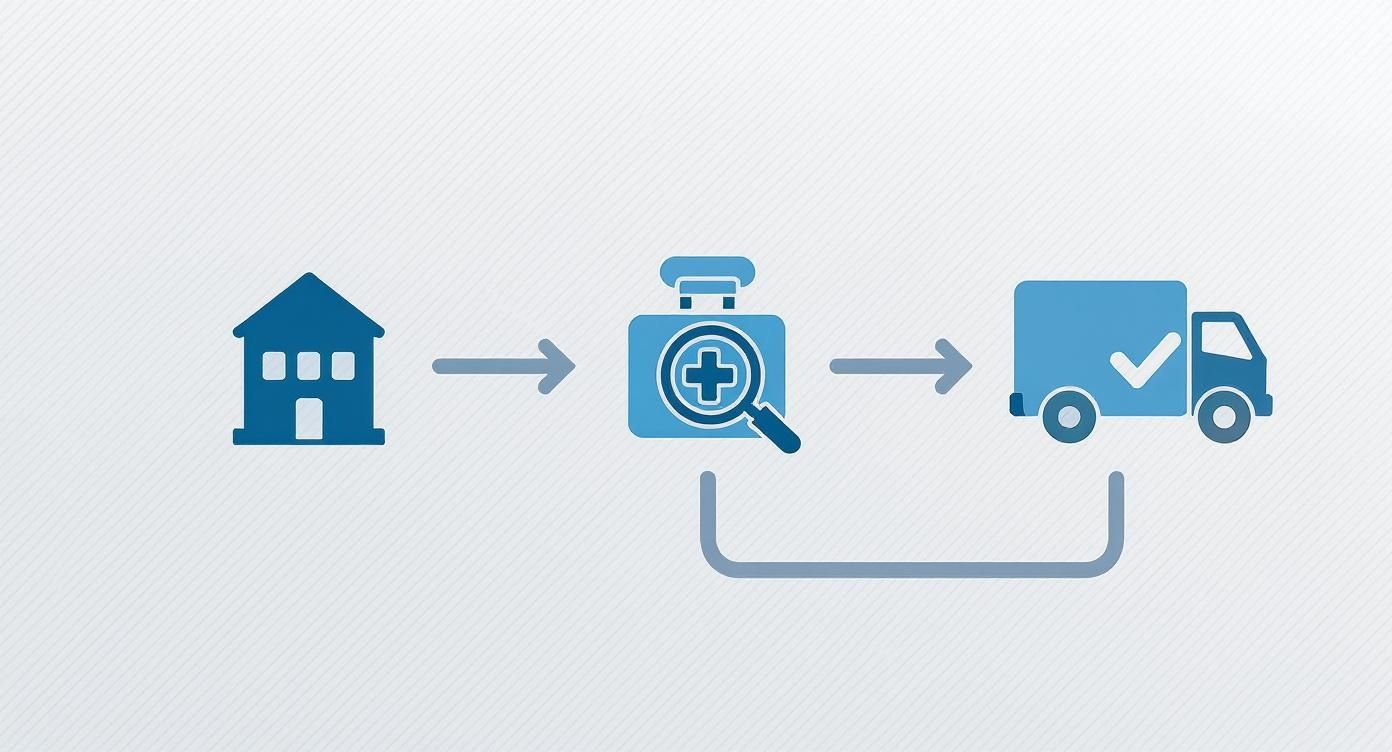
As you can see, getting the business, health, and vehicle-specific permits are all separate stages, but they're all connected. You can't skip ahead.
Mapping Your Application Sequence
With your business registration and EIN in hand, you can start chasing the permits that actually let you cook and sell. The exact order might shift a little depending on your city, but it generally follows a logical path where one step unlocks the next.
-
Business License: This is usually first on the list. Your city or county issues this license, and it's their way of officially saying your company is a legitimate business in the area. Most other agencies won't even talk to you until you have this.
-
Health Department Plan Review & Permit: Get ready, because this is the big one. You'll submit detailed blueprints of your truck's layout—everything from equipment specs and plumbing diagrams to your menu. The health department pores over these plans to make sure you're meeting every single food safety code. Once they approve the plans, they'll schedule an in-person inspection of the finished truck.
-
Mobile Vending License: After you've got the green light from the health department, you can finally apply for the license that lets you operate as a mobile vendor. This is the permit that grants you the right to actually sell food to the public.
-
Specialized Permits: Last but not least, you'll round up all the other required permits. This could include a Fire Department Permit, a Seller's Permit for collecting sales tax, and any special permits for parking or operating at big events.
Plan for a marathon, not a sprint. Every step builds on the last one. A delay in one application will have a domino effect, pushing back your grand opening.
Navigating Timelines and Roadblocks
Patience is your best friend during this phase. The whole process, from start to finish, can take anywhere from a few weeks to several months. In tightly regulated cities, it's not unheard of for it to take six months to get through all the red tape and inspections. For example, New York City’s Department of Health and Mental Hygiene is known for its demanding paperwork, which can really slow things down. You can get a better sense of these timelines by checking out these insights on food truck operational timelines on Cloudwaitress.com.
A few common roadblocks tend to trip up new owners. Knowing what they are ahead of time can save you weeks of headaches.
- Incomplete Paperwork: This is the number one cause of delays, hands down. Double-check every single form before you submit it, and always keep copies of everything.
- Failed Inspections: It happens. Your truck might fail its first health or fire inspection for something minor. It’s smart to have a little cash set aside for quick fixes needed to pass a re-inspection.
- Commissary Agreement Issues: Health departments need to see a signed contract with a licensed commissary kitchen. Before you sign anything, make absolutely sure your chosen commissary is approved by your local health authority.
If you anticipate these challenges and stick to a structured plan, you can work your way through the permitting maze and get your truck on the road that much faster.
Choosing Health Code Compliant Prep Tables
Getting that health department permit isn't just about filling out forms—it's about passing a real-deal physical inspection of your mobile kitchen. And you know what the inspector will be looking at first? Your food prep surfaces. This is where your food truck permits and licenses directly crash into your equipment choices, and one material rules them all: stainless steel.
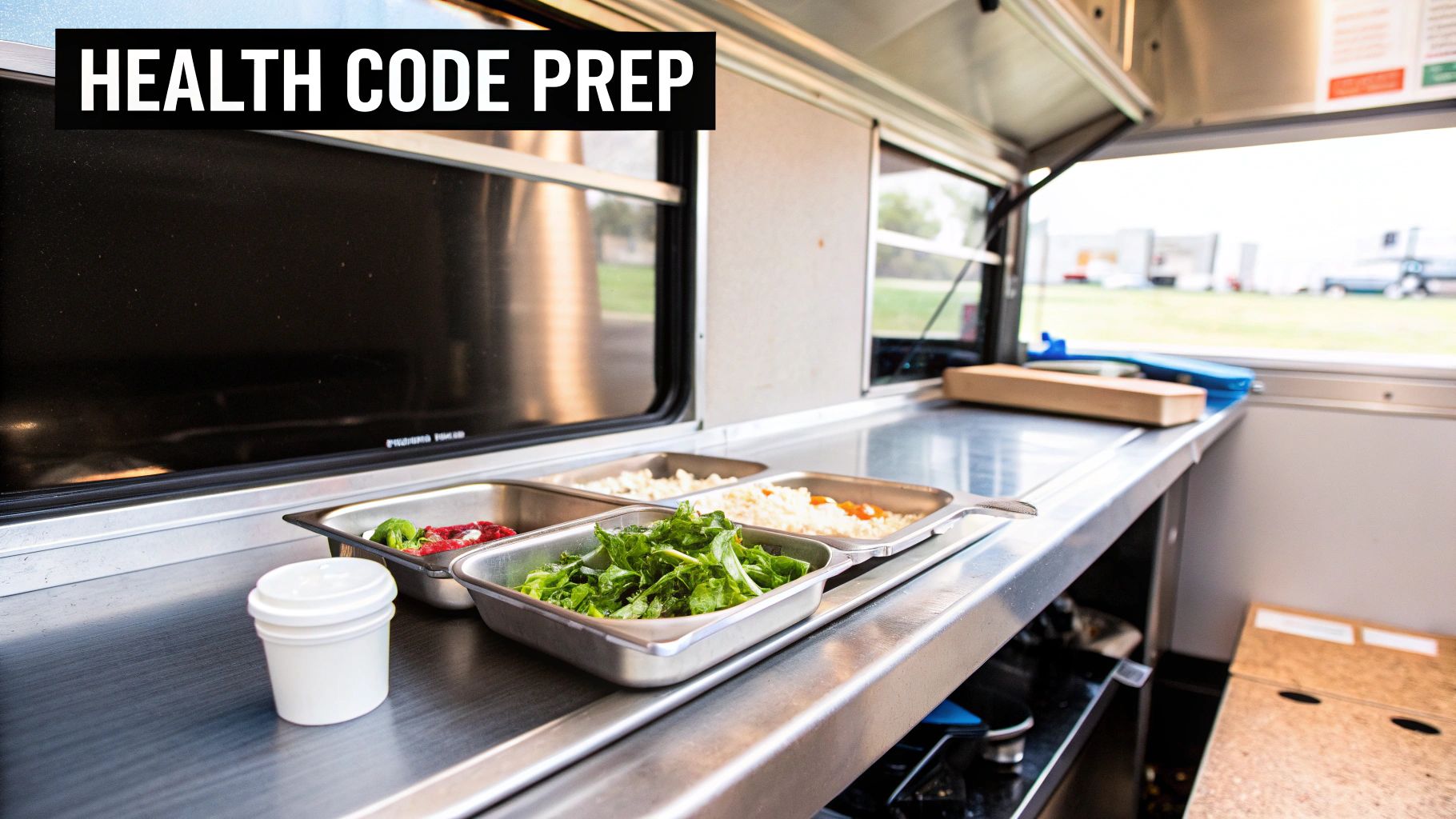
There's a simple reason stainless steel is the undisputed king of commercial kitchens: it's non-porous. Unlike wood or even some plastics, its surface has zero microscopic cracks or holes for bacteria to hide and throw a party. That makes it incredibly easy to clean and sanitize, which is a non-negotiable for passing any health inspection.
Think of your prep table as the foundation of your food safety program. A durable, NSF-certified stainless steel table is a clear signal to health inspectors that you are serious about hygiene and compliance from the ground up.
Types of Stainless Steel Prep Tables
From basic work surfaces to specialized refrigerated units, the right prep table can dramatically improve your food truck's workflow and efficiency. Let's explore the common types available.
Standard Work Tables
The standard stainless steel work table is the dependable workhorse of any kitchen. It provides a simple, flat surface for chopping, mixing, and plating. In the tight quarters of a food truck, these tables are vital for maximizing every square inch of space. Key features to look for include an undershelf for extra storage and a backsplash to prevent food and liquids from falling behind the unit. You'll also see tables rated by "gauge," which refers to the thickness of the steel—a lower number like 16-gauge means thicker, more durable steel.
Sandwich Prep Tables
If you're serving burgers, salads, tacos, or wraps, a sandwich prep table (also called a salad prep unit) is a game-changer. It combines a stainless steel work surface—often with a cutting board—directly in front of a refrigerated rail that holds multiple food pans. This design keeps your most-used cold ingredients like lettuce, tomatoes, cheese, and sauces perfectly chilled and within arm's reach. Below, a refrigerated cabinet provides backup storage, creating an all-in-one station that eliminates wasted movement and speeds up service.
Pizza Prep Tables
Pizza prep tables operate on the same principle as sandwich units but are specifically designed for making pies. They feature a wider and deeper work surface to accommodate large pizza doughs, and the refrigerated rail is typically raised to make it easier to grab toppings. The refrigerated base offers ample space for storing dough trays, extra cheese, and sauce. For a food truck, the right pizza prep table can significantly increase your output, directly impacting your bottom line.
Choosing NSF-certified tables ensures they meet strict public health standards, making your journey to securing food truck permits and licenses much smoother. For a deeper dive into the nitty-gritty of materials and construction, our guide on selecting the right stainless steel prep table has all the details you need to make a smart buy.
Navigating Local and Global Regulations
The world of food truck permits and licenses is intensely local. What gets you a green light in one city could be completely irrelevant just a few miles down the road. Getting a handle on these variations is absolutely critical to launching and expanding your business. The rules can shift dramatically based on everything from population density to local politics and public health priorities.
Think of it this way: getting licensed in a huge city like Los Angeles is like navigating a complex highway system full of interchanges. You're going to face higher fees, tougher zoning rules that dictate exactly where you can park, and a much longer list of permits you have to chase down. The number of departments you'll deal with—health, fire, transportation, business licensing—can feel like a full-time job in itself.
On the other hand, operating in a smaller town is more like driving on a quiet country road. The process is often simpler, with fewer required permits and much lower fees. You might even find yourself dealing with just one or two officials at city hall who handle everything. The trade-off? You might run into stricter rules about your operating hours or how close you can park to brick-and-mortar restaurants.
Big City vs. Small Town Permitting
The differences between urban and rural permitting are stark. A major city demands a deep dive into complex legal frameworks, while a smaller town might require more personal relationship-building with local officials. Neither is necessarily "easier"—they're just different beasts.
Here’s a quick comparison to give you an idea of what you might encounter:
- Los Angeles (Major City): Get ready to secure a whole stack of permits. We're talking a county health permit, a city business license, specific parking permits for designated zones, and rigorous fire department inspections. The total cost can easily blow past $15,000, with application timelines that can drag on for months.
- A Smaller Town: You'll likely just need the basics—a health permit and a business license. Zoning rules are often simpler, and the fees could be just a fraction of what you'd pay in a big city. The entire process might only take a few weeks from start to finish.
A Look at International Food Truck Rules
When you zoom out to a global view, you see even more diversity in how food trucks are regulated. The core principles of food safety and running a legitimate business are pretty universal, but how cities enforce them varies wildly. International cities often have unique requirements tied to their own cultural and legal systems.
For example, the landscape for food truck permits and licenses looks quite different overseas. In Berlin, Germany, vendors have to get a trade license (Gewerbeschein), a food safety certificate from the public health office, and a specific location permit (Sondernutzungserlaubnis) to operate. The total cost for these can often exceed €3,000, which is a significant financial hurdle. For a broader look, you can find detailed insights on the food truck industry from GM Insights.
Mumbai, India, is another unique case. Operators there have to navigate a complex web of licenses from the Municipal Corporation, the Food Safety and Standards Authority of India (FSSAI), and even the local police. These international examples show that while the goal is always the same—safe, legal mobile food service—the path to get there is shaped by local governance. As you sort through these rules, remember that having a specialized fire suppression system requirements for kitchens is often non-negotiable to meet local safety codes.
No matter where you set up shop—be it Los Angeles or Berlin—the golden rule is to do your homework. Never, ever assume the rules are the same. Researching the specific, hyper-local requirements for your area is the single most important step you can take.
Permit Cost and Timeline Comparison
To put things in perspective, let's look at how wildly the costs and timelines can vary. The initial investment in paperwork alone can be a major factor in deciding where to launch.
| Market Location | Estimated Permit Costs (USD) | Average Application Timeline |
|---|---|---|
| New York City, USA | $10,000 - $20,000+ | 6 - 18 months (or longer) |
| London, UK | $3,000 - $7,000 | 3 - 6 months |
| Sydney, Australia | $4,000 - $8,000 | 4 - 8 months |
| Small Town, Midwest USA | $500 - $2,500 | 4 - 8 weeks |
This table makes it clear: your location dictates your startup journey. A global perspective isn't just an interesting fact; it's a practical lesson. It trains you to ask the right questions and dig deep into the specific rules of any city or country you're considering. That way, you’re ready to comply, no matter where you park your truck.
Staying Compliant and Renewing Your Licenses
Getting that first stack of food truck permits and licenses feels like a massive win, but don't spike the football just yet. This is the start of a marathon, not the finish line. Staying in business for the long haul is all about ongoing compliance. You have to be organized, vigilant, and ready for anything, because keeping your legal status in check is what protects your investment and your reputation.
The very first thing you should do is create a master calendar. Every single permit, from your health department approval to your business license, has an expiration date. Missing a renewal deadline can mean hefty fines or, even worse, a temporary shutdown. Tracking these dates isn’t just good practice—it's essential for survival.
Staying Prepared for Surprise Inspections
Health inspectors don’t make appointments. A surprise visit is just part of the industry, and how ready you are says a lot about your operation. The real key to passing every time? Treat every single day like it's inspection day.
This proactive mindset really comes down to a few core habits:
- Daily Cleaning Checklists: Make cleaning schedules non-negotiable. Every surface, piece of equipment, and storage area needs daily attention.
- Proper Food Storage: Always keep an eye on the temperatures in your refrigerators and freezers. Make sure every food item is correctly labeled, dated, and stored to avoid any chance of cross-contamination.
Think of ongoing compliance as continuous quality control for your business. It’s not about passing a single test; it's about proving every day that your food truck is a safe, professional, and legally sound operation.
Adapting to Regulatory Changes
Laws and regulations aren't set in stone. They can—and do—change. A new city ordinance or a state-level update to the health code can hit your business directly. Part of your job as an owner is staying informed, so subscribe to newsletters from your local health department and business associations.
And if you're thinking about expanding your territory into a new city or state, you have to start the research process all over again. Never, ever assume the rules are the same. Each new jurisdiction brings its own set of food truck permits and licenses, a new inspection process, and different operational rules you'll need to follow.
This need to constantly adapt is a challenge food truck owners face everywhere. Despite high costs and tricky regulations, the food truck market is blowing up worldwide. The Asia-Pacific region, for example, is seeing the fastest growth, with a projected compound annual growth rate (CAGR) of 9.4% between 2025 and 2034, all thanks to growing cities. You can read the full research on the food truck industry to get more details on these market trends.
Common Questions About Food Truck Permits
You've navigated the paperwork maze, but staying compliant doesn't stop once the permits are in hand. The equipment inside your truck is just as important, especially the surfaces where all the magic happens. Health inspectors have a sharp eye for prep areas, so choosing the right stainless steel tables from the get-go is a huge step toward passing inspections without a hitch.
Stainless steel is the undisputed champion in any commercial kitchen. Why? It’s non-porous, which is a technical way of saying it doesn't have tiny holes where bacteria can hide and multiply. This makes it incredibly easy to clean and sanitize—a must-have for keeping your food safe and the health department happy.
Standard Work Tables
Think of the standard stainless steel work table as the foundation of your mobile kitchen. It's your all-purpose surface for chopping, mixing, plating, and everything in between. When you're shopping, look for a model with an undershelf—that extra storage space is pure gold in a food truck. A backsplash is another great feature, preventing food scraps and liquids from getting trapped behind the table in those impossible-to-reach spots.
You'll also hear the term "gauge" tossed around. This just refers to the steel's thickness. A lower number means thicker, tougher steel. For a food truck that sees a lot of action, a 16-gauge table is a solid investment that will stand up to heavy daily use.
Specialized Prep Tables
If you're cranking out a high volume of orders, a specialized prep table can be a game-changer. These units are built for pure efficiency, combining your workspace with refrigeration to keep everything you need right at your fingertips. In a tight space like a food truck, that kind of streamlined workflow is essential.
-
Sandwich Prep Tables: These are a dream for anyone making sandwiches, tacos, salads, or bowls. You get a cutting board right in front of a refrigerated rail that holds all your fresh ingredients in pans—lettuce, tomatoes, cheese, sauces, you name it. It keeps everything chilled, organized, and within arm's reach.
-
Pizza Prep Tables: Built with a much wider and deeper countertop, these tables give you plenty of room to stretch and top large pizza doughs. Like the sandwich units, they have a refrigerated rail for toppings and often feature refrigerated cabinets below to store extra dough and ingredients.
Always look for tables that are NSF-certified, as this guarantees they meet strict public health and safety standards. And remember, long-term compliance isn't just about the equipment; it's also about maintaining a clean environment. Getting familiar with Integrated Pest Management (IPM) strategies is a smart move to prevent unwanted visitors and ensure you pass every inspection.
At PrepTables.com, we provide the durable, NSF-certified stainless steel prep tables your food truck needs to pass inspection and operate efficiently. Explore our selection of standard work tables, sandwich prep units, and pizza prep stations at https://preptables.com.