

A Guide to Cafeteria Serving line Layout Design
An effective cafeteria serving line layout is really the heart of a good dining operation. A well-designed line moves people along smoothly and gives your staff a safe, productive space to work. Get it right, and you have a seamless flow; get it wrong, and you've got a chaotic queue. It all comes down to knowing your diners and the space you're working with.
Designing a Foundation for Your Serving Line
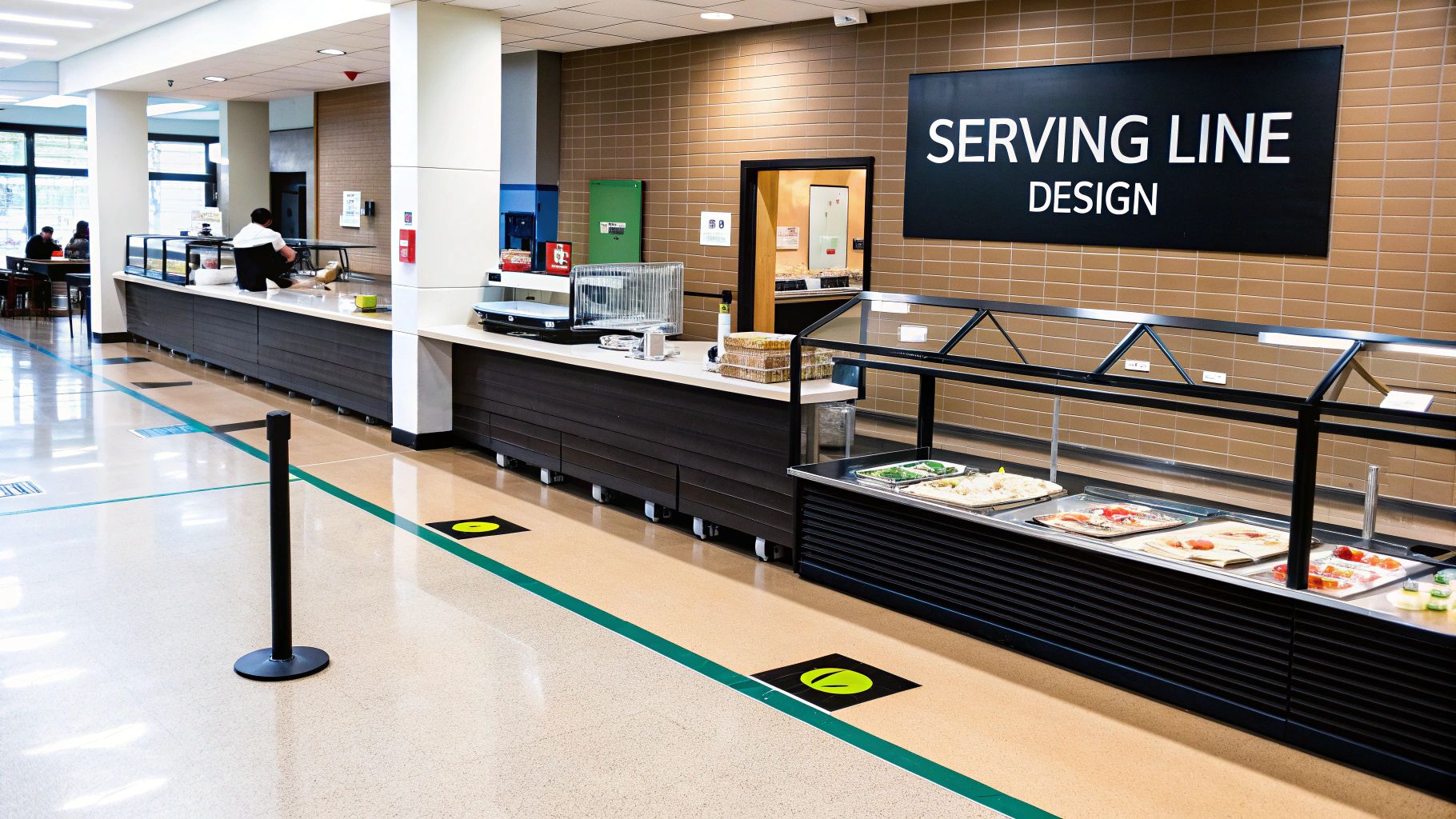
Before you even think about placing equipment, you need a solid plan. A successful layout isn't just about creating a path for food—it's about engineering an experience. The main goal here is pretty simple: cut down on wait times and make sure everyone, from students to corporate employees, leaves happy.
This all starts with a close look at three things: your audience, your physical space, and your operational goals. Nail these down, and they'll guide every other decision you make.
Know Your Audience and Their Needs
First thing's first: who are you serving? You can't design a great serving line without knowing who's going to be using it. The needs of elementary schoolers are worlds apart from hospital staff grabbing a quick bite.
- K-12 Schools: Kids are on a tight clock. Your design has to prioritize speed and make choices obvious. Long lines can easily eat up their entire lunch break.
- Corporate Cafeterias: Professionals usually want more variety and the ability to customize their meals. You might need to build in space for made-to-order stations or plenty of "grab-and-go" options.
- Healthcare Facilities: Here, staff and visitors often need 24/7 access and service that's incredibly fast. The layout needs to be intuitive for people who are often stressed and in a hurry.
In a school setting, where lunch periods are often just 25-30 minutes long, the layout is critical. A clunky design creates bottlenecks that steal precious dining time from students.
Assess Your Physical Space
Your building's layout sets the boundaries for what's possible. A detailed assessment of your square footage, entry and exit points, and where your utility hookups are is non-negotiable. Measure everything (twice!) and map out potential obstacles like support columns or large windows that might get in the way.
When you're just starting, it helps to look at established principles of commercial building floor plans. This gives you a better feel for spatial relationships and how to make the flow work within your building's constraints. A great layout doesn't just focus on the line itself; it considers how it connects to the dining room and kitchen. For a deeper dive into the kitchen side of the equation, check out our guide on commercial kitchen layout planning.
One of the biggest mistakes I see is designing the serving line in a vacuum. It doesn't exist on its own. It has to connect seamlessly to your back-of-house prep areas and the front-of-house dining room. Think of it as the central artery of your entire dining operation.
Set Clear Operational Goals
Finally, what are you trying to accomplish with this serving line? Your goals will ultimately shape the final design. Are you trying to serve more people per hour? Or maybe your focus is on making the food look so good it encourages healthier choices.
A few common goals might include:
- Maximizing Throughput: The classic goal—move as many people through the line as fast as possible.
- Improving Food Presentation: Creating an appetizing display that highlights fresh ingredients and the care you put into the food.
- Increasing Participation: Making the whole dining experience so convenient and pleasant that more people choose to eat on-site.
By clearly defining who you're serving, what space you have, and what you want to achieve, you build a strong foundation. This strategic thinking is what turns a merely functional layout into a truly effective one.
Choosing the Right Serving Line Configuration
Not all cafeterias are built the same, so trying to shoehorn a one-size-fits-all layout into your space is a surefire way to create headaches. Picking the right configuration really comes down to matching the design to your day-to-day operations, how complex your menu is, and how many people you’re serving. The best choice always creates a path that feels intuitive for your guests and is just plain practical for your staff.
We can't really talk about today's layouts without a nod to the past. The classic cafeteria line has its roots in the early 20th century, born from the need to feed huge urban workforces fast. Now, the game is all about balancing that speed with variety and customer choice. This shift has pushed designers to come up with innovative layouts that are a far cry from a simple straight line. You can discover more about this evolution and modern cafeteria designs on Chowbus.com.
The Traditional Straight-Line Layout
The straight-line (or linear) setup is what most people picture when they think of a cafeteria. It’s a classic for a good reason—it gives you maximum control over the flow and is incredibly simple for diners to navigate. Everyone grabs a tray at point A, moves past each station in order, and ends up at the cashier at point B.
This layout really shines in places with a limited menu where the main objective is just to move a lot of people through a set sequence. A K-12 school serving a standard "meal of the day" is a perfect example. The predictability of the straight-line model cuts down on confusion and keeps the queue moving forward.
But its greatest strength is also its biggest weakness. Any little delay—someone taking too long to decide on a side dish—creates a bottleneck that stops the entire line cold. It's an all-or-nothing system that can feel pretty restrictive if you’re offering a lot of options.
The Scramble System
On the complete opposite end of the spectrum is the scramble system. Think of it like a food court, with several freestanding stations that people can visit in any order they want. One person can make a beeline for the pizza, another can hit the salad bar, and someone else can grab a pre-made sandwich.
- Empowers Choice: This design gives diners a sense of freedom, which is a big deal in corporate or university cafeterias.
- Reduces Bottlenecks: By spreading out the serving points, the scramble system gets rid of that single-file line. This means it can serve way more people in less time.
- Requires More Space: The major trade-off here is floor space. You need plenty of room between stations to handle cross-traffic without people bumping into each other.
The scramble system is ideal for operations with a diverse, multi-station menu. It completely breaks the rigid structure of a traditional line, but you have to plan it carefully to manage traffic coming from every direction.
Hollow Square and Bypass Layouts
Beyond the two big ones, there are some hybrid setups that offer their own unique perks. The hollow square layout puts serving stations around a central island where your staff works. Diners move along the outside, which can feel more organized than a full-on scramble while still offering multiple service points.
Another clever twist on the traditional line is the bypass layout. It adds dedicated lanes that let people skip entire sections they don't want. For example, a customer just grabbing a salad and a drink can completely bypass the hot food stations, so they aren't holding up the main queue. This simple change can make a huge difference in throughput, especially during your busiest hours.
Mastering Traffic Flow and Queue Management
You can have the best-looking serving line in the world, but if it creates chaos during the lunch rush, it’s a failure. A brilliant design on paper can quickly crumble into a frustrating mess of bottlenecks and confusing pathways if you don't nail the traffic flow. This is all about guiding people through your space smoothly and intuitively.
Getting this right means establishing obvious entry and exit points, using visual cues to direct your guests, and making sure your aisles are wide enough to prevent jams. Long lines are the number one killer of customer satisfaction. I’ve seen viral foodie spots with hour-long waits, but that’s a non-starter for a daily cafeteria service. Your layout has to be engineered to prevent that gridlock at all costs.
This diagram shows how different layouts—linear, scramble, and bypass—approach the customer journey.
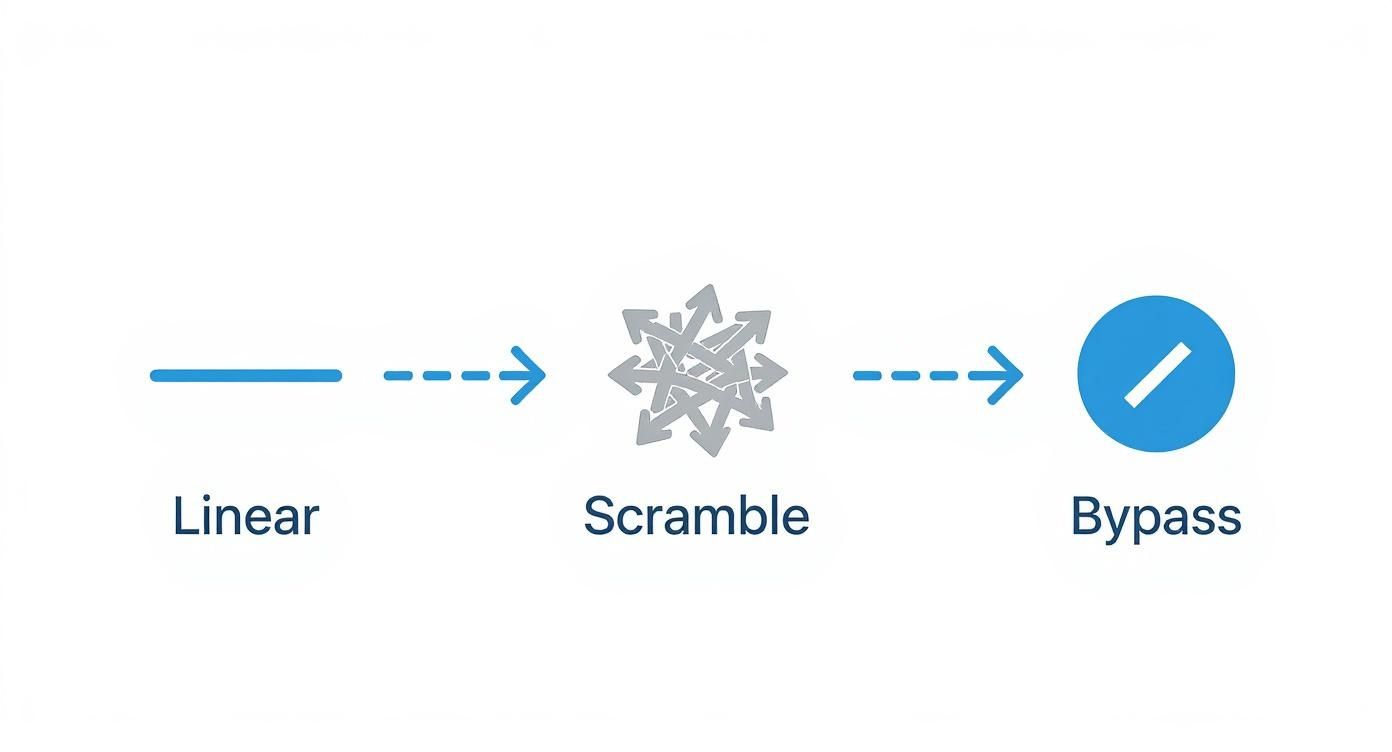
Each model offers a totally different way of managing flow, from a highly structured single line to a more free-form, station-based approach.
Defining Clear Pathways
The path through your serving line should feel completely natural, not like solving a puzzle. From the moment someone walks in, they should know exactly where to go. It all starts with a single, clearly marked entry point to stop people from cutting in and causing confusion right from the get-go.
From there, the flow must be logical and one-directional. This is critical for preventing backtracking, which is a primary cause of congestion. Think about a school cafeteria that puts the milk cooler before the hot entrees. Kids who want milk after grabbing their main dish have to swim upstream against everyone else, creating a predictable pile-up every single day.
Using Visual Cues for Guidance
You can't have staff directing traffic all day, so you need to let the environment do the heavy lifting. This is where visual cues become your best friend in creating an intuitive path.
- Floor Markings: You'd be surprised how effective some high-contrast floor tape or decals can be. Use them to create queuing lanes, show the direction of travel, and mark proper spacing between guests.
- Signage: Big, easy-to-read signs are non-negotiable. Label every station—"Salad Bar," "Hot Entrees," "Desserts"—and hang them high enough to be seen over a crowd.
- Stanchions and Dividers: Retractable belt barriers are fantastic for creating flexible queues. You can set them up during peak hours and then easily move them out of the way when things slow down.
These simple tools guide people without them even realizing it, smoothing out the whole process.
Ensuring Adequate Clearances and Spacing
Cramped aisles are a recipe for disaster. You have to give people enough room to move comfortably, especially when they're carrying trays. The goal is to build in a natural buffer that prevents gridlock before it even starts.
The table below outlines some key clearance measurements you'll want to keep in mind. These aren't just suggestions; they're foundational for a functional and accessible space.
Recommended Clearances for Cafeteria Layouts
| Area | Minimum Clearance | Recommended Clearance | ADA Guideline |
|---|---|---|---|
| Main Traffic Aisle | 48 inches | 60 inches | 36 inches (continuous passage) |
| Queuing Line (Single File) | 36 inches | 48 inches | 36 inches |
| Between Tables/Chairs | 36 inches | 44 inches | 36 inches (between fixed seats) |
| Serving Counter Access | 36 inches | 40 inches | 36 inches |
Following these guidelines ensures everyone, including those using wheelchairs, can navigate the space safely and without hassle.
A common mistake I see is underestimating the space needed for a proper queue. For a single-file line, you absolutely must maintain a clear width of 36 to 48 inches. This provides enough room for people to move without bumping into each other and keeps things accessible.
Strategic placement of small items makes a huge difference, too. Put trays, napkins, and cutlery right at the start of the line so people can grab them and get moving. The payment station should always be the final stop, located near the exit with enough space for a line to form without blocking the beverage station or the path to the dining area. It's all about designing a journey that feels effortless and keeps everyone moving forward.
Choosing and Placing Your Serving Line Equipment
The gear you pick is really the heart and soul of your serving line. Getting the selection and placement just right is a balancing act between pure function, food safety, and making sure your staff can work without tripping over each other. We're moving past the floor plans and getting into the actual hardware—from the hot wells keeping entrees perfect to the prep tables that are the real workhorses of the line.
Think about the flow from the customer's perspective. It has to feel natural. Hot food first, then cold stuff like salads and sides, and finally beverages and desserts. It's an intuitive path that just makes sense. This simple order prevents people from doubling back and keeps the whole line moving forward.
The Foundation: Stainless Steel Prep Tables
Every solid serving line is built on a foundation of stainless steel prep tables. They’re the industry standard for a good reason—they're tough as nails, easy to sanitize because they're non-porous, and can handle the daily chaos of a busy cafeteria. But you need to know that not all stainless steel is created equal.
The gauge of the steel is a big deal. It’s all about thickness, and it’s a little backward: a lower gauge number means thicker, more robust steel. For a serving line that’s going to get hammered with use day in and day out, you absolutely want 14-gauge or 16-gauge stainless steel. You might get away with an 18-gauge table for lighter work, but for the main line, investing in a thicker gauge will pay for itself over and over in durability.
Beyond gauge, you've got a few basic styles of stainless steel tables to think about for general prep and serving:
- Tables with an Undershelf: This is probably the most common setup you'll see. That lower shelf is gold for storing extra pans, utensils, or backup supplies, which keeps your main workspace from getting cluttered.
- Open Base Tables: No undershelf here, which gives you a lot of open real estate underneath. This style is perfect if you need to roll larger equipment like proofing cabinets or bus tubs under the table.
- Tables with a Backsplash: It’s just a small raised edge at the back of the table, but it's a lifesaver. It stops food and liquids from splashing all over your walls, which makes cleanup so much easier and keeps things more sanitary.
Quick tip: Always, always look for the NSF (National Sanitation Foundation) certification on any table you buy. That little seal is your guarantee that the table is built to strict public health standards and is safe for direct food contact. Don't skip this.
Specialized Tables for a More Dynamic Line
Standard flat-top tables are great for the basics, but specialized prep tables can turn a boring part of your serving line into a dynamic, made-to-order station. Bringing these units into your layout lets you offer fresher, customized food that your customers will love. These tables aren't meant to be hidden in the back; they're designed for the front line.
They create a great connection between your kitchen staff and the people they're serving. There's a certain magic to seeing a sandwich or pizza made fresh right in front of you—it adds a layer of trust and appeal that pre-packaged items just can't compete with.
A sandwich prep table (which works just as well for salads) is a total game-changer if you want to serve fresh, custom meals. These are refrigerated units built for assembly-line speed. Their best feature is the refrigerated top rail that holds a bunch of food pans. You can load it up with sliced meats, cheeses, veggies, and condiments, all kept perfectly chilled and right at your staff's fingertips.
If fresh pizza is on your menu, a dedicated pizza prep table isn't a luxury—it's a necessity. These units are designed from the ground up specifically for making pizza. They usually have a nice, wide work surface, sometimes made of marble that’s perfect for stretching dough. Just like the sandwich units, they have a refrigerated rail for all your toppings—sauce, cheese, pepperoni, you name it. Adding a pizza prep table creates an exciting live-action station that's a huge draw for customers.
Integrating Specialized Prep Tables into Your Line
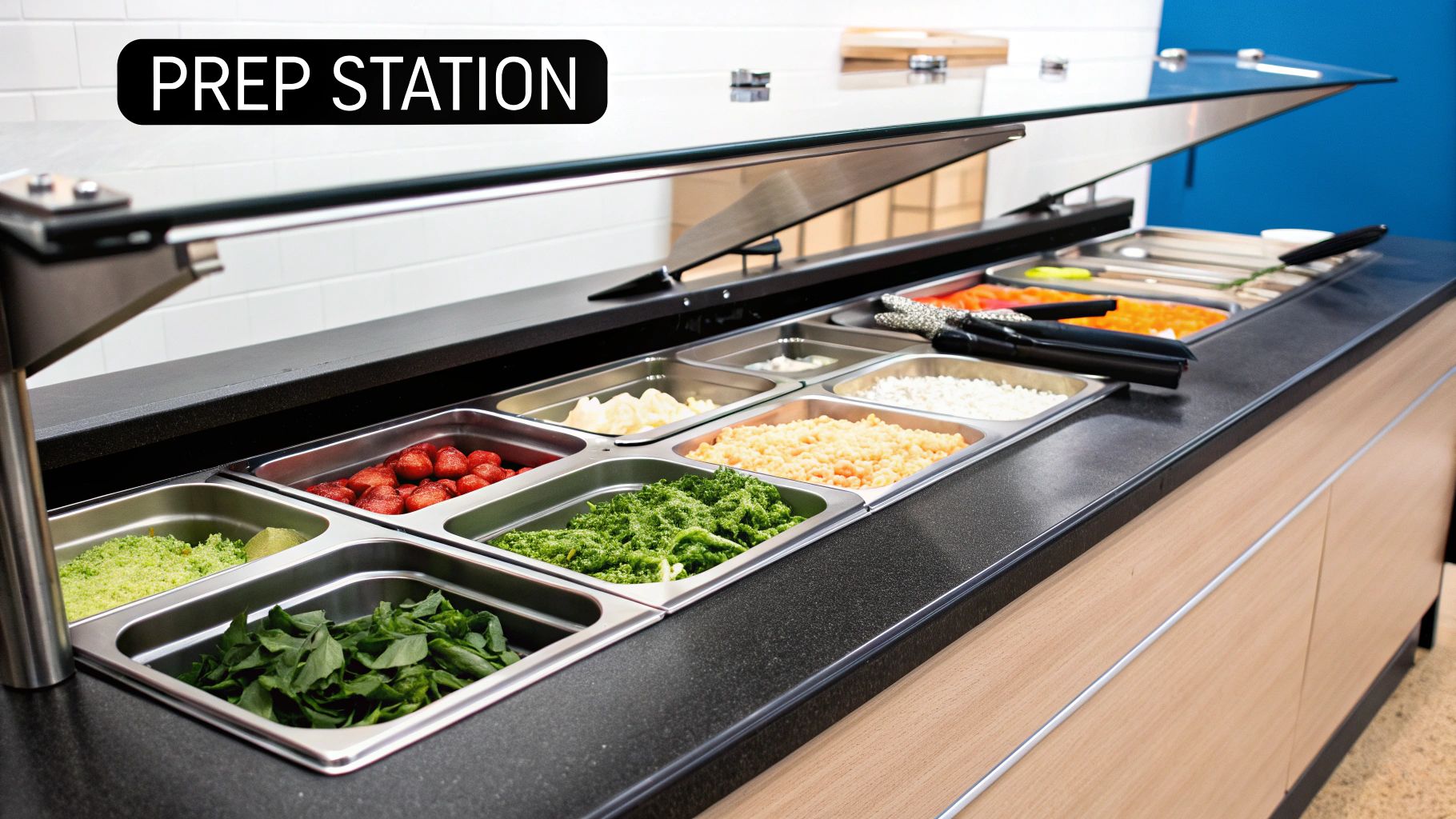
While your standard stainless steel tables are the workhorses of any line, specialized prep tables are what really bring it to life. Think of them as more than just surfaces; they're dynamic mini-workstations that connect your back-of-house kitchen directly to the customer experience.
When you integrate these units right into your cafeteria serving line layout, you transform a static serving point into an active, made-to-order station. Seeing a sandwich built from scratch or a pizza topped right before their eyes adds a level of transparency and excitement for diners. This "live-action" cooking can be a game-changer, boosting participation and making a simple meal feel like a more engaging event.
The Role of Standard Stainless Steel Prep Tables
Before we get into the specialized gear, we have to talk about the foundation: basic stainless steel tables. These are the unsung heroes of any food service operation, prized for their sheer durability and how easy they are to keep sanitized. When you’re choosing these tables, look for a few key features that will make your life easier.
- Tables with Undershelves: This is non-negotiable for immediate storage. Staff can stash backup food pans, extra utensils, or plate stacks right where they need them. It saves countless trips back to the kitchen and keeps the line moving.
- Tables with Backsplashes: That simple raised edge at the back of a table is a lifesaver for sanitation. It effectively contains spills and splatters, protecting your walls and making cleanup a much faster job.
- Tables on Casters: Mobility equals flexibility. Putting some of your tables on locking casters means you can reconfigure your line for special events, deep cleaning, or menu overhauls without a major headache.
The core ideas behind an efficient workstation are pretty universal. Interestingly, you can find surprisingly relevant insights from other fields. For example, a guide on setting up lab workstations and tables touches on material choice and ergonomic design in ways that translate directly to a busy kitchen environment.
Elevating Service with Sandwich Prep Tables
A dedicated sandwich prep table is probably one of the smartest upgrades you can make to a cafeteria line. These refrigerated units are engineered for one thing: high-speed assembly. They're perfect for crafting custom sandwiches, wraps, or salads right in front of your customers.
The magic is in the refrigerated top rail that holds all your ingredient pans. Sliced deli meats, cheeses, fresh veggies, and sauces are all kept at a safe, cool temperature and perfectly organized for quick access. Below, a refrigerated cabinet provides bulk storage, so staff can restock on the fly without ever leaving the line. This one piece of equipment can create a full-service deli station, instantly adding fresh, customizable options to your menu. To see what's out there, you can explore the different types of commercial refrigerated prep tables and figure out which one fits your space.
Creating a Destination with Pizza Prep Tables
If you're looking to add a high-demand item that customers love, a pizza prep table is a must. These units are built from the ground up for the pizza-making workflow, from stretching the dough to piling on the toppings. They usually have a wide, deep work surface—often made of marble or another stone that stays cool, which is ideal for handling dough.
Just like the sandwich units, pizza prep tables have a refrigerated rail to keep sauce, cheese, and all your toppings organized and chilled. The base is often designed to hold standard-sized dough boxes, keeping your dough perfectly proofed and ready to go. Putting a pizza prep table in your serving line creates an instant focal point. The sights and smells of fresh pizza being made will draw people in, turning a section of your cafeteria into its own destination.
Making Sure Your Design is Safe, Accessible, and Up to Code
A beautiful and efficient serving line is a great start, but if it's not safe, accessible, and compliant, you're only halfway there. This is where you have to get serious about health codes and accessibility standards. Cutting corners isn't just a mistake—it's a gamble that can lead to fines, shutdowns, and, most importantly, putting your customers and staff at risk.
A truly compliant design is a thoughtful one, covering everything from basic sanitation to total inclusivity. That means getting the details right, like installing proper sneeze guards, maintaining strict food temperature zones, and making sure the entire space works for every single person who comes through your doors.
Health Codes and Sanitation Priorities
The bedrock of any safe serving line is rock-solid sanitation. Health departments have strict rules for a reason—to stop foodborne illness in its tracks—and your layout needs to make following them feel like second nature for your team. This begins with the surfaces you choose.
There's a reason stainless steel is the industry standard. Non-porous materials like it don't give bacteria a place to hide and are a breeze to clean and sanitize. This is non-negotiable for any surface that touches food. Beyond materials, you have to think about the practical details:
- Sneeze Guards: These aren't just for show. They have to be at the right height and angle to shield food from coughs and sneezes without making it impossible for people to grab their items.
- Temperature Control: Your layout must create a clear, physical separation between hot and cold zones. Hot wells need to keep food steaming above 135°F, while cold pans have to hold items safely below 41°F.
- Workflow: Think about the journey of a dirty tray. You need a clear path for soiled dishes and waste that is completely separate from where clean dishes are stored and food is prepped. It's the only way to prevent cross-contamination.
Getting these elements right is absolutely fundamental. For a much deeper dive into the nitty-gritty, you can review more detailed food safety and sanitation guidelines that cover everything from proper surface cleaning to safe food handling.
Meeting Americans with Disabilities Act Guidelines
An inclusive operation is one where everyone feels welcome, and that means your serving line has to be fully accessible for people with disabilities. The Americans with Disabilities Act (ADA) lays out clear, enforceable standards that you must build into your cafeteria serving line layout.
Falling short of these standards doesn’t just alienate members of your community; it also exposes your business to serious legal trouble. The guidelines are practical and all about removing the physical hurdles for people who use wheelchairs or other mobility aids.
A truly great design is one that no one has to think about—it just works for them. For someone in a wheelchair, that means having the space to navigate, reach, and pay for their meal with the same ease as everyone else.
Here are a few key ADA requirements to bake into your design from the start:
- Counter Height: At least one portion of your serving line needs a counter that’s no more than 34 inches high from the floor.
- Aisle Width: Every pathway, including the queueing lines, must have a clear width of at least 36 inches. This gives wheelchairs enough room to pass through comfortably.
- Reach Ranges: Make sure self-serve items like condiment packets, drinks, and silverware are placed where someone in a seated position can easily reach them.
These aren't just rules to follow; they're principles that help create a space where everyone can dine with dignity. The impact of a good layout is huge, especially in schools. Studies have shown that slow, poorly designed lines with outdated equipment actually cause some students to skip meals. You can read more about how modern layouts maximize throughput and improve the student experience.
At PrepTables.com, we provide the durable, NSF-certified stainless steel tables and specialized equipment you need to build a safe, efficient, and compliant serving line. Explore our extensive collection at https://preptables.com to find the perfect foundation for your design.