

Beverage Fridge UnderCounter: The Ultimate Guide for Commercial Kitchens
Picture this: it’s the middle of a chaotic dinner rush. Servers are dodging each other in tight spaces, the bartender is buried trying to restock the most popular drinks, and the kitchen line is one big bottleneck. Every single second counts. But time is being wasted as staff trek back and forth to the main walk-in cooler. This constant, inefficient shuffle is a silent profit killer. A beverage fridge undercounter is the strategic fix that turns those wasted steps into seamless, fluid service.
How an Undercounter Fridge Boosts Kitchen Efficiency
In any commercial kitchen—whether it's a sprawling restaurant or a tiny food truck—space and workflow are king. An undercounter beverage fridge isn't just a mini-cooler; it's a smart piece of equipment designed to streamline your entire operation. By tucking neatly beneath stainless steel countertops, these units transform dead space into a productive, money-making zone.
Think about a bar where every critical mixer, garnish, and bottle is chilled and right under the counter. Or a sandwich station where drinks are close enough to grab without taking a single step, letting one person build the order and ring up the sale from one spot. That’s the real power of decentralized refrigeration.
Strategic Placement for Maximum Impact
Placing a beverage fridge undercounter at key service areas creates what the pros call "point-of-use" storage. It seems simple, but this one change sends positive ripples through your whole operation.
- Less Staff Movement: It slashes the number of trips your team makes to a central cooler. This means less foot traffic and fewer chances for collisions in an already crowded kitchen.
- Faster Service: With drinks right at their fingertips, bartenders and servers can get orders out much quicker. That leads to faster table turnover and happier customers.
- Better Organization: It frees up valuable real estate in your main walk-in for perishable food, helping you run a more organized and compliant kitchen.
This isn't just about convenience. It's a direct investment in your kitchen's productivity. By cutting out wasted motion, you free up your staff to focus on what really matters: creating great food and drinks and serving customers well.
The Financial Case for Compact Refrigeration
The benefits of an undercounter fridge show up right on your bottom line. The beverage refrigeration market, where these compact units are a major player, was valued at USD 3,349.3 million in 2024 and is set to keep growing. Here's a key number: undercounter models are on track to grab 36% of the total revenue in this market by 2025, which shows just how essential they've become.
When you're shopping for one, keeping an eye on energy use is a must for controlling your operating costs. The same principles that apply to energy efficiency in commercial buildings can bring you big savings here, too. At the end of the day, the right equipment isn't just another expense; it’s a building block for a smarter, faster, and more profitable kitchen. You might also be interested in our other tips on how to improve workplace efficiency.
Choosing The Right Undercounter Beverage Fridge
Picking the right beverage fridge undercounter can feel like trying to crack a code. You're staring at spec sheets full of jargon, but what do those numbers really mean for your day-to-day operations? This guide is here to translate those technical details into real-world benefits, so you can confidently choose a unit that fits your commercial kitchen like a glove. It's all about understanding how the specs impact your workflow, efficiency, and ultimately, your profits.
The first thing to consider is what you'll actually be storing. Your beverage menu, from standard sodas to specialty THC drink options, will dictate the capacity and shelving setup you need. This isn't just about fitting things in; it's about making service faster and smoother.
From Cubic Feet to Can Count
Manufacturers love to list capacity in cubic feet, but let's be honest, that doesn't help much when you're in the weeds. A 2.9 cubic foot fridge doesn't paint a picture. Knowing it holds 54 cans or 8 wine bottles? Now that's useful information you can plan a busy Saturday night around.
Here's a pro tip: always overestimate your capacity needs a little. A fridge stuffed to the gills kills airflow, which makes the compressor work overtime and creates frustrating warm spots. Plan for your absolute busiest day, not your average Tuesday. This ensures you’ve always got perfectly chilled drinks ready to go.
This entire process—from noticing your space is getting crowded to adding the right equipment—is about boosting efficiency. It’s a simple but critical decision.
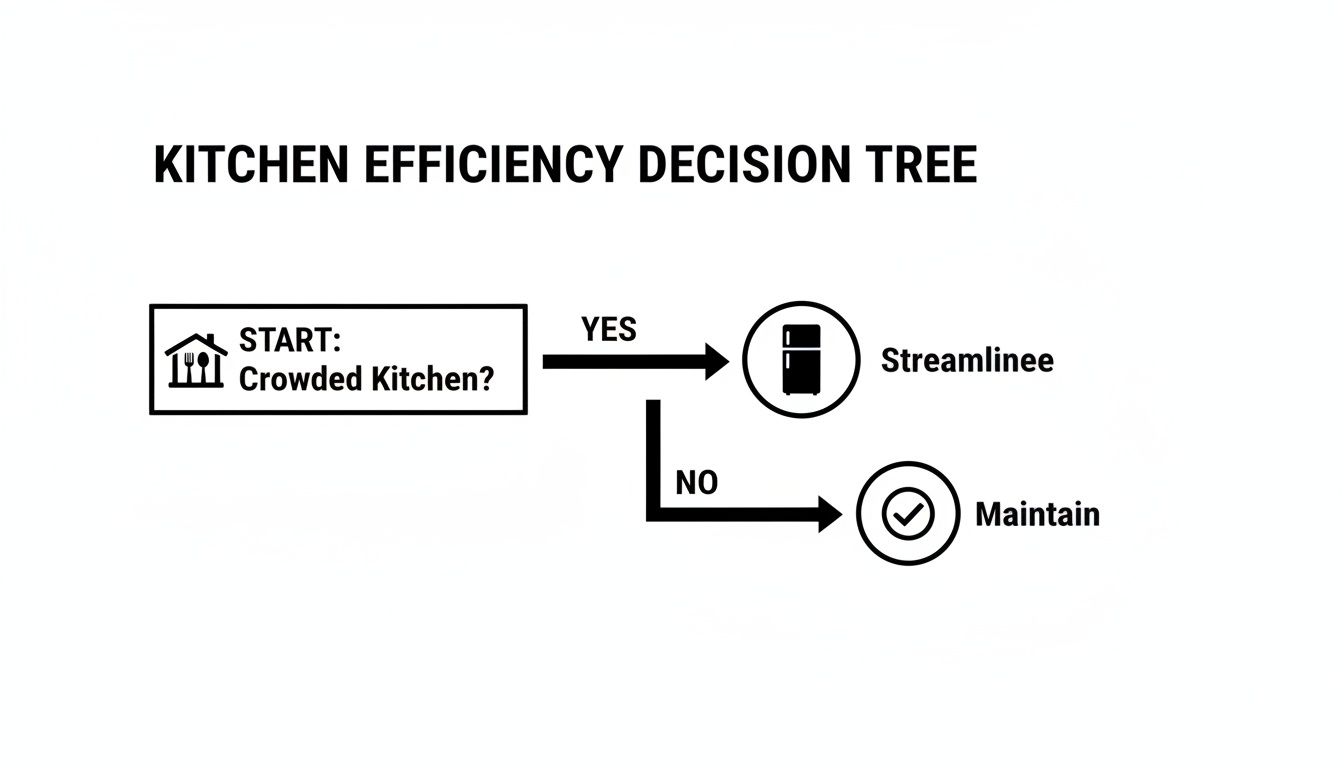
As you can see, recognizing a bottleneck is the first step. A dedicated undercounter fridge is often the simplest, most effective solution.
Before we dive deeper into specific features, here’s a quick-glance table to help you compare the most important elements when shopping for a commercial undercounter fridge.
Key Features of Commercial Undercounter Fridges
| Feature | What It Means for Your Kitchen | Ideal For | Expert Tip |
|---|---|---|---|
| Ventilation (Front vs. Rear) | Determines where you can install the unit. Front-venting is required for built-in applications. | Front: Built-in bar dies, tight cabinetry. Rear: Freestanding use with ample airflow space. | Never enclose a rear-venting model. It's a guaranteed way to burn out the compressor. |
| Capacity (Cubic Feet & Can Count) | Practical measure of how much product you can store. Can count is more useful than cubic feet. | High-volume bars, cafes, delis needing quick access to chilled beverages. | Always buy a slightly larger capacity than you think you need to ensure proper airflow and cooling. |
| NSF Certification | A requirement for health code compliance. Proves the unit is made with food-safe materials. | All commercial food service establishments, including restaurants, labs, and food trucks. | Non-NSF equipment is a red flag for health inspectors. Don't risk it. |
| Energy Star Certification | Indicates the unit is energy-efficient, saving you money on your utility bills over time. | Any business looking to reduce long-term operating costs. | The upfront cost might be slightly higher, but the energy savings will pay for it over the unit's lifespan. |
This table covers the non-negotiables. Getting these four things right will put you on the path to choosing a reliable and efficient unit that serves your business well for years.
The Critical Role of Ventilation
Of all the features, ventilation is the one people mess up most often. It’s also one of the most important. Whether you choose a front-venting or rear-venting model dictates exactly where you can put your beverage fridge undercounter.
Think of the compressor as the fridge's engine. It works hard and gets hot. The vents are its radiator, and if you block them, the whole system overheats and eventually breaks down.
-
Front-Venting Models: These are the champs of tight spaces. They breathe in and out through a grille at the front, usually right under the door. This design is absolutely essential if you plan to build the fridge into a cabinet or place it flush under a counter.
-
Rear-Venting Models: These units need room to breathe. Designed for freestanding use, they require several inches of clearance on the back and sides to get rid of heat. Boxing one in is a recipe for a very expensive repair bill.
Bottom line: if your fridge is going to be enclosed by anything—a bar die, cabinets, another piece of equipment—you must get a front-venting model. It's the golden rule for a long, happy service life.
Demystifying Important Certifications
In a commercial kitchen, certifications aren't just fancy stickers; they're your ticket to being compliant and efficient. The two you absolutely need to look for are NSF and Energy Star.
An NSF (National Sanitation Foundation) certification is your guarantee that the unit is built for commercial food safety. It means the materials are tough, non-porous, and easy to sanitize, which is exactly what health inspectors are looking for. Using non-certified gear is a huge gamble you don't want to take.
The Energy Star label is all about your wallet. A certified fridge has been independently tested and proven to use less electricity than standard models. That translates directly to lower utility bills every single month. Over the life of the fridge, those savings really add up.
The demand for these compact, efficient fridges is exploding. The global beverage fridge market hit USD 6.83 billion in 2024 and is expected to climb to USD 9.23 billion by 2030. Undercounter models are a massive driver of that growth, projected to grab a 36% revenue share by 2025 because they're so perfect for restaurants, food trucks, and delis. By nailing these key features—practical capacity, the right ventilation, and essential certifications—you’re not just buying an appliance. You're making a smart, strategic investment in your business.
Integrating Refrigeration with Prep Tables
A standalone beverage fridge undercounter is a solid addition to any kitchen, but its true power comes alive when it’s part of a complete workstation. Pairing undercounter refrigeration with a durable stainless steel prep table creates a seamless system that seriously boosts speed, tightens up food safety, and makes the most of every square inch. Stainless steel is the industry standard for a reason: it's durable, hygienic, and easy to clean. Various types are available to suit any need.
Understanding Different Types of Prep Tables
While a basic stainless steel work table provides a solid foundation, specialized prep tables integrate refrigeration to create all-in-one workstations. These units are designed to maximize efficiency for specific tasks.
-
Standard Work Tables: These are the versatile workhorses of any kitchen. Available with flat tops, backsplashes, or undershelves for storage, they provide a simple, durable surface for any prep task. Sliding a beverage fridge undercounter beneath a standard work table is an easy way to create a custom station.
-
Sandwich Prep Tables: A sandwich prep table is an assembly line built for speed. It combines three key components: a refrigerated base for bulk storage, a refrigerated pan rail on top for fresh toppings, and an integrated cutting board running along the front. This setup contains everything needed for assembly in one efficient, food-safe space.
-
Pizza Prep Tables: These units are optimized for pizzerias. They feature a similar design to sandwich tables but with a deeper, raised refrigerated rail. This design is perfect for holding large pans of sauce, cheese, and various toppings, allowing pizza makers to work ergonomically and quickly. The refrigerated base offers ample room for dough boxes and other bulk ingredients. For a deeper look, check out our guide on commercial refrigerated prep tables.
The whole idea behind integrated prep tables is to eliminate wasted motion. By bringing the cooler to the prep line, you turn a multi-step process into a single fluid motion. You're saving seconds on every single order, and that adds up to huge labor savings over time.
Customizing Your Integrated Workstation
Whether you choose a specialized unit or create your own workstation, the goal is to enhance workflow. When pairing a standalone beverage fridge undercounter with a prep table, consider features that support your specific needs.
This is where you really start to think about features like door types and shelving. Solid doors are great for insulation and energy efficiency, making them ideal for temperature-sensitive items like milk or cream. Glass doors, on the other hand, let your staff see what’s inside at a glance, so they can grab a beverage without opening the door and letting all the cold air out. Adjustable shelves are another must-have, letting you configure the interior to fit everything from tall sauce bottles to short juice cartons.
The market for these units is booming because the benefits are real. The beverage refrigeration market is projected to jump from USD 5.1 billion in 2025 to USD 7.6 billion by 2035, driven by smart, energy-efficient tech. Undercounter units are leading the way, expected to grab a 36% revenue share by 2025 as operators look to cut energy costs. When you pair these advanced fridges with high-quality stainless steel work surfaces, you get an NSF-certified, hygienic, and incredibly efficient workstation perfect for any busy kitchen. You can read more about these market trends and their impact on refrigeration.
Proper Installation and Ventilation
So you’ve unboxed your new beverage fridge undercounter. Getting it set up correctly is the real key to making sure it runs efficiently for years to come. A proper installation right from the start saves you from future headaches, whether it’s weird noises, poor cooling, or a machine that dies way too soon.
It’s not a complicated job, but you do need to pay attention to the details. Trying to cut corners here is a fast track to a strained compressor or an overworked cooling system, and that means expensive repair bills you don't need.
Leveling Your Unit for Quiet Operation
First things first: your fridge has to be perfectly level. If it’s off-balance, the compressor motor will vibrate more than it should, creating a constant hum that will drive your staff crazy. Even worse, that constant shaking puts a ton of stress on the motor and will dramatically shorten its life.
Grab a standard level and check the top of the unit, both front-to-back and side-to-side. You'll find adjustable feet on most models—just give them a twist to raise or lower each corner until that bubble sits right in the middle. This one simple step keeps the internal parts aligned and humming along quietly.
Confirming Your Electrical Setup
Next up is power. A commercial beverage fridge undercounter is a serious piece of equipment. It needs a lot of juice, especially when the compressor cycles on. You absolutely cannot plug this into a circuit that’s already maxed out.
- Dedicated Circuit: Your best bet is to give the fridge its own dedicated circuit. This will stop the breaker from tripping right in the middle of a busy service when the dishwasher and microwave are also running.
- Avoid Extension Cords: Never, ever use a regular household extension cord. They simply aren’t built to handle the heavy electrical load, which creates a major fire hazard and will likely void your warranty.
- Check the Amperage: Before you plug anything in, double-check that the circuit's amperage rating is equal to or higher than what's specified on your fridge’s data plate.
A stable power source is non-negotiable for commercial refrigeration. An underrated or shared circuit starves the compressor of the power it needs, leading to inefficient cooling and eventual burnout.
Mastering Ventilation for Compressor Health
Ventilation is probably the single most important part of the installation process, and it’s where most people mess up. Your fridge’s compressor generates a ton of heat as it cools, and it needs a constant flow of air to get rid of that heat. If you suffocate it, you’re basically guaranteeing a catastrophic failure.
The trick is knowing whether you have a front-venting or rear-venting model. A front-venting unit is made specifically to be built into cabinetry. It draws air in and pushes hot air out through a grille on the front, so it can be installed flush with its surroundings with zero clearance.
A rear-venting model, on the other hand, needs room to breathe. The heat comes off the back and sides, so it requires several inches of open space all around it. Boxing in a rear-venting unit is like trying to run a car engine without a radiator—it’s going to overheat and die, fast. This is a common and costly mistake, often leading to a total system failure that won’t be covered under warranty.
For a deeper dive into airflow management, check out our guide on commercial kitchen ventilation requirements. Taking a few extra minutes to level the unit, secure the right power source, and ensure proper airflow will set your fridge up for a long, productive life.
A Maintenance Plan for Lasting Performance
Your undercounter beverage fridge is one of the most reliable workhorses in your entire operation. But just like any essential piece of equipment, it needs a little TLC to keep running smoothly and avoid a surprise breakdown on a busy Friday night. A simple, consistent maintenance plan is the best way to protect your investment and make sure your drinks are always perfectly chilled.
Think of it this way: a few minutes of preventative care each week can save you from hours of costly downtime and a hefty repair bill. This isn't about becoming a refrigeration technician; it's about building simple habits that keep your fridge efficient, clean, and ready for service.
Your Daily, Weekly, and Monthly Checklist
To make things easy, it helps to break down maintenance into a simple schedule. Sticking to these routines will not only extend the life of your fridge but also help you catch small issues before they snowball into major failures.
Here’s a straightforward schedule you can start using right away.
Commercial Undercounter Fridge Maintenance Schedule
| Frequency | Task | Why It Matters |
|---|---|---|
| Daily | Wipe down the interior and exterior surfaces | This prevents sticky messes from building up and keeps your unit looking professional for both staff and customers. |
| Weekly | Inspect and clean door gaskets (the rubber seals) | A dirty or torn gasket lets cold air leak out, which makes the compressor work overtime and drives up your energy bill. |
| Monthly | Clean the condenser coils | This is the single most important task. Clogged coils make the compressor overheat, which leads to poor cooling and eventual burnout. |
| Quarterly | Check and calibrate the thermostat | This ensures your fridge is holding the right temperature—critical for both beverage quality and food safety. |
Following this simple schedule is genuinely the easiest way to head off the most common refrigeration problems. It’s a small operational habit that pays for itself over and over again.
Mastering Essential Maintenance Tasks
Some of these tasks pack a much bigger punch than others. Cleaning the condenser coils, without a doubt, is the most critical thing you can do for the long-term health of your fridge. The coils are basically the unit's lungs—if they can't breathe, the whole system starts to struggle.
In a busy commercial kitchen loaded with grease, dust, and flour, condenser coils can get completely clogged in as little as 30 days. This blockage forces the compressor to run nonstop, spiking your energy bill and leading to a much shorter lifespan for the motor.
To clean them, just unplug the unit first. Then, grab a stiff-bristled brush or a vacuum with a brush attachment and gently clear away all the dust and gunk from the coils. This one five-minute task, done monthly, can single-handedly prevent the number one cause of commercial refrigeration failure.
Checking the door gaskets is another game-changer. You need a tight seal to keep the cold air in. An easy way to test this is to close the door on a dollar bill. If you can pull the bill out with no resistance, the seal is weak and probably needs to be replaced. This quick check stops energy waste and keeps your temperatures stable.
And a quick pro-tip for cleaning: when you're wiping down the stainless steel exterior, always wipe with the grain using a soft cloth and a proper stainless steel cleaner. Going against the grain can leave tiny scratches that will dull the finish over time.
Simple Troubleshooting for Common Issues
Even with the best maintenance, you might still hit a snag now and then. Before you call a technician, here are a few common problems you can often solve yourself:
- Poor Cooling: First, check the basics. Is the unit plugged in all the way? Is the outlet working? Is the thermostat set to the right temperature? Most importantly, are the condenser coils clean, and does the unit have enough space around it for proper airflow?
- Condensation Buildup: This usually points to a leaky door gasket. Run your fingers along the seal to feel for any cracks, gaps, or cold air escaping. High humidity in your kitchen can also be a factor, so make sure your main ventilation system is doing its job.
- Constant Running: If the compressor never seems to turn off, the coils are almost always the culprit. If cleaning them doesn't fix it, the door might not be sealing properly. If both of those are fine, the unit could be low on refrigerant, and that's when it's time to call in a pro.
Frequently Asked Questions
When you're outfitting a commercial kitchen, you run into a lot of practical questions. Getting straight answers is the key to buying with confidence and sidestepping those all-too-common mistakes. Here, we'll tackle the most frequent questions we hear from operators just like you.
We'll clear up the difference between commercial and residential fridges, solve the ventilation puzzle for good, and give you the simple maintenance tips that will keep your beverage fridge undercounter humming along for years to come.
What Is the Difference Between a Commercial and Residential Undercounter Fridge?
The biggest differences come down to durability, raw cooling power, and the certifications you absolutely need. A commercial-grade unit is built like a tank with tough stuff like stainless steel to handle the daily grind of a busy kitchen. Their compressors are powerful, designed to get back to a cold temperature fast after the door swings open again and again during a service rush.
Most importantly, commercial models are NSF certified. This isn't just a nice-to-have; it's a non-negotiable for passing health inspections. This certification is your guarantee that the unit is safe for food storage and designed to be sanitized easily, stopping bacteria in its tracks.
Can I Install a Rear-Venting Fridge Inside a Cabinet?
Absolutely not. This is probably one of the most common—and costly—mistakes an operator can make. Rear-venting fridges are designed to push heat out from the back and sides, which means they need several inches of open air all around them to breathe.
If you box in a rear-venting model, you're trapping all that heat. The compressor will quickly overheat and burn itself out. For that true, flush built-in look under a counter, you must pick a front-venting beverage fridge undercounter. These models pull air in and push it out through a grille right on the front, which allows for a zero-clearance installation.
Think of it this way: enclosing a rear-venting fridge is like trying to run a marathon while holding your breath. The system is going to fail from the heat. Always match your ventilation type to your installation plans.
What Is the Ideal Temperature for My Beverage Fridge?
For most drinks like sodas, juices, and bottled water, the sweet spot is between 35-40°F (2-4°C). This range keeps everything perfectly chilled and refreshing without any risk of freezing.
But if you're storing something more specialized like craft beer or wine, the right temperature can be very different. It's always a good idea to check the storage recommendations for your specific products. This ensures you're preserving their quality and giving your customers the best possible experience.
How Often Should I Clean the Condenser Coils?
In a busy kitchen with grease, dust, and flour in the air, cleaning your condenser coils every 30-90 days is the best practice. When those coils get clogged up, they can't release heat effectively, and that forces your compressor to work way harder than it should.
This extra strain doesn't just make your energy bill creep up; it's also the number one cause of premature compressor failure. A quick cleaning with a stiff brush or a shop vacuum is the single best thing you can do to protect your investment.
Ready to enhance your kitchen's efficiency with the perfect undercounter refrigeration solution? At PrepTables.com, we offer a wide selection of durable, NSF-certified beverage fridges designed for the demands of a professional kitchen. Explore our collection and find the ideal unit for your space at https://preptables.com.