

Finding the Best Commercial Fridge for Your Business
Picking the best commercial fridge isn't about finding some magical brand. It’s about finding the right tool for the job—a perfect match for your kitchen's unique grind. The right unit is a workhorse that streamlines your workflow, keeps your food safe, and directly impacts your bottom line. Think of this guide as your roadmap to making a smart, confident decision.
Your Guide to Choosing the Best Commercial Fridge
A commercial refrigerator is a serious investment, and it’s the heart of your day-to-day operations. Whether you're running a packed restaurant, a busy deli, or a massive institutional kitchen, that cold box is more than just a place to chill things. It's the guardian of your inventory and a critical line of defense for food safety.
Get this decision right, and you're set up with efficiency, reliability, and peace of mind. Get it wrong? You're looking at spoiled food, frustrating workflow jams, and even a visit from the health inspector. This isn't just another appliance purchase; it's a strategic move for your business.
The market for these machines is huge and only getting bigger. The global commercial refrigeration market hit an impressive USD 85.6 billion in 2024 and is on track to hit USD 161 billion by 2034. That growth is all about the demand for smart, energy-efficient systems that keep food fresh without killing your utility budget. You can read the full research about the commercial refrigeration market to get a sense of the trends.
Key Considerations Before You Buy
To find the right fridge, you need to wear a few different hats: kitchen designer, health inspector, and accountant. It’s all about balancing a few key factors to land on a unit that works for you now and can grow with you later.
Before you even start looking at specific models, nail down these basics:
- Primary Use Case: What are you actually storing? Fresh produce has different needs than raw meat, bottled drinks, or prepped meals. A butcher shop’s needs are a world away from a bakery's.
- Available Space: Break out the tape measure and be realistic about your kitchen's layout. It’s not just about the unit's footprint; you have to account for clearance so the unit can breathe and the doors can actually open without blocking a walkway. An ill-fitting fridge can throw your whole kitchen into chaos.
- Health and Safety Compliance: Is the unit NSF certified? This isn't just a fancy sticker. In most places, it's a legal must-have for any commercial food operation to ensure everything is hygienic and safe.
A classic mistake is getting fixated on the upfront price tag and ignoring the long-term cost. A cheaper, less efficient fridge can end up costing you a fortune in energy bills and repair calls over its life.
This guide will walk you through all of it. We’ll break down the different types of refrigerators, from the jack-of-all-trades reach-ins to specialized prep tables. We'll also cover the nitty-gritty details like stainless steel grades, energy ratings, and what it takes to keep them clean, so you can choose a commercial refrigerator that will be a true workhorse for your business.
Decoding the Different Commercial Refrigerator Types
Picking the right commercial fridge is a lot like stocking a mechanic's toolbox—you wouldn’t use a single wrench for every job. The same logic applies here. A one-size-fits-all approach just doesn't cut it in a busy kitchen. The real secret is matching the type of refrigerator to the specific needs of your menu, your layout, and your team's workflow.
Every category of commercial refrigeration was designed to solve a specific problem, whether that's holding bulk ingredients, giving cooks instant access to prepped items, or streamlining the entire assembly line for making sandwiches or pizzas. Getting a handle on these differences is your first step to a more organized and productive kitchen.
This quick flowchart breaks down the decision-making process. You'll start with the basics—your available space and how you'll use the unit—while always keeping those critical health codes in mind.
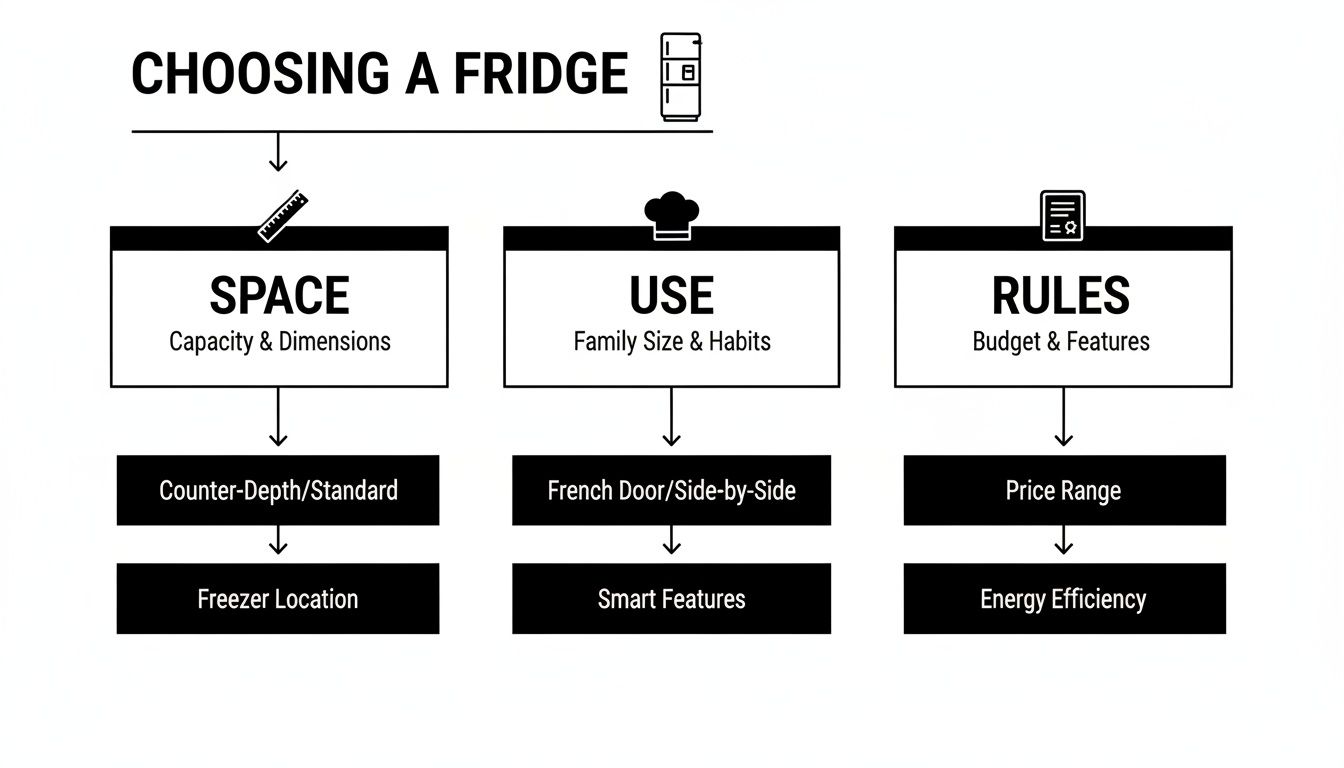
As you can see, your choice boils down to three core things: the physical reality of your kitchen (space), how your staff operates (use), and the non-negotiable health and safety standards you have to follow (rules).
Reach-In Refrigerators: The Kitchen Workhorse
When you picture a commercial kitchen, a reach-in refrigerator is probably what comes to mind. These are the classic, upright powerhouses you'll find in almost any foodservice spot. Their main job is simple but crucial: keep a ready supply of ingredients perfectly chilled and right at hand for the cooks on the line.
Reach-ins typically come in one, two, or three-door models, and you can choose between solid and glass doors. Solid doors are the champs of insulation, but glass doors are great for high-turnover items, letting your staff see what’s inside without opening the door and letting all the cold air out. If you want to get into the nitty-gritty, check out this deep dive into the benefits of a reach-in cooler.
Undercounter and Worktop Refrigerators: The Space Savers
In a tight kitchen where every inch of floor space is prime real estate, undercounter and worktop refrigerators are lifesavers. These compact units are designed to slide right under your countertops, putting cold storage exactly where your staff is prepping food. That simple design tweak saves a ton of steps and makes the whole kitchen run smoother.
A worktop unit kicks it up a notch by giving you a tough stainless steel work surface on top of the refrigerated base. It’s a prep station and a fridge all rolled into one, making it an incredible solution for small kitchens, food trucks, or dedicated areas like your salad or dessert station.
Refrigerated Prep Tables: The Ultimate Workflow Enhancers
If your business is built on assembling dishes to order—think delis, pizzerias, and sandwich shops—then refrigerated prep tables aren't just a nice-to-have; they're essential. These units are the peak of kitchen efficiency, blending refrigeration, storage, and a workspace into one seamless piece of equipment.
They are engineered to keep every ingredient you need perfectly chilled and literally within arm's reach. This lets your team build orders faster and more safely than ever before, all without leaving their station. That integration is what makes them such a game-changer for high-volume operations.
The real magic of a prep table isn't just that it's cold; it's how it optimizes every single movement. By bringing everything together, it cuts out wasted steps, slashes ticket times, and directly increases how much food your kitchen can put out during a crazy-busy rush.
There are various types of stainless steel prep tables available, each one built for a different kind of menu.
Sandwich and Salad Prep Tables
Picture a packed deli during the lunch rush. The sandwich prep table is mission control. These units have a cutting board that runs along the front edge, with a refrigerated rail of cold wells sitting right behind it. Those wells are filled with pans of toppings, meats, cheeses, and veggies.
- Design: An employee can stand in one spot, assemble the sandwich on the cutting board using ingredients from the cold wells, and plate it. Everything they need is right there.
- Refrigerated Base: Underneath the work surface, a refrigerated cabinet holds backup pans of ingredients, sauces, and other essentials, making restocks quick and easy.
- Efficiency: This all-in-one setup keeps temperature-sensitive ingredients safely chilled until the very last second, ensuring you meet food safety rules while flying through orders.
Pizza Prep Tables
Pizza prep tables are a more specialized version, fine-tuned for the unique demands of a pizzeria. They share a similar concept with sandwich tables but have a few key differences built specifically for slinging pies.
The most obvious feature is the raised refrigerated rail. This design lifts the ingredient pans up and away from the prep surface, which makes them easier to grab from and, just as importantly, keeps stray flour and sauce from falling into your toppings.
On top of that, pizza prep tables have an extra-deep cutting board, usually made of a tough poly material. This gives you plenty of room to stretch dough and build massive pizzas without making a mess. The refrigerated cabinet below is also designed differently, often configured to perfectly hold dough boxes and other bulk pizza supplies. This makes it, without a doubt, the best commercial fridge for any serious pizza joint.
Mega-Top Prep Tables
A mega-top table is essentially a sandwich prep table on steroids. It features an extra row (or two) of cold wells in its refrigerated rail. This expanded capacity allows you to hold about 30-50% more ingredients right at your fingertips compared to a standard unit. They are the perfect solution for businesses with extensive menus or those needing a wide variety of toppings, such as high-volume sandwich shops or build-your-own salad bars.
Essential Features That Define Quality and Performance
Once you've zeroed in on the right type of commercial fridge for your kitchen's flow, it's time to look under the hood. Beyond its basic shape and size, the real value of a refrigerator is in its construction and technical guts. These details are what separate a dependable workhorse from a source of constant headaches.
Making a smart choice means looking past the price tag to understand what actually defines durability, safety, and performance over the long haul. From the grade of the steel to the way it defrosts, these features directly impact your day-to-day operations, your utility bills, and whether you’ll pass that next health inspection with flying colors.
This is the knowledge that helps you pick a fridge that will be a true asset to your business for years to come.
Why NSF Certification Is Non-Negotiable
If there's only one sticker you look for on a potential new fridge, make it the NSF certification. This isn't just some marketing fluff; it's a critical seal of approval from NSF International, an independent organization that sets incredibly strict standards for public health and safety.
For any business serving food, NSF certification is almost always a hard requirement from local health departments. An inspector will look for that seal as proof that your equipment is designed and built to prevent foodborne illness.
Here’s what that NSF seal guarantees:
- Safe Materials: The unit is built from non-toxic materials that won't leach harmful chemicals into your food.
- Easy to Clean: Every surface, corner, and joint is smooth and accessible, leaving nowhere for bacteria to hide.
- Durable Construction: The equipment is made to handle the chaos of a commercial kitchen without breaking down or developing unsafe cracks.
Trying to save a few bucks on a non-certified unit is a huge gamble. It can lead to failed health inspections, hefty fines, and even a forced shutdown—making it one of the costliest "deals" you could ever make.
Understanding Stainless Steel Grades
The term "stainless steel" isn't a one-size-fits-all label. It covers a range of different metal alloys, and the specific grade used in your fridge makes a massive difference in its lifespan. In the world of commercial kitchens, you'll mainly see two types: 304 stainless steel and 430 stainless steel.
Think of it like choosing between a heavy-duty rain jacket and a light windbreaker. Both offer some protection, but one is clearly built for tougher conditions.
-
304 Stainless Steel: This is the premium stuff. It has more chromium and nickel, giving it superior resistance to rust and corrosion. In a steamy, fast-paced kitchen where spills and humidity are a given, 304 stainless steel offers the best long-term durability. You’ll often find it used for the fridge interior, where contact with food and moisture is highest.
-
430 Stainless Steel: This is the more budget-friendly option. It's still durable enough for many uses, but its lower nickel content makes it more likely to corrode over time, especially in harsh environments. It's commonly used on the exterior sides and back of a unit—the parts that face less direct abuse.
For the best all-around commercial fridge, look for a unit with a 304 stainless steel interior and front. This combo gives you an excellent balance of durability where it counts and cost-effectiveness.
Deciphering Temperature Control and Defrost Systems
A refrigerator’s number one job is to maintain a consistent, safe temperature. Modern units come with precise digital thermostats that let you easily set and monitor temperatures, ensuring your food always stays out of the "danger zone" (between 40°F and 140°F), where bacteria multiply like crazy.
Just as important is the defrost system, which stops ice from building up on the evaporator coils and choking the fridge's performance. There are two main ways they handle this.
-
Automatic (or Timed) Defrost: This system is the old reliable. It runs on a pre-set schedule, usually kicking on a small heating element a few times a day to melt away any frost. It’s a set-it-and-forget-it system that keeps the coils clear without any staff intervention.
-
Adaptive Defrost: This is the smarter, more modern approach. An adaptive system uses sensors to monitor when a defrost cycle is actually needed. This intelligence-driven method is far more energy-efficient because it avoids running unnecessary heating cycles, which saves you real money on your electricity bill.
While automatic defrost gets the job done, an adaptive system is a smarter investment that will pay for itself in lower operating costs over the life of the unit.
Sizing Your Fridge for Capacity and Kitchen Layout
Choosing the right size for a commercial refrigerator is one of those critical balancing acts in kitchen design. You're not just trying to squeeze a box into a free spot; you're matching your daily inventory needs with the hard realities of your kitchen's footprint. The goal is to think like a seasoned kitchen designer—every square foot is precious, and your equipment should improve workflow, not create a traffic jam.
It’s easy to make a mistake here. Buying a unit that’s way too big is a classic blunder that just wastes energy cooling empty space and inflates your utility bills. But going too small is even worse—it's a food safety disaster waiting to happen. When you overstuff a fridge, you block airflow, which creates dangerous hot spots and dramatically increases the risk of spoilage. The perfect fit is one that supports both your profits and your health inspection scores.
Calculating Your True Capacity Needs
Before you even glance at a tape measure, you need to figure out the actual storage volume your kitchen requires. The best way to do this is to look at your menu and inventory turnover. How much fresh produce, meat, and dairy do you really need to keep on hand between deliveries? Don't forget to plan for your busiest days. A fridge that seems fine on a slow Tuesday could be dangerously undersized for a Saturday night dinner rush.
- Inventory Volume: Make a quick list of your core refrigerated ingredients and get a rough idea of the space they occupy.
- Delivery Frequency: If you get fresh deliveries every day, you can get by with less capacity. If you're only stocking up once or twice a week, you'll obviously need more room.
- Menu Seasonality: Think about how your menu changes throughout the year. Will summer salads or winter stews require you to hold more or less cold stock?
Taking a moment to answer these questions ensures you invest in a unit that actually fits how your kitchen operates.
The sweet spot is having enough space to keep everything organized and allow for proper air circulation—aim for about 3-4 inches of clearance around the unit and between items—without paying to cool empty cubic feet.
Integrating the Fridge into Your Kitchen Workflow
Beyond just holding food, you have to consider how the refrigerator will fit into the daily dance of your kitchen. This is all about ergonomics and workflow efficiency. A poorly placed fridge can become a major roadblock, disrupting the rhythm of your entire team.
Take the door swing direction for example—it's a small detail that's often overlooked but has a huge impact. You need to make sure the door opens in a way that doesn’t block a busy walkway or trap a cook in a tight corner. You also need to account for the clearance required to open the door fully for loading heavy boxes and for deep cleaning. For a closer look at how these units fit into tight spots, you can explore detailed guides on things like the standard undercounter fridge size to see why even smaller models demand careful planning.
Top-Mounted vs Bottom-Mounted Compressors
Finally, let's talk about the engine of your refrigerator: the compressor. Where it's located—on the top or the bottom of the unit—has a real-world impact on maintenance, efficiency, and how it handles heat.
- Top-Mounted Compressors: These are generally best for cooler, less greasy kitchens. Because heat rises, they vent hot air up and away from your workspace. They also have a tendency to stay cleaner since they are far away from floor dust and debris that can clog up the coils.
- Bottom-Mounted Compressors: These are often much easier for technicians to get to for maintenance and repairs. In a scorching hot kitchen, they can actually be more energy-efficient because they pull in cooler air from near the floor. The downside is that they are magnets for dust and grease, meaning you'll need to clean them more often to keep them from overheating.
The right choice really depends on your specific kitchen environment. A hot, frantic cooking line might benefit from a bottom-mounted unit, while a cooler, calmer prep area is the perfect home for a top-mounted model.
Understanding Energy Efficiency and Long-Term Costs
That shiny new fridge’s price tag is just the first page of its financial story. The real cost of ownership plays out over years on your electricity bill. The smartest way to look at a new commercial refrigerator is as a long-term investment, where the day-to-day running cost is just as important as the upfront price.
It can feel a little backward to spend more on a high-efficiency unit, but that initial extra cost often unlocks massive savings down the road. These modern workhorses are built to do the same job with way less power, a difference you’ll see plain as day on your monthly utility statement.
Let's break down exactly how to size up a fridge's efficiency and see how its features connect directly to your bottom line.
What an ENERGY STAR Rating Really Means
When you spot that little blue ENERGY STAR label, it's not just a sticker. It's a guarantee from the U.S. Environmental Protection Agency (EPA) that the unit hits some very strict energy performance targets. On average, an ENERGY STAR certified commercial refrigerator is a full 20% more efficient than a standard model.
For a busy restaurant, that 20% isn't just a number—it's real money in your pocket. A single ENERGY STAR certified solid-door reach-in can save a business over $140 annually on electricity. That means it can pay back the extra you spent on it in just a couple of years.
Choosing an ENERGY STAR model is one of the simplest, most reliable ways to make sure your new fridge helps cut your operating costs right from day one. It’s a proven mark of both financial and environmental smarts.
Key Features That Drive Efficiency
So, what exactly makes one fridge sip electricity while another one guzzles it? It all comes down to smart design choices and modern parts working together to keep energy waste to a minimum. These are the nuts and bolts that translate directly into lower power bills.
Here are the efficiency drivers to keep an eye out for:
- High-Quality Insulation: Modern polyurethane foam insulation is thicker and denser, which drastically reduces how much cold air escapes and how much kitchen heat gets in. The result? The compressor simply doesn't have to kick on as often or work as hard.
- LED Lighting: Old-school light bulbs don’t just use more power—they actually generate heat, making the fridge work even harder to stay cool. Bright, cool-running LED lights slash energy use by up to 90% and last a whole lot longer, too.
- Electronically Commutated Motors (ECMs): Think of these as super-efficient fan motors. They can cut the energy needed for air circulation by as much as 75% compared to older, clunkier motor technologies.
- Self-Closing Doors: Every single time a fridge door is left open, even for a second, cold air rushes out and the compressor goes into overdrive. Self-closing doors with tight magnetic gaskets are simple but incredibly effective at stopping this common energy leak.
When you prioritize a model with these features, you’re not just buying a box to keep things cold. You’re making an investment in a more profitable and sustainable kitchen. Over its entire lifespan, the best commercial fridge is always the one that saves you the most money.
Installation Tips and Maintenance Routines for Longevity
Your investment in a new commercial fridge isn't complete the moment it's delivered—that's just the beginning. Getting the installation right from the start and sticking to a simple maintenance routine are the two pillars that will support a long, trouble-free service life. Think of it this way: a proper setup prevents day-one headaches, while consistent care stops minor issues from snowballing into a full-blown, kitchen-stopping catastrophe.
A successful installation boils down to giving your refrigerator the right environment to do its job. One of the most common—and damaging—mistakes we see is tucking a unit into a tight space with no room to breathe. The compressor is the heart of your fridge, and it works hard to push heat out. If it can't get enough air, it will overheat, struggle, and eventually burn out.
Make sure there’s at least 3-4 inches of clearance around the sides and back of your unit. This space is non-negotiable; it lets air circulate freely and keeps that vital compressor running cool and efficiently. You'll also want to get a level out and make sure the unit is perfectly flat, which helps the doors seal tightly and prevents extra wear on the hinges.
Building a Simple and Effective Maintenance Checklist
Once your fridge is humming along in its new home, a little proactive care is your best weapon against unexpected downtime. You don’t need a complicated, multi-page manual. A straightforward checklist broken down into daily, weekly, and monthly tasks will make all the difference.
The secret isn't complexity; it's consistency.
- Daily Tasks: At the end of every service, give all interior and exterior surfaces a quick wipe-down with a food-safe cleaner. Glance at the door gaskets for any rips or weak spots, and double-check that the doors are sealing shut.
- Weekly Tasks: Pull out the shelving and any bins for a good cleaning. This is also a great time to check the drain pans and tubes for any blockages that could cause odors or backups.
- Monthly Tasks: Now for the big one: cleaning the condenser coils.
The Critical Task of Cleaning Condenser Coils
If the compressor is the heart of your fridge, the condenser coils are its lungs. Over time, these coils get clogged with all the grease, dust, and grime floating around a busy kitchen. This buildup acts like a thick blanket, forcing the compressor to work much harder to release heat. In fact, it's the #1 cause of premature equipment failure and bloated energy bills.
Cleaning these coils every 90 days (or even more frequently in a high-grease environment like a fry station) is an absolute must. You can find simple tools for the job, and our guide on using a fridge condenser cleaner walks you through the entire process.
Neglecting your condenser coils is like forcing a marathon runner to breathe through a straw. Sooner or later, the system will fail under the strain. This simple, 15-minute task can add years to your unit's life.
Finally, remember that good maintenance involves your whole team. Make sure your staff knows not to overload shelves (this blocks airflow) or use harsh chemicals like bleach on stainless steel surfaces, which can cause them to rust. Training them and implementing work safety procedures during cleaning and daily use protects both your people and your equipment, keeping your unit running smoothly for years to come.
Frequently Asked Questions
When you're about to invest in a piece of equipment as crucial as a commercial refrigerator, a few questions are bound to come up. Let's tackle some of the most common ones to help you feel confident in your choice.
What Is the Difference Between Commercial and Residential Fridges?
The biggest differences come down to pure muscle, cooling power, and staying on the right side of the health department. Commercial fridges are built tough, usually with stainless steel, to handle the chaos of a busy kitchen. Their compressors are powerful, designed to get back to a safe, cold temperature in a flash after the doors have been opened and closed a hundred times during a rush.
Most importantly, they are NSF certified, which is a deal-breaker for health inspectors. This certification means they meet incredibly strict standards for food safety and are easy to properly clean—something a home refrigerator is never designed or tested for.
How Often Should I Clean My Commercial Refrigerator Coils?
You should make it a habit to clean the condenser coils at least every 90 days. If your kitchen has a lot of grease in the air from a fryer, or just gets dusty, doing it more often—even once a month—is a really smart move.
When coils get clogged, the compressor has to work way too hard. This will absolutely spike your energy bill and dramatically increases the risk of a very expensive breakdown. It's one of the easiest bits of maintenance you can do to protect your investment.
What Does Top Mounted vs Bottom Mounted Compressor Mean?
Where the compressor sits on the unit actually makes a difference in how it performs and how easy it is to service.
- Top-mounted compressors are great for cooler, less greasy kitchens. They push hot air up and away from the unit and your staff. They also tend to stay cleaner since they're far away from all the dust and debris on the floor.
- Bottom-mounted compressors are a favorite for maintenance technicians because they're much easier to get to. In really hot kitchens, they can be more efficient since they pull in cooler air from down low instead of the hotter air that naturally rises to the ceiling.
Is an NSF Certified Refrigerator Really Necessary?
Yes, absolutely. For any business that serves food to the public, NSF certification is almost always a non-negotiable rule set by your local health department. Think of it as your guarantee that the refrigerator was built from the ground up with food safety in mind.
It confirms the unit is made with materials that are durable, non-porous, and can be completely sanitized, leaving no tiny crevices for bacteria to hide. Using equipment that isn't NSF-certified can get you hit with serious health code violations, fines, or even a shutdown. It's an essential feature, not a bonus.
Ready to find the perfect refrigeration solution for your kitchen? The experts at PrepTables.com offer a wide selection of NSF-certified refrigerators, freezers, and prep tables designed for durability and efficiency. Explore our collection and equip your business for success. Visit us at https://preptables.com today.