

A Guide to Under Counter Refrigerator Sizes and Prep Tables
Your Quick Guide to Standard Undercounter Refrigerator Sizes
Picking out the right undercounter refrigerator is a lot like finding the perfect puzzle piece for your kitchen's layout. If it fits just right, you get a seamless look and a smooth workflow. While you'll see slight differences from one brand to another, most models are built to industry standards that play nicely with typical cabinets and countertops.
These units are all about maximizing your cold storage without getting in the way. For the most part, you'll find they are designed for easy, slide-in installation.
The Core Dimensions
Width, height, and depth. These are the three numbers that will make or break your installation. Get them right, and you're golden.
- Width: This is usually the first measurement people look at. You can find slim 15-inch models for those really tight spots, but the 24-inch width is the undisputed champion. For bigger commercial operations, you'll see them go all the way up to 36, 48, or even 72 inches.
- Height: The standard height is usually just a hair under 36 inches, giving it enough clearance to slip right under a normal countertop. Most have adjustable legs, too, which gives you an inch or two of wiggle room to get it perfectly level.
- Depth: A standard depth of about 24 inches is what allows the refrigerator to sit flush with your cabinets. This is key to avoiding a unit that juts out and disrupts the flow of traffic.
This visual gives you a quick snapshot of the standard dimensions you'll be working with.
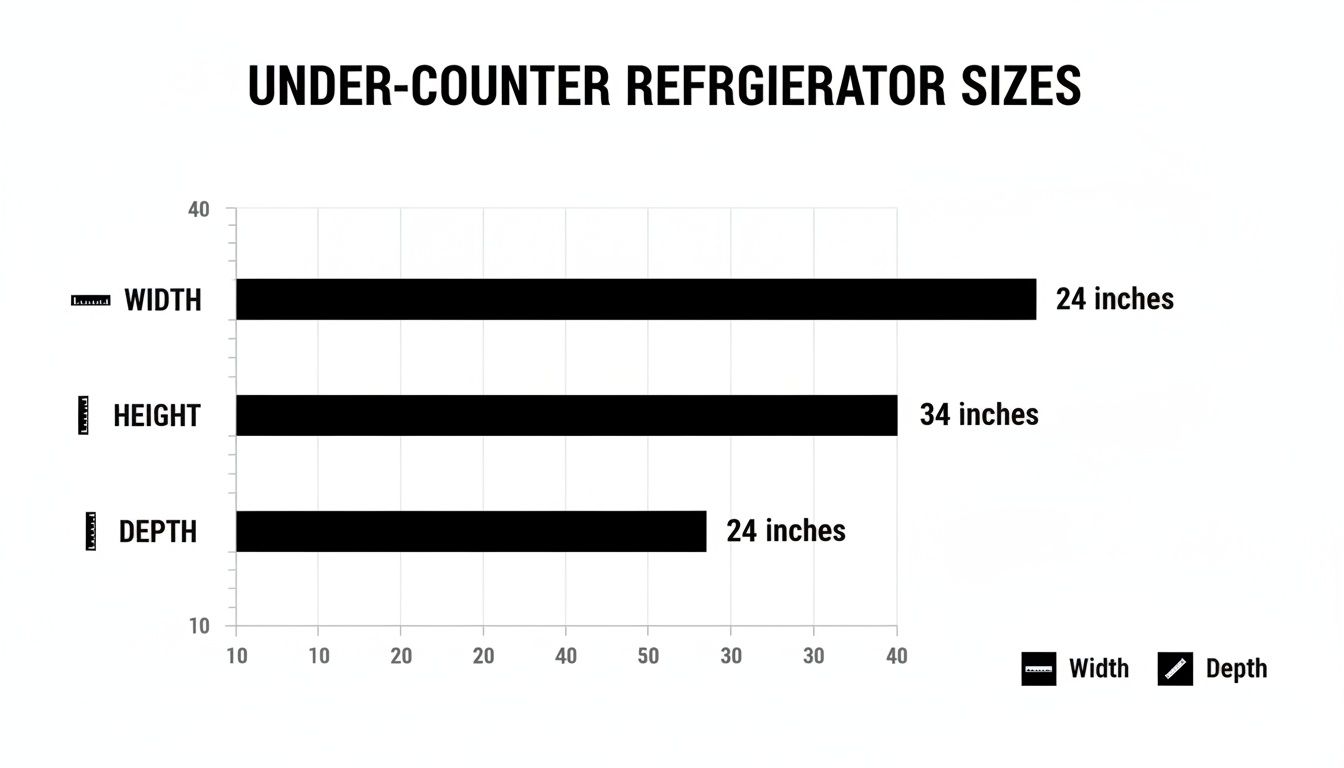
As you can see, that classic 24-inch width and depth, paired with a 34-inch height, creates that perfect cube shape designed to integrate right into your kitchen's design.
The 24-inch undercounter refrigerator has really become the go-to size for both homes and professional kitchens. It hits that sweet spot between having plenty of storage and fitting in without a fuss. A unit this size typically gives you 5 to 7 cubic feet of space inside—more than enough for a full day's worth of ingredients in a busy kitchen.
If you want to see how these dimensions fit into the bigger picture, you might be interested in exploring the different types of under counter fridges available for commercial spaces.
How to Measure Your Space for a Flawless Fit
Nothing’s worse than the thud of a new undercounter refrigerator arriving, only to discover it’s a quarter-inch too wide for the opening. It's a frustrating and expensive mistake. Before you even think about clicking "buy," grabbing a tape measure is the most important thing you'll do.
Think of it as creating a blueprint for your new equipment. A few minutes of careful measuring now will save you a world of headaches later.
A simple tape measure is all you need, but the real secret to a perfect fit is a technique I call the 'three-point check.' This little trick accounts for all the quirks you find in the real world, like floors that aren't quite level or walls that have a subtle bow.

Executing the Three-Point Check
To get numbers you can actually trust, you need to measure the height, width, and depth of your space at three different spots for each dimension. This helps you find the narrowest point—which is the only measurement that really matters.
- Measure the Width: Check the width across the top, middle, and bottom of the opening. Jot down the smallest of those three numbers.
- Measure the Height: Next, measure from the floor up to the countertop on the left, in the center, and on the right. Once again, the smallest number is the one you keep.
- Measure the Depth: Finally, measure from the back wall to the front edge of the cabinets. Do this near the top and bottom of the opening, and record the smallest of the two.
Why the smallest number? This is your "worst-case scenario" measurement. If the refrigerator fits this tightest dimension, it’s guaranteed to slide into the rest of the space without a fight.
Accounting for Obstructions and Utilities
You're not done just yet. Now you have to play detective and look for the little things that can completely derail an installation. These are the details people always forget.
- Countertop Overhang: Does the lip of your counter stick out past the cabinet face? Your depth measurement needs to account for this so the refrigerator door can open freely.
- Baseboards and Trim: Always measure from the wall itself, not the trim. That little piece of molding can easily eat up a half-inch of your available space.
- Utility Connections: Find your electrical outlets and any water lines. Make sure the refrigerator's plug and cord have room and won't stop the unit from pushing all the way back.
For complex renovations or commercial kitchens where every millimeter counts, some pros use accurate scan to BIM services to create a perfect digital map of the space. This completely removes the guesswork.
Follow these steps, and you can shop with confidence, knowing your new unit will have a smooth, trouble-free installation.
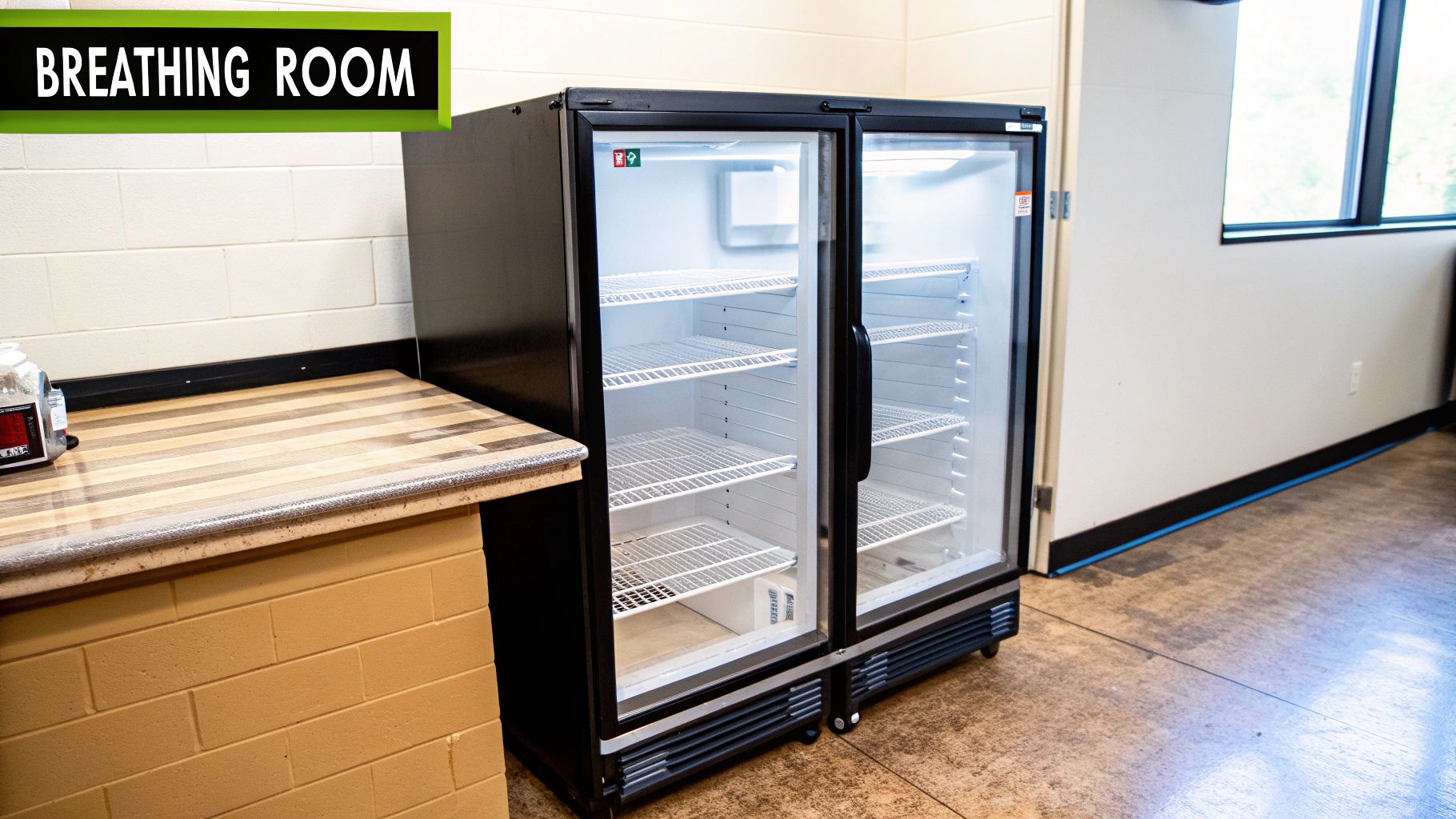
Giving Your Refrigerator Room to Breathe
Think about how your refrigerator works. It's not just about the space inside; its performance is all about proper ventilation. Imagine asking a marathon runner to race while breathing through a tiny straw. They'd overheat and burn out fast, right? Your refrigerator’s compressor is in the same boat. It generates a ton of heat while it works, and it needs open air to get rid of it and run efficiently.
When you cram a unit into a tight space with no "breathing room," you're forcing that compressor to work overtime. It's constantly fighting to cool down, which leads to skyrocketing energy bills, components failing way too early, and food temperatures that are all over the place. That clearance space isn't just a friendly suggestion from the manufacturer—it's a critical requirement for keeping your equipment healthy.
Why Airflow Is Your Refrigerator’s Best Friend
Good ventilation directly impacts three key areas: performance, cost, and lifespan. Ignoring these can lead to expensive repairs and a whole lot of operational headaches later on.
- Prevents Overheating: As the compressor cools the inside, it gets hot. Proper airflow acts like a fan, whisking that heat away so the unit isn't fighting itself. An overheated compressor is an inefficient one, plain and simple.
- Cuts Down Energy Use: When a unit has room to breathe, it sheds heat easily. This means the compressor doesn't have to run as long or as hard. In fact, studies show poor ventilation can jack up your energy consumption by as much as 15%.
- Extends Lifespan: Constantly running hot puts a massive strain on the compressor and all the other cooling parts. Giving it the right amount of clearance is probably the single easiest thing you can do to get more years out of your investment.
It's a simple trade-off: provide the recommended clearance, and you protect your equipment from its own worst enemy—excess heat. That one small step ensures the unit runs cooler, quieter, and more efficiently for years.
Front-Venting vs. Rear-Venting Models
Here’s a crucial detail: not all undercounter refrigerators breathe the same way. The location of the vents dictates where you must leave space, and picking the wrong type for your setup is a recipe for disaster. Getting this right is a huge part of planning your under counter refrigerator sizes and placement.
Front-Venting Refrigerators
These are the go-to models for any kind of built-in, seamless installation. They pull in cool air and push out hot air through a grille right on the front, usually near the bottom.
- Ideal For: Tight, enclosed spaces where the unit sits flush with the cabinets around it.
- Clearance Needed: You need little to no clearance on the back and sides. The one golden rule? The front grille must never be blocked.
- Best Use Case: Perfect for that clean, integrated look in a bar, kitchen island, or tucked neatly under a counter between other cabinets.
Rear-Venting Refrigerators
These units are more like your classic, freestanding refrigerator. All the important heat exchange happens via coils on the back of the unit.
- Ideal For: Freestanding setups or spots with plenty of room behind the unit.
- Clearance Needed: They absolutely require several inches of open space at the back, and often on the sides, to let air move freely.
- Best Use Case: Works well in open areas or installations where the back of the unit isn't shoved up against a solid wall. If you install a rear-venting model in a tight enclosure, it's guaranteed to overheat and fail.
Matching Refrigerator Type to Your Workflow
Finding the right under counter refrigerator size is about so much more than just slotting a metal box into an empty space. When you get it right, the refrigerator becomes a core part of your kitchen's rhythm, helping your team work faster and smarter. It stops being just a cold box and transforms into a tool that can make or break your daily efficiency.
Think about how the right unit can completely change the way your staff operates. A glass-door merchandiser in a bustling café puts drinks and grab-and-go snacks front and center, tempting customers and making it simple to see when you're running low. A solid-door workhorse, on the other hand, is built for the chaos of the prep line, offering better insulation to keep bulk ingredients safe from the kitchen's heat.

It all comes down to one simple question: what do you need this refrigerator to do? Start with that, and you'll naturally find your way to the perfect size and style.
Specialized Units for Peak Efficiency
For a lot of businesses, the biggest efficiency boosts come from specialized gear that combines cold storage with a dedicated workspace. This is where stainless steel prep tables with built-in refrigeration truly shine. They take a simple storage unit and turn it into a high-octane production station.
These all-in-one solutions are designed to keep your most-used ingredients perfectly chilled and organized, right underneath a clean, durable work surface. By putting everything a chef needs just an arm's length away, these tables cut out the endless trips to the walk-in cooler. That simple change can slash prep times, speed up service, and make your kitchen feel a whole lot less crowded. Beyond the popular sandwich and pizza configurations, you can find other models tailored to specific needs, such as salad prep tables with deeper wells for leafy greens or worktop refrigerators offering a simple, flat stainless steel surface for general use.
Sandwich Prep Tables: A Deli’s Best Friend
Walk into any busy deli, cafe, or sandwich shop, and you'll find a sandwich prep table holding down the fort. These units are specifically engineered to help staff assemble orders with lightning speed and consistency.
- Integrated Food Pans: The top features a refrigerated rail that holds an army of food pans (usually 1/6 or 1/3 size) filled with every topping imaginable—meats, cheeses, veggies, and sauces.
- Narrow Cutting Board: Running along the front is a built-in cutting board, typically 8 to 12 inches deep, giving you a dedicated spot for assembly.
- Undercounter Storage: Beneath it all, you’ve got refrigerated cabinet or drawer space for all your backup ingredients, so you never run out mid-rush.
The result is a self-contained, ergonomic workstation. A single employee can crank out dozens of sandwiches without taking more than a step, all while keeping ingredients safely chilled right up to the last second.
A well-organized prep table doesn't just make work faster; it ensures food safety by keeping temperature-sensitive ingredients within a controlled environment throughout the entire assembly process.
Pizza Prep Tables: For High-Volume Pizzerias
Pizza prep tables look similar, but they're built to handle the unique demands of a pizzeria. The differences are all about accommodating bigger products and a very specific workflow.
The first thing you'll notice is the raised refrigerated rail. It’s angled toward the cook, making it easier to grab big handfuls of cheese and toppings. But the real game-changer is the extra-deep cutting board, which is often 16 to 20 inches or even wider. That extra real estate is crucial for stretching out large pizza doughs without fumbling for space.
For any pizza joint pushing out serious volume, these units are non-negotiable. They streamline the entire process, from dough to oven. To really get into the nitty-gritty of how these units can transform a kitchen, you can learn more about the specifics of commercial refrigerated prep tables and find the perfect match for your operation. After all, picking the right prep table is just as important as picking the right oven.
Understanding What Refrigerator Capacity Really Means
The outside dimensions tell you if the unit will squeeze into your space, but the inside capacity tells you if it will actually do its job. When you're comparing under counter refrigerator sizes, you'll see capacity listed in cubic feet. It's the industry standard, but it can feel pretty abstract. What does "7 cubic feet" really mean when you're staring down a stack of food pans during a chaotic lunch rush?
Let’s translate this spec sheet number into something you can actually use in your kitchen. Think of cubic feet as the total volume of air inside the refrigerator if you stripped it bare—no shelves, no bumps, just an empty box. It’s a decent starting point, but it's far from the whole story.
Total Capacity vs Usable Capacity
The number you see advertised is the total capacity. But the actual room you have for storage—what we call usable capacity—is always going to be less. Why the difference? Internal parts like shelves, the bulky compressor housing at the bottom, and even the way the walls are shaped all eat into that total volume.
This is a critical distinction to make. A poorly designed 8-cubic-foot model with awkward shelving might actually hold less than a smartly designed 7-cubic-foot unit. Don't let the raw number be your only guide; you have to look at the internal layout.
The best way to judge a refrigerator's real-world capacity isn't by its cubic feet alone. It's by picturing how your actual inventory—whether it's food pans, wine bottles, or deli containers—will fit on its shelves.
From Cubic Feet to Kitchen Reality
To make a smart buy, you have to connect that abstract cubic foot measurement to the physical items you work with every single day. A small unit might be perfect for holding drinks and garnishes at a bar, while a much larger one is essential for a high-volume sandwich station.
For example, a compact 5-cubic-foot refrigerator might comfortably hold a handful of sixth-size food pans and some backup sauces. This makes it a great fit for a small coffee shop's milk station. On the other hand, a bigger 12-cubic-foot model can handle multiple full-size sheet pans or a deep inventory of third-size pans, which is a must-have for a busy prep line.
The real goal here is to pick a size that fits your space and prevents you from over-stuffing it. An overloaded refrigerator can't maintain proper airflow, which leads to hot spots, inconsistent temperatures, and serious food safety risks. The right capacity keeps everything safely chilled and easy to grab.
To help you visualize what these numbers mean for real-world kitchen storage, we've put together a quick conversion guide.
Cubic Feet to Practical Storage Conversion Guide
This table helps translate those abstract capacity numbers into tangible items you use every day, like food pans and cans.
| Capacity (Cubic Feet) | Approx. 1/6 Size Food Pans | Approx. 12oz Cans | Ideal For |
|---|---|---|---|
| 5 - 7 cu. ft. | 8 - 12 pans | 120 - 150 cans | Bars, coffee shops, or small prep stations. |
| 8 - 10 cu. ft. | 12 - 18 pans | 160 - 200 cans | Small delis, dessert stations, or secondary prep. |
| 11 - 13 cu. ft. | 18 - 24 pans | 200 - 250 cans | Busy prep lines, high-volume sandwich shops. |
By thinking in terms of what you’ll actually be putting inside, you can choose an undercounter refrigerator with a capacity that truly supports your daily workflow, keeping things running smoothly and efficiently.
Solving Common Fit and Installation Problems
Even with the most careful measurements, installation day can throw you a curveball. You might discover an unexpected dip in the floor or a power outlet that’s in the absolute worst spot. These little things can turn a simple slide-in job into a real headache.
This guide is here to help you navigate those common fit issues. The goal isn't to call a contractor—it's to turn those potential setbacks into quick, simple fixes so you can get your new unit up and running.
The Unit Is Slightly Too Tall
This is probably the most frequent hiccup we see, but thankfully, it's often the easiest to solve. If your new refrigerator won't quite clear the countertop, don't panic.
Before you even think about modifying your cabinets, take a look at the unit’s feet. Almost all commercial undercounter refrigerators come with adjustable leveling legs. You can usually screw them in to lower the unit's total height by a crucial half-inch to a full inch, which is often all you need.
The Floor Is Uneven
An uneven floor is a classic problem, especially in older buildings. It can make the refrigerator rock, stop the door from sealing correctly, and put unnecessary stress on the compressor. Leveling isn't just about stability; it's critical for the machine's performance.
Grab a carpenter's level and place it on top of the unit. Adjust the leveling legs one at a time until the bubble is perfectly centered, checking both front-to-back and side-to-side. A stable, level refrigerator runs quieter and more efficiently.
A perfectly level installation ensures the door seals tightly every time, trapping cold air inside and preventing the compressor from working overtime. This simple adjustment directly impacts your energy bills and the unit's lifespan.
The Door Swing Is Blocked
You've slid the refrigerator into place, and it looks perfect—until you try to open the door and it smacks right into a cabinet handle or another piece of equipment. An obstructed door swing kills your workflow and can damage both the door and whatever it's hitting.
Many undercounter refrigerators come with reversible doors. Check your owner’s manual for instructions on how to switch the hinge to the other side. This simple change completely solves the problem by reversing the direction the door opens.
The Power Outlet Is in an Awkward Spot
Sometimes, the electrical outlet is positioned just right to prevent the refrigerator from sliding all the way back, leaving it sticking out from the counter. This doesn't just look bad; it can disrupt the flow in a busy kitchen.
A quick fix is to use a flat-head or right-angle plug adapter. These low-profile plugs let the cord run flush against the wall, giving you back those critical few inches of space. Just make sure any adapter you use is rated for the appliance's power draw.
In trickier situations, it helps to know all your options. For specialized units where a simple fix won't cut it, understanding the potential RV refrigerator replacement cost can offer a broader perspective on installation factors. And if you're still weighing different models, exploring an undercounter freezer refrigerator combo might reveal a more versatile solution for a challenging space.
Frequently Asked Questions
Got a few last-minute questions before you commit? We get it. Let’s clear up some of the most common things people ask about under counter refrigerator sizes so you can finalize your decision with total confidence.
What Is the Standard Height for an Undercounter Refrigerator?
Most commercial undercounter refrigerators are built to a height between 34 and 36 inches. This isn't a random number—it's designed specifically to let them slide right under a standard 36-inch countertop, leaving a small but critical gap for air to circulate.
You'll also find that many models come with adjustable legs or casters. This is a lifesaver for slightly uneven floors, giving you an extra inch or two to get the unit perfectly level and snug.
Are There ADA-Compliant Undercounter Refrigerator Sizes?
Absolutely, and they are essential for creating an accessible kitchen space. To comply with the Americans with Disabilities Act (ADA), countertops can't be higher than 34 inches.
Because of this, ADA-compliant refrigerators are built shorter, typically around 32 inches high. If accessibility is a must for your business, always look for the "ADA Compliant" spec on the product details page before you buy.
What Is the Difference Between a Sandwich and Pizza Prep Table?
At a glance, they look almost the same, but the real difference is in how they're designed for a specific workflow, especially when it comes to the work surface and ingredient rails.
- Sandwich Prep Tables: These have a narrower cutting board, usually 8 to 12 inches deep. The refrigerated rail above is set up to hold smaller pans (think third- or sixth-size) for things like deli meats, cheeses, and veggies.
- Pizza Prep Tables: Built for slinging pies, these feature a much deeper cutting board, often 16 to 20 inches, to handle a large pizza base. Their refrigerated rails are also raised and angled, making it easier to grab handfuls of toppings from bigger pans.
It all comes down to function. A sandwich table is built for precision and smaller-scale assembly. A pizza table is built for speed and large-format production.
Does a Wider Refrigerator Use a Lot More Energy?
While a bigger fridge will use more energy than a smaller one, the jump in consumption is often less than you'd think, especially with modern units. Size isn't the only thing that matters.
Factors like an ENERGY STAR rating, the quality of the insulation, and the compressor's design have a much bigger impact. In fact, a new, highly efficient 48-inch model could easily use less power than a ten-year-old 24-inch unit with outdated components.
At PrepTables.com, we provide durable, high-performance refrigeration solutions and prep tables designed for the demands of a professional kitchen. Explore our extensive collection to find the perfect fit for your workflow and space. Find your ideal commercial refrigeration unit today!