

Choosing a Fridge Under Counter
A fridge under counter is a compact refrigerator built to slide right under a standard countertop. It's a game-changer for turning what's usually dead space into a highly efficient, easy-to-access cold station. In a professional kitchen, these units are mission-critical for optimizing workflow, keeping essential ingredients chilled and always within arm's reach.
Transforming Your Kitchen Workflow
In any professional kitchen, every second and every inch of space is gold. A smartly placed fridge under counter isn't just about cramming in more storage; it's a strategic move to streamline your entire operation, improve food safety, and boost productivity.
Think of it as decentralizing your cold storage. Instead of a dozen trips to the main walk-in cooler, you're moving key ingredients to a point-of-use station, right where the magic happens.
This simple shift cuts out wasted steps, letting chefs grab produce, sauces, or proteins without ever leaving their post. The result? Faster ticket times, less chaos on the line, and a more organized, fluid kitchen. It's the kind of practical upgrade often seen in major kitchen remodeling projects where the goal is to make daily operations smoother and more efficient.

The Real-World Advantages
The payoff for adding an undercounter fridge goes way beyond just convenience. Ask any seasoned chef or kitchen manager—they rely on these workhorses for a few key reasons that directly impact the bottom line.
Here’s what you can realistically expect:
- Enhanced Speed and Efficiency: Placing ingredients right at the prep station shaves precious seconds off every order. That time really adds up over a busy service, leading to some serious gains in output.
- Improved Food Safety: With dedicated units, you can store specific items like raw meat or dairy at precise, consistent temperatures, well away from other ingredients. This drastically cuts the risk of cross-contamination and makes it easier to stay on the right side of health codes.
- Optimized Space Utilization: These fridges are built to fit into spots that would otherwise be wasted, like under a prep table or behind a bar. You get to maximize your kitchen's usable footprint without needing a full-blown renovation.
Setting the Stage for the Right Choice
Picking the right fridge under counter is about more than just measuring an empty space and hoping for the best. This guide is here to walk you through the big decisions you'll need to make, from understanding commercial-grade specs to planning for proper ventilation and installation.
We’ll get into why NSF certification is an absolute must-have and how to match a unit’s features to what your kitchen actually needs. Making a smart choice from the get-go means your investment will pay off in productivity and reliability for years to come.
Understanding Commercial-Grade Specifications
When you step into the world of commercial kitchen equipment, you're looking past the pretty designs and focusing squarely on performance. A spec sheet for a fridge under counter can feel like you're trying to read a foreign language at first, but it's where the real story of the unit’s capabilities is told.
Think of it like choosing an engine. Your daily driver needs to be reliable, sure. But a race car? That needs raw power, incredible endurance, and precision engineering to even finish the race, let alone win. A commercial kitchen is a racetrack, and your gear has to be built to perform lap after lap under intense, unrelenting pressure.
A residential fridge just isn't built for that kind of abuse. It can't handle the constant door openings, the high ambient heat from the cookline, or the tough cleaning protocols of a professional kitchen. Its parts would fail in no time, leading to fluctuating temperatures and a cooler full of spoiled food. Commercial-grade units, on the other hand, are built with beastly compressors and heavy-duty insulation. They're designed for one thing: rapid temperature recovery and rock-solid performance, service after service.
Decoding Dimensions and Capacity
The first things you'll see on any spec sheet are dimensions and capacity. Height, width, and depth tell you if the unit will physically fit in your space, but in a pro kitchen, you have to look a lot closer.
For instance, ADA (Americans with Disabilities Act) compliance is a huge deal for many businesses. An ADA-compliant fridge under counter will have a countertop height of 34 inches or less, which is non-negotiable for ensuring an accessible workspace for every employee. It's a perfect example of how a single spec can impact your entire kitchen design and legal compliance.
Beyond the physical footprint, you’ve got capacity, which is measured in cubic feet. This tells you how much product you can actually store inside.
A classic rookie mistake is buying a unit based only on its outside dimensions, then realizing the inside is way too small. You have to connect the cubic footage to your real-world inventory. How many sixth-pans, hotel pans, or cases of drinks does that station need to hold?
Thinking this way ensures your new fridge is an asset to your workflow, not a bottleneck.
The Critical Role of Temperature Control
Let's be clear: precise, stable temperature control is the single most important job of any commercial refrigerator. Food safety isn't a "nice to have," it's the law. Health codes are strict, demanding that perishable foods stay in a tight temperature range, usually between 35°F and 38°F (1.7°C to 3.3°C), to stop bacteria in its tracks.
This is where you'll see a massive difference from residential models. Commercial units come standard with digital thermostats and easy-to-read external temperature displays. These aren't just for convenience—they are mission-critical tools for monitoring food safety with a quick glance. They let you make tiny, precise adjustments and give you the instant feedback you need to stay in compliance and keep your ingredients perfectly safe. You can dive deeper into this in our detailed guide on selecting a commercial refrigerator.
This constant need for better performance has lit a fire under the commercial refrigeration market. The global market for these undercounter and worktop units was valued at USD 11,402.25 million in 2024 and is projected to hit USD 15,014.58 million by 2032. This growth is all about the demand for efficient, space-saving coolers that can meet the ridiculously high standards of modern kitchens. You can check out more market insights from Credence Research.
Once you get a handle on these core specs, you'll be able to confidently pick a frudge under counter that’s truly built to handle the heat.
Commercial vs. Residential Fridge At a Glance
To put it all in perspective, the gap between a commercial and a residential undercounter fridge is massive. They might look similar on the outside, but they're engineered for completely different worlds. Here's a quick breakdown of what sets them apart.
| Feature | Commercial Undercounter Fridge | Residential Undercounter Fridge |
|---|---|---|
| Cooling Power | High-powered compressor for fast temperature recovery after frequent door openings. | Weaker system designed for infrequent use; struggles in high heat. |
| Construction | Heavy-duty stainless steel (interior and exterior) for durability and easy cleaning. | Often uses plastic interiors and lighter-gauge metal or decorative fronts. |
| Temperature Control | Precise digital thermostat with external display for strict food safety monitoring. | Basic analog or simple digital controls; less accurate and consistent. |
| Certifications | NSF Certified to meet public health standards. UL Listed for safety. | Not certified for commercial use; will not pass a health inspection. |
| Ventilation | Front-breathing design for true built-in installation with zero clearance. | Typically requires side and rear clearance, not suitable for tight spaces. |
| Lifespan & Warranty | Built for 24/7 operation with a commercial-grade warranty covering parts and labor. | Designed for light use with a limited warranty voided by commercial use. |
Simply put, a residential unit in a commercial kitchen is a health code violation waiting to happen. It's not just about durability—it's about food safety, compliance, and keeping your doors open.
Navigating Health Codes and Safety Certifications
Putting a new commercial fridge under counter in your kitchen is a big move. But if that shiny new unit doesn’t meet legal standards, your investment can quickly become a huge liability. A non-compliant fridge isn't a small hiccup; it's a critical failure that can lead to steep fines, a cooler full of spoiled product, or even a shutdown notice from the health department.
Think of these certifications less like optional extras and more like your license to operate. They are non-negotiable requirements for running a safe, legal, and professional kitchen. Understanding the alphabet soup of acronyms on these labels is your first line of defense, guaranteeing the equipment is built tough enough for a commercial environment—from its wiring to how you clean it.
The Gold Standard: NSF Certification
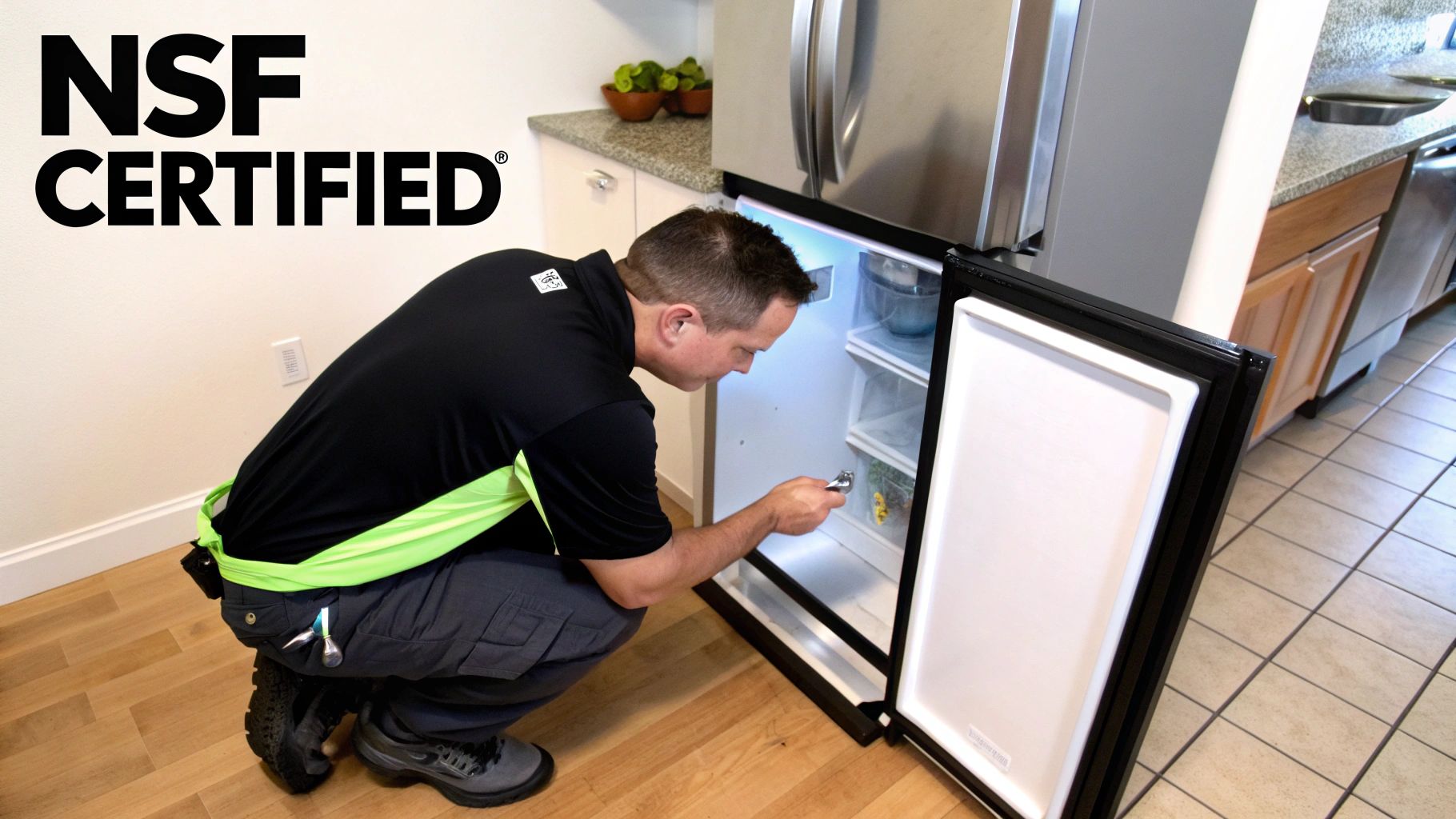
When a health inspector walks through your door, their eyes will almost immediately scan for one thing on your equipment: the NSF certification mark. That little blue logo is the single most important credential for any piece of food service gear. It’s proof that the National Sanitation Foundation has put the unit through the wringer, verifying it meets their strict public health and safety standards.
This goes way beyond just the type of metal used. An NSF-certified fridge is designed from the ground up to be cleaned easily and completely. You'll see smart features like:
- Coved Corners: The interior corners are rounded, eliminating those tight 90-degree angles where grime and bacteria love to hide.
- Removable Gaskets: The rubber door seals pop right off, so you can deep clean them and prevent nasty mold from growing.
- Non-Porous Surfaces: Any surface that might touch food is smooth, tough, and won't corrode or harbor germs.
In short, an NSF sticker is your pre-approved passing grade. It tells the health department your fridge under counter is designed to prevent foodborne illness. If you want to dive deeper, you can learn more about what NSF certification means for your kitchen and see why it’s so critical.
Understanding Electrical Safety: UL and ETL Marks
While NSF has sanitation covered, other certifications handle electrical safety—a must-have for an appliance running 24/7 in a kitchen where spills happen. The two marks you’ll see everywhere are UL (Underwriters Laboratories) and ETL (Intertek). Both are official Nationally Recognized Testing Laboratories, and their stamp of approval confirms a product meets established electrical safety standards.
The presence of a UL or ETL mark means the fridge's wiring, components, and overall construction have been tested to prevent electrical shock and fire hazards. Functionally, there is no difference between the two; both are accepted across the United States as proof of electrical safety.
Always Check Local Regulations
Even with national standards like NSF, UL, and ETL, the local health department has the final word. Regulations can and do vary slightly between cities, counties, and states. Before you buy any fridge under counter, take five minutes to call your local health inspector or check their guidelines online.
Confirming their specific rules upfront is a simple step that saves a world of headaches later. It ensures your investment is compliant from day one and protects you from the stress and cost of a failed inspection. You can operate with confidence knowing you did it right.
Pairing Your Fridge with the Perfect Prep Table
An undercounter fridge isn't just a box for chilling ingredients; it's the heart of a truly efficient prep station. When you pair that refrigerated base with the right work surface, you're not just storing food—you're building a powerhouse of productivity. The whole idea is to create a seamless workflow where everything you need is right at your fingertips, cutting down on wasted steps and speeding up your whole line.
The real magic happens when you match your fridge with a stainless steel prep table. Think of the fridge as the engine and the table as the chassis. Together, they create a high-performance vehicle for your kitchen. These tables are more than just metal tops; they're purpose-built tools designed to handle the chaos of a commercial kitchen, and they come in all sorts of configurations.
Matching the Table to the Task
Not all stainless steel prep tables are created equal. The most straightforward and flexible choice is the standard worktop table. This is your all-purpose surface for chopping, mixing, and general prep tasks, giving you a clean, tough area directly above your chilled ingredients. Its simplicity is its greatest asset, offering a blank canvas for whatever you throw at it.
But for more specialized kitchens, you need equipment designed for a specific job. That's where dedicated prep tables come in, merging cold storage and prep surfaces into one slick unit. For major jobs like restaurant remodeling projects, designing these integrated stations from the get-go is absolutely essential for hitting peak efficiency.
Here are the main types you'll run into:
- Sandwich and Salad Prep Tables: These are a deli or café's best friend. They combine a refrigerated base, a cutting board work surface, and a refrigerated top rail with wells for holding standard food pans. This setup keeps all your greens, veggies, meats, and cheeses perfectly chilled and ready to grab, letting your team build orders in record time.
- Pizza Prep Tables: A pizzeria's flow is unique, and so is its prep table. These units have an extra-deep work surface (often made of marble or another material that stays cool) for stretching dough. Below, you have a refrigerated base for dough boxes, and up top, a raised refrigerated rail holds all your sauce, cheese, and toppings.
Understanding Stainless Steel Grades
The steel itself is a huge factor in your prep station's lifespan and its ability to meet health codes. You’ll mostly see two grades of stainless steel: 430 and 304. The difference is a big deal.
Think of 430 stainless steel as the standard-duty option. It's tough and resists corrosion well enough for most dry uses, making it a budget-friendly pick for table legs, shelves, and worktops that won't see a lot of moisture or acidic foods.
304 stainless steel, on the other hand, is the premium, heavy-duty workhorse. It has more nickel in it, which gives it superior protection against rust and corrosion from salts, acids, and harsh cleaning chemicals. For any surface that food will touch constantly—especially acidic things like tomato sauce or vinaigrette—304 is the way to go for hygiene and durability.
Essential Features for Sanitation and Workflow
Beyond the table type and steel grade, a few small features can make a world of difference in your day-to-day grind. One of the most critical is the backsplash. A backsplash is just a raised edge along the back of the table, but it's brilliant at preventing food, liquids, and utensils from falling into that nasty gap between the table and the wall.
This simple addition is a sanitation game-changer. It contains messes and makes cleanup a whole lot faster. Many prep tables also offer options like undershelves for extra storage or casters so you can move them around. By thinking through these details, you can build a custom prep station around your undercounter fridge that becomes the true backbone of your kitchen.
Mastering Installation and Ventilation
Getting the installation right isn’t just the last thing you do—it's the single most important step for guaranteeing the long life and performance of your commercial fridge under counter. Do it correctly, and your unit will hum along efficiently for years. But if you mess it up, you're just asking for an early breakdown and a hefty repair bill.
Think of your fridge's compressor like a set of lungs. It has to breathe in cool, fresh air to do its job and keep things cold. If you suffocate it by blocking the airflow, you're fast-tracking it to overheating. That forces the compressor to work overtime until it burns itself out. This is why getting the ventilation right isn't just a technicality; it's the bedrock of a reliable kitchen.
The Critical Difference in Ventilation Types
The most common mistake we see is people picking the wrong type of unit for their space. Commercial undercounter fridges come with one of two ventilation systems, and you absolutely cannot swap them.
-
Front-Venting Units: These are your true "built-in" models. They pull air in and push it out through a grille right on the front, usually near the bottom. This design is what lets you slide them in perfectly flush with your cabinets, needing zero extra space on the sides, back, or top.
-
Rear-Venting Units: These units need room to breathe. The cooling coils are typically on the back, and they need open space all around to get rid of heat. If you box one of these into a tight cabinet, you're just trapping hot air, which will cook the components and lead to a quick failure. They're meant for freestanding spots where air can move freely.
A huge number of early equipment failures trace right back to bad ventilation. Always, always check the unit's venting style before you lock in your kitchen design. It needs its breathing room to work properly.
Avoiding Common Installation Pitfalls
Besides ventilation, a couple of other details are crucial. One of the most overlooked is making sure the unit is perfectly level. An off-kilter fridge can stop the door from sealing tightly. When that happens, cold air leaks out, and the compressor has to run constantly to keep up. It’s a huge energy waster and will wreck your door gaskets over time.
Likewise, miscalculating the cutouts for built-in models can be a real headache. You have to follow the manufacturer's specs down to the millimeter. An opening that's too small will choke the unit, and one that's too big can become a cleaning nightmare and a sanitation risk. Getting these details right is a huge part of the process, and you can learn more about planning your layout by checking out these undercounter refrigerator dimensions.
These versatile units are becoming a cornerstone of the modern commercial kitchen. The global market for undercounter refrigerators hit US$ 4.5 billion in 2024 and is projected to climb to US$ 7.1 billion by 2033, thanks to growth in the restaurant and hospitality world. By taking the time to install your unit with care, you’re making sure your investment pays off for years to come.
Proactive Maintenance and Troubleshooting
An undercounter fridge is a serious investment in your kitchen’s flow, but just like any other workhorse on the line, it needs some regular attention to keep pulling its weight. If you ignore basic upkeep, you're just asking for an equipment failure—and they always seem to happen right in the middle of a Friday night dinner rush.
Think of it as a quick check-up to keep your kitchen's heart beating strong. Proactive maintenance isn’t some complicated chore; it's all about building simple, consistent habits that stop huge problems from ever starting. By getting ahead of the common issues, you can add years to your unit's life, keep it running efficiently, and skip the stress of unexpected downtime.
Your Essential Maintenance Checklist
Spending just a little time on these tasks each month can save you a fortune in emergency repair bills and spoiled inventory. It’s the cheapest insurance policy you can get for your equipment.
Here’s a simple routine to get into:
- Clean Condenser Coils (Monthly): The condenser coils are basically your fridge’s lungs. When they get caked with dust and kitchen grease, the compressor has to work overtime just to keep things cool. This wastes a ton of energy and is the fastest way to burn out the motor. A quick once-over with a vacuum or a stiff brush is all it takes.
- Inspect Door Gaskets (Weekly): That rubber seal around the door is the only thing keeping the cold air in and the warm air out. Give it a quick look for any cracks, tears, or spots where it’s getting brittle. The classic "dollar bill test" still works wonders: close the door on a bill. If you can pull it out with zero resistance, your seal is weak and it’s time for a new gasket.
- Clear Vents and Fans (Weekly): Airflow is everything for a refrigeration system. Make sure nothing is blocking the interior and exterior vents—no boxes, no stray pans, nothing. If the air can't circulate, the whole system struggles.
Solving Common Fridge Problems
Even the best-maintained gear can have a bad day. Knowing how to spot the difference between a quick fix and a "call the technician now" problem is a crucial skill for any kitchen manager. This know-how is just as useful whether you're running a commercial kitchen or have a high-end unit at home.
The market for household undercounter refrigerators is ballooning, with a projected size of $2.5 billion in 2025. This is largely driven by homeowners wanting the same space-saving efficiency in their modern kitchens. You can find more data on the household undercounter refrigerator market on archivemarketresearch.com.
Let's walk through a couple of the most frequent headaches.
Common Problem 1: The Unit Isn't Cooling Properly
Before you hit the panic button, check the obvious stuff. Is the thermostat set where it should be? Is the door shut all the way, with the gasket making a tight seal? Did someone forget to clean the condenser coils or block a vent? More often than not, the culprit is one of these simple oversights.
Common Problem 2: The Unit is Making Strange Noises
A steady, low hum is the sound of money being made. But if you hear rattling, grinding, or clanking, that’s a red flag. First, check if the unit is perfectly level; an uneven floor can cause vibrations. If that doesn't fix it, you might be hearing the early signs of a failing condenser fan or compressor motor, and that's a job for a pro.
Following this proactive approach puts you in control of your equipment. You'll save time, money, and the massive headache of a fridge dying at the worst possible moment.
Answering Your Undercounter Fridge Questions
Even with all the specs laid out, there are always a few lingering questions that pop up when you're about to make a purchase. Let's tackle the most common ones head-on so you can choose your next fridge under counter with complete confidence.
Can I Use a Residential Fridge in My Commercial Kitchen?
I hear this one all the time, and the answer is a hard no. A residential fridge under counter just isn't built for the grind of a professional kitchen. It doesn't have the muscle in its cooling system to bounce back after the door is opened every few minutes, and it certainly can't handle the high ambient heat of a busy cook line.
More importantly, it won't have the NSF certification that health departments require. Trying to get by with a home unit is a recipe for spoiled food, failed inspections, and a fridge that will burn itself out in no time. It's a costly mistake you don't want to make.
What Is a Front-Venting Refrigerator?
Think of it as a fridge that breathes through its chin. A front-venting refrigerator is specifically designed to be built right into your cabinetry or prep line. It has a grille on the front, usually near the floor, that pulls in cool air and pushes out hot air.
This clever design means you can install it completely flush on the sides, back, and top without any fear of it overheating. A rear-venting model, on the other hand, needs inches of clearance all around to breathe. Box one in, and you’ll kill it.
Always double-check the ventilation type before you buy. For that seamless, built-in look that won't cook your compressor, a front-venting fridge under counter is non-negotiable.
How Often Should I Clean the Condenser Coils?
For a typical commercial kitchen, cleaning the condenser coils every 90 days is a solid rule of thumb. But if you're running a bakery with flour in the air or have a high-grease setup with a charbroiler, you’ll need to be more aggressive. Bump that schedule up to every 30 to 60 days.
Clean coils are absolutely critical. When they get clogged with dust and grease, the compressor has to work overtime, jacking up your energy bills and putting the whole unit at risk of a total meltdown.
What Does NSF Certification Actually Mean?
When you see that NSF (National Sanitation Foundation) logo, it's basically a guarantee that the equipment is built to meet strict public health and safety rules. For a fridge, this means a few things. First, it’s made from materials that are food-safe and won't grow bacteria.
It also means the unit is designed to be cleaned easily and completely, with things like coved corners and removable parts to stop germs from hiding. And finally, it certifies that the fridge can hold its temperature to keep food safe. In the U.S., most health inspectors won't let you operate without it.
Ready to create the perfect, high-efficiency prep station for your kitchen? Explore our wide selection of commercial-grade undercounter refrigerators, prep tables, and more at PrepTables.com. Find the durable, NSF-certified equipment you need to optimize your workflow and meet health code standards with confidence. https://preptables.com