

stainless steel table commercial: Your Guide
Walk into any professional kitchen, and you'll quickly spot its true workhorse: the commercial stainless steel table. This isn't just a piece of furniture; it's the very foundation of an efficient, hygienic, and smooth-running operation. This guide is for the pros who know that picking the right table is a serious investment in their success.
Why Your Stainless Steel Table Matters
A stainless steel table is an indispensable tool that has a direct, daily impact on your kitchen’s performance. It’s the central hub for prep work, assembly, and plating—it's the stage where your culinary vision becomes reality. Getting this choice wrong can create frustrating workflow bottlenecks, introduce hygiene risks, and lead to expensive replacements down the line.
We're going to move past the generic advice and dig into the nitty-gritty details that separate a true, long-lasting asset from a costly mistake. We’ll cover everything from decoding steel grades to understanding what NSF certification really means for your business. You're about to learn how to select a table that doesn't just fit your space, but actually elevates your entire operation.
To really get a feel for how crucial every piece of equipment is, it helps to understand the comprehensive landscape of Back of House (BOH) operations. Seeing the bigger picture makes it clear why something as fundamental as your work surface is so important.
The Foundation of a Professional Workspace
The right table is built to support your team and take a beating. Day in and day out, it needs to withstand the chaos of a demanding kitchen. Its non-porous, easy-to-sanitize surface is what makes it the go-to choice not just for restaurants, but for labs and industrial settings, too.
Choosing this equipment isn't a small decision, and it’s backed by a massive global market.
The global stainless steel market, valued at USD 188.76 billion, is projected to expand to USD 329.90 billion by 2025. This growth reflects the material's essential role in commercial and industrial applications worldwide.
This powerhouse industry ensures there's a steady supply of high-quality materials to build the tough, reliable tables your operation depends on. Whether you're running a slammed restaurant or a sterile lab, the core needs for durability and hygiene never change.
Choosing the Right Stainless Steel Table Type
Picking the right stainless steel table commercial kitchens need isn't a one-size-fits-all deal. The model you bring in can make or break your kitchen's flow, organization, and overall speed. It's like trying to build a cabinet with a sledgehammer—you need the right tool for the job.
Let's start with the basics, the foundational tables that act as the backbone for just about every professional kitchen. These are your all-purpose work surfaces where most of the daily grind happens. Getting a handle on their core features is the first step to building a smarter workspace.
The Essential Workhorses
The most common starting point is the standard flat-top work table. This is your classic prep surface—a simple, open design that gives you the maximum amount of real estate for chopping, mixing, and general prep. Its simplicity is its biggest asset, offering a clean slate for whatever task comes its way.
But in a commercial kitchen, every square inch counts. That's where tables with built-in features really shine, adding a ton of utility without taking up any more floor space.
Here's a breakdown of the most popular configurations:
- Tables with Undershelves: This is probably the most popular upgrade, and for good reason. An undershelf, whether it's solid or slatted, turns that dead space under the table into prime storage for bulk ingredients, small appliances, or extra pots and pans. It keeps your essentials off the floor and close by, which is a massive win for organization.
- Tables with Backsplashes: A backsplash is just a raised lip along the back of the table. Its main job is to keep splashes and spills from hitting your walls, which makes cleanup a whole lot easier. It also stops stray veggies or small tools from disappearing into that annoying gap between the table and the wall.
These basic setups can handle a huge range of general kitchen duties. But what if your operation is built around specific, high-volume tasks? That’s when you need to bring in the specialists.
Specialized Tables for Peak Efficiency
When your menu is heavy on items like sandwiches, salads, or pizzas, a standard flat-top table can quickly become a major bottleneck. Specialized prep tables are engineered to attack these exact workflows by building refrigeration and organization right into the work surface. Before we dive in, let's look at how these different tables stack up for various kitchen needs.
Matching Table Types to Your Kitchen's Needs
This table gives you a quick rundown of the most common stainless steel table types to help you pinpoint the best fit for your operation.
| Table Type | Key Features | Primary Use Case | Ideal Environment |
|---|---|---|---|
| Flat-Top Work Table | Simple, open surface; optional undershelf | General prep: chopping, mixing, portioning | Any kitchen needing versatile workspace; bakeries, commissaries |
| Table with Backsplash | Raised rear edge to contain messes | Prep work near walls; washing stations | Any kitchen where wall protection and hygiene are priorities |
| Sandwich/Salad Prep Table | Refrigerated top rail for pans; cold storage base | High-volume sandwich and salad assembly | Delis, cafes, quick-service restaurants, catering |
| Pizza Prep Table | Wide, cool work surface; refrigerated topping rail | Dough stretching and high-speed pizza assembly | Pizzerias, Italian restaurants, high-volume casual dining |
Understanding these distinctions is key. While a flat-top is a must-have, a specialized table is what takes your efficiency to the next level.
The Sandwich & Salad Station
A sandwich and salad prep table is an absolute game-changer for delis, cafes, and any quick-service spot. Picture a stainless steel work surface fused with a refrigerated rail on top. This rail is lined with food pans full of fresh ingredients—lettuce, tomatoes, cheeses, meats—all held at the perfect, food-safe temperature.
This design means your team can build orders from start to finish without ever leaving their station. Everything is organized, within arm's reach, and properly chilled. It doesn't just make service faster; it's a huge boost for food safety and quality. The base of these units is almost always a set of refrigerated cabinets for holding backup ingredients, keeping the whole process contained in one spot.
Mastering High-Volume Pizza Production
In the same vein, a pizza prep table is purpose-built for the unique art of slinging pies. These units tackle the specific needs of a pizzeria by blending a large, durable work surface with refrigerated ingredient storage. The work surface itself is often made of thick-gauge stainless steel or even marble to provide a cool, non-stick surface that's perfect for stretching dough.
A well-designed pizza prep station can significantly reduce assembly time per pizza. By keeping dough, sauce, cheese, and toppings within arm's reach and at optimal temperatures, kitchens can increase their output by up to 30% during peak hours.
Just like their sandwich-making cousins, these tables have a refrigerated rail packed with all the necessary toppings. This ergonomic layout gets rid of wasted steps, letting a single cook sauce, cheese, and top a pizza in a matter of seconds. For any place that's serious about its pizza, this kind of specialized stainless steel table commercial unit isn't a luxury—it's an operational necessity for speed and consistency.
Decoding Steel Grades, Gauges, and Construction
Once you’ve settled on the type of table you need, the real story of its lifespan and performance is written in the steel itself. Getting a handle on steel grades, gauges, and construction methods is like learning the secret language of quality. It’s the difference between buying a table that lasts a couple of years and investing in a workhorse that will anchor your kitchen for a decade or more.
Think of the steel's gauge as its armor—the lower the number, the thicker and tougher the steel. This one number tells you exactly how much punishment the table can take. Getting this wrong can lead to a dented, warped surface that messes up your workflow and can even be a safety hazard.
This diagram helps you connect the dots, matching your kitchen's daily tasks—prep, general work, or a mix of both—to the right table features.
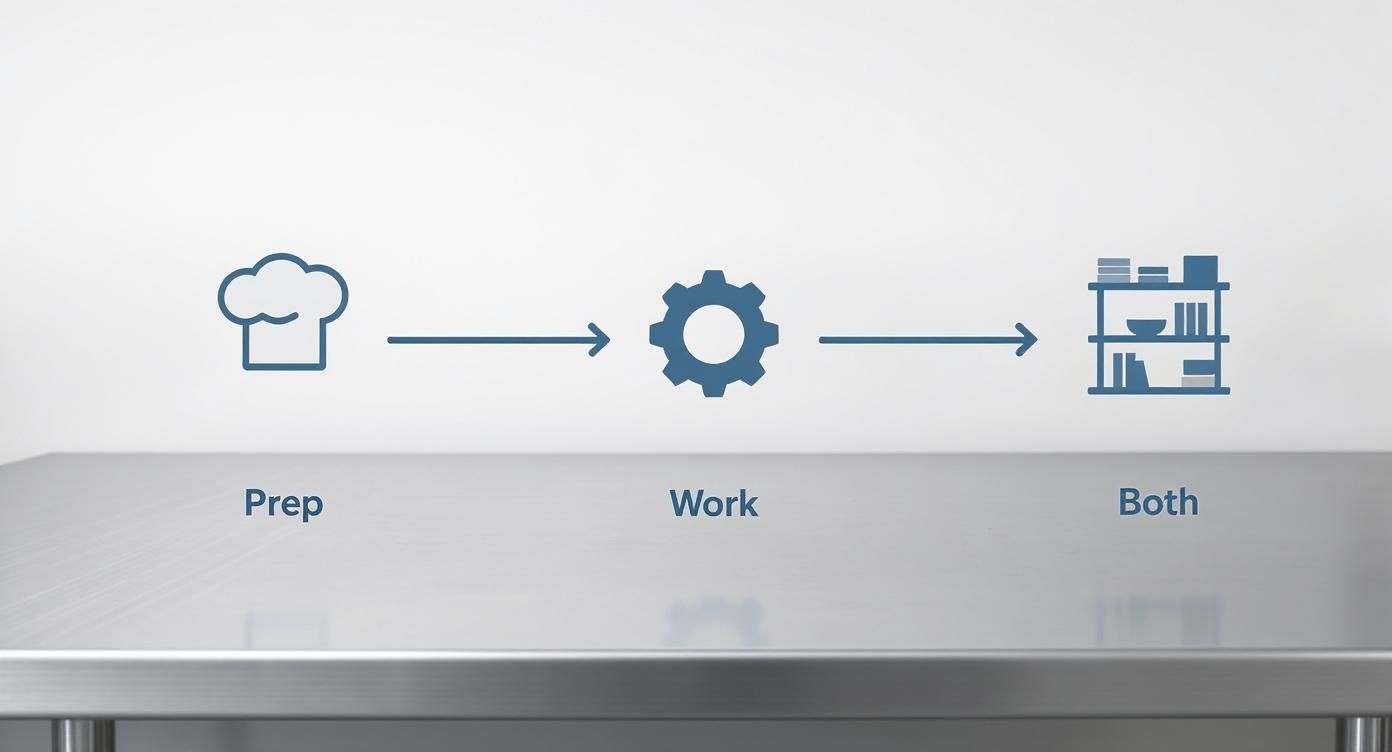
It breaks down the decision-making process by linking common kitchen jobs to specific table setups, making sure your choice is a perfect fit for what you do every day.
Understanding Steel Gauge
The gauge of a stainless steel table commercial top is all about its strength and how well it stands up to impacts. Matching the gauge to the job is non-negotiable.
- 18-Gauge: This is your lightest-duty option. It’s perfect for light prep work, simple assembly, or just extra storage space. It’s a solid, budget-friendly choice for areas that don't see a ton of heavy action.
- 16-Gauge: Meet the industry standard. For most kitchens, 16-gauge steel is the sweet spot, balancing great durability with a reasonable cost. It's tough enough for the daily grind of chopping, mixing, and general prep in a bustling kitchen.
- 14-Gauge: This is the undisputed heavy-hitter. When you need a surface that can hold heavy gear like a commercial mixer or take a beating from butchering, 14-gauge is the only way to go. Its serious thickness prevents any bending and keeps things rock-solid.
The Critical Role of Steel Grade
While gauge is about thickness, the steel's grade is about its DNA—its chemical makeup and, most importantly, its ability to fight off rust and corrosion. In any food-service spot, this is a deal-breaker.
The two grades you’ll run into most often are 304 and 430.
Type 304 stainless steel is the gold standard for any surface that touches food. It’s packed with more chromium and nickel, giving it fantastic resistance to rust and corrosion from acidic ingredients, cleaning chemicals, and moisture. This is the grade you’ll find on most NSF-certified tabletops for a reason.
On the flip side, 430 stainless steel is a more economical choice. It has less nickel, which makes it more likely to corrode over time, particularly in damp environments. While it's not the right call for your main prep surfaces, it’s a perfectly good and cost-effective material for table legs, undershelves, and bracing in drier areas. To really get into the weeds on this, you can learn more about what separates different stainless steel grades in our detailed guide.
Construction Details That Matter
How a table is put together is just as vital as the steel it's made from. Little details in construction can make a huge difference in stability, safety, and how easy it is to clean.
One of the biggest things to look at is how it's joined. Welded joints create a single, seamless piece, which is way stronger and more stable than a table that’s bolted together. Bolted tables can—and do—loosen up from vibrations and heavy use, leading to wobbles and potential failure.
A well-constructed table is an investment in safety and longevity. Welded corners and polished seams not only provide superior structural integrity but also eliminate crevices where bacteria can hide, making sanitation simpler and more effective.
Another key feature to check is the edge type. Rolled or 'marine' edges have a raised lip around the perimeter that’s brilliant for containing spills and stopping ingredients from rolling onto the floor. It’s a small touch that you’ll be thankful for in a fast-paced kitchen. Thanks to growth in stainless steel production, which hit around 6.9 million metric tonnes globally back in 2017, these kinds of advanced manufacturing touches have become much more common and affordable.
Sizing Your Table for Space and Strength
Picking the right size for your stainless steel commercial table is about more than just finding a spot for it. The right dimensions and strength are the backbone of a smooth workflow. Get it wrong, and you're creating a bottleneck. Get it right, and the whole kitchen just flows.
It all starts with what you’ll be doing on it. Are you just chopping veggies and doing light prep? Or do you need a solid foundation for a 300-pound commercial mixer? That one question will guide everything from the table's footprint to its underlying strength.
Measuring Your Workspace for Optimal Flow
Before you even glance at table specs, get out the tape measure. But don't just measure the floor space where the table will sit—think about the space around it. A classic rookie mistake is buying the biggest table that fits, only to realize your staff is squeezing past each other all day.
You need to leave a bare minimum of 36 inches of clearance on all working sides of the table. This isn't just a friendly tip; it's a crucial safety standard that prevents collisions and lets people and carts move freely during the dinner rush.
Think about its neighbors, too. Should it be right next to the walk-in for grabbing ingredients, or closer to the line for plating? Mapping out these paths ahead of time is the secret to a kitchen that feels intuitive, not chaotic.
Matching Load Capacity to Your Tasks
Load capacity is simply how much weight a table can hold before it starts to bend, warp, or fail. This isn't just about the top surface; the legs and undershelf have to be up to the task, too. Overloading a table is a major safety hazard and a quick way to destroy your investment.
Here's a quick cheat sheet for matching strength to your kitchen's needs:
- Light-Duty (Up to 300 lbs): Perfect for basic food prep, plating salads, or as a landing zone for finished dishes. This is your go-to for tasks that don't involve heavy equipment.
- Standard-Duty (300-600 lbs): The all-rounder for most commercial kitchens. It can handle daily chopping and mixing, and it's sturdy enough for countertop appliances like blenders or food processors.
- Heavy-Duty (Over 600 lbs): This is for the big jobs. If you're supporting serious machinery like a floor mixer, dough sheeter, or a heavy meat slicer, a heavy-duty table is the only option.
The global demand for these tables tells you just how critical they are. The market for stainless steel tables hit a value of about USD 1.2 billion and is still climbing, showing just how much professional kitchens rely on purpose-built gear. You can discover more insights about the stainless steel table market size and forecast to see how the industry is growing.
Mobility vs. Stability: Casters or Feet?
Finally, how will your table meet the floor? The choice really comes down to one question: does this table need to move?
Mobile tables with casters (wheels) give you incredible flexibility. You can roll them out of the way for deep cleaning, shift them around for a new menu prep, or move them between stations. Just make sure they have locking casters so the table stays put when you're working.
Stationary tables with adjustable feet offer rock-solid stability. These are the best choice for heavy-duty work where the table will hold a lot of weight and can't have any wobble. The adjustable "bullet feet" let you level the table on uneven floors, giving you a completely solid work surface.
Why NSF Certification Is Non-Negotiable
In any professional kitchen, hygiene isn't just a goal—it's everything. When a health inspector walks through your door, that little blue NSF logo on your stainless steel table commercial unit does the talking for you. It's not just a sticker; it's your proof that you’re serious about public safety, showing your equipment is built to meet the strictest sanitation standards.
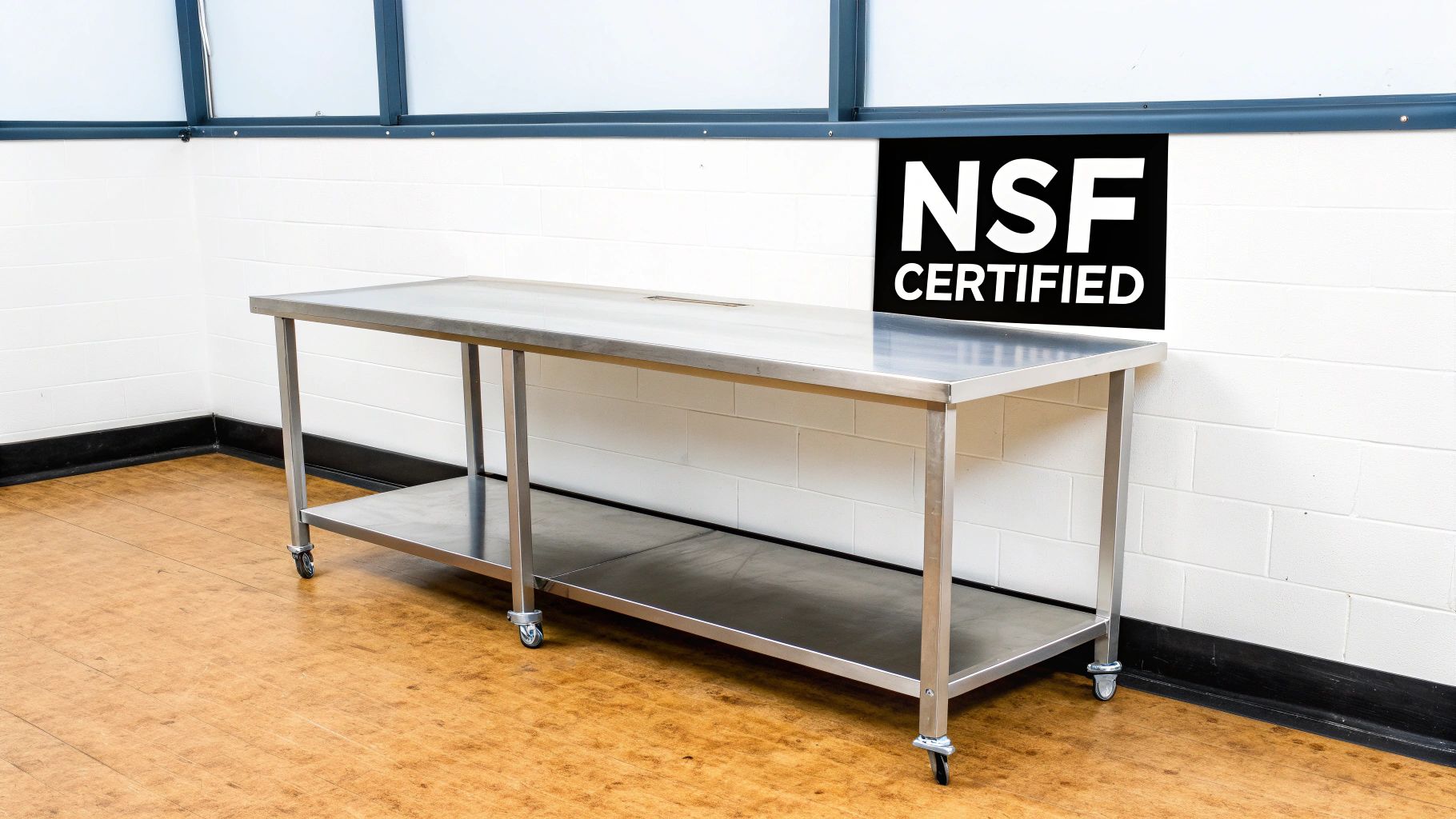
This seal of approval comes from NSF International, an independent body that puts products through the wringer to ensure they meet public health codes. For a stainless steel table, this is a deep dive into its materials, design, and overall construction. The whole point is to guarantee it can be cleaned effectively and won't become a hiding place for bacteria. Without that logo, you're risking failed inspections, fines, and a hit to your reputation.
The Anatomy of an NSF Certified Table
So, what’s the big deal? What does NSF actually look for? Think of it as engineering hygiene directly into the table itself, leaving no weak spots where germs could thrive.
An NSF-certified table has to be made from materials that are non-porous, non-toxic, and resistant to corrosion. This is exactly why 304-grade stainless steel is the gold standard for any surface that touches food. But the right material is just the starting line; the real test is in the construction.
Here are the key design details that NSF demands:
- Seamless Welds: All joints and corners are smoothly welded and polished down. This gets rid of the tiny cracks and gaps you’d find in bolted tables—the perfect place for food bits and bacteria to get trapped.
- Coved Corners: Any corner where the tabletop meets a backsplash or a shelf meets a leg must be curved, or "coved." Sharp 90-degree angles are a nightmare to clean properly, making them a breeding ground for germs.
- Easily Cleanable Surfaces: The entire surface needs to be perfectly smooth, with no pits, cracks, or deep grooves. This means a simple wipe-down is all it takes to remove contaminants.
- No Exposed Threads or Fasteners: All hardware has to be sealed or covered. This prevents food debris from getting stuck in those impossible-to-reach spots.
More Than Just a Sticker
At the end of the day, NSF certification is so much more than a box to check. It's a cornerstone of a safe, professional kitchen. It gives your team a sanitary surface to work on, protecting both your staff and your customers from foodborne illness.
Investing in NSF-certified equipment isn't just about compliance; it's a proactive step to safeguard your entire operation. It shows a commitment to food safety that builds trust with health inspectors and the community you serve.
Choosing a certified stainless steel table commercial model is a must-do for any responsible food business. It makes your sanitation process easier, takes the stress out of health inspections, and gives you valuable peace of mind. To get a closer look at the requirements, you can find out more about what is NSF certification in our complete guide. The knowledge will empower you to make a smart choice that supports a clean, efficient, and professional kitchen.
Maintaining Your Table for a Lifetime of Use
Think of a high-quality stainless steel table commercial kitchens use as a long-term partner in your business. It's a serious investment, but protecting that investment is actually pretty straightforward. With the right care routine, your table can look great and stay hygienic for years, if not decades, to come.
The secret to its longevity is an invisible shield called the passive chromium oxide layer. This layer forms naturally when the chromium in the steel meets the air, and it's what makes stainless steel "stainless." But things like dirt, grease, and especially harsh chemicals can break down this barrier, leaving the steel open to rust and corrosion. So, good cleaning isn't just about appearances—it's about keeping that essential protective layer intact.
Daily and Weekly Cleaning Routines
The best defense is a good offense, and that means building a simple, consistent cleaning habit. Wiping down the table daily stops food acids and other gunk from sitting on the surface and causing pitting over time.
For most daily cleaning, a soft cloth, some warm water, and a little mild detergent are all you need. The key is to always wipe in the same direction as the steel's grain—those faint polish lines you can see. Wiping against the grain can create tiny scratches that dull the finish and give grime a place to hide. Once you're done, give it a quick rinse with clean water and dry it right away with a towel to prevent ugly water spots.
Here's a pro tip that makes a huge difference: always clean with the grain. It's a small detail, but it prevents the micro-scratches that build up over time, which keeps the table's finish looking new and makes it easier to clean next time.
For tougher jobs like baked-on grease, a simple paste of baking soda and water works wonders without being too abrasive. For a deeper dive into safe cleaning methods, check out our complete guide on how to clean stainless steel for more detailed tips.
What to Avoid at All Costs
Knowing what not to do is just as critical as knowing what to do. Some common cleaning products can strip that protective layer off your table and cause permanent damage in an instant.
Make sure you never use these on your stainless steel surfaces:
- Chlorine Bleach: Any cleaner with chlorine is a major no-go. It will aggressively attack the chromium layer, quickly leading to pitting and rust.
- Steel Wool or Abrasive Scrubbers: These will leave deep scratches on the surface, creating perfect little highways for rust to form. Stick to soft cloths or nylon scrubbers.
- Abrasive Powders: Harsh scouring powders will scratch and dull the finish, compromising the steel's integrity.
- Hard Water: If your business is in an area with hard water, be extra vigilant about drying surfaces completely. Mineral deposits can build up and leave stubborn stains on the steel.
By sticking to these simple rules, you'll ensure your stainless steel table commercial unit stays a pristine and reliable workhorse in your kitchen. And for keeping the rest of your facility up to snuff, professional commercial cleaning services can help maintain high standards of hygiene across the board.
Frequently Asked Questions
When you're outfitting a kitchen, questions about stainless steel tables always come up. Getting the right answers is key to making a smart investment that will stand up to years of hard use. Here are some of the most common questions we hear from buyers.
What Is the Best Grade of Stainless Steel for a Restaurant Table?
This really comes down to where the table will be used and what it will touch. For any surface that comes into direct contact with food—like a prep top—304-grade stainless steel is the gold standard, no questions asked. Its mix of chromium and nickel gives it top-tier protection against rust and corrosion from things like citrus juices, vinegar, and sanitizing chemicals.
But not every part of the table needs that level of defense. For legs, bracing, or an undershelf that's just holding dry goods, 430-grade steel is a great, cost-effective choice. It’s plenty durable for structural parts and helps you save a bit of money where you don't need the premium corrosion resistance of 304-grade.
How Do I Choose the Right Steel Gauge?
Think of the steel gauge as the table's muscle. It’s all about what you plan to do on it. And remember, with gauge, the numbers work in reverse—the lower the number, the thicker and stronger the steel.
- 18-Gauge: This is your best bet for light-duty work. Think sandwich assembly, light prep, or just a landing spot for equipment. It's a great economical option for less demanding areas.
- 16-Gauge: The all-rounder and the most popular choice for a reason. 16-gauge hits the sweet spot between toughness and price, making it perfect for the daily grind of chopping, mixing, and general prep in a busy kitchen.
- 14-Gauge: When you need a beast, you need 14-gauge. This is heavy-duty steel built for serious work. It’s designed to handle heavy equipment like floor mixers or to take the impact of butchering without denting, bowing, or complaining.
Choosing the correct gauge is fundamental to a table's longevity. A 14-gauge table can easily support weights exceeding 600 pounds, ensuring a stable and safe platform for your most demanding tasks and heaviest equipment.
Can Stainless Steel Actually Rust?
It’s rare, but yes, it can happen. The key thing to remember is that stainless steel is rust-resistant, not entirely rust-proof. Its magic comes from an invisible, self-healing layer of chromium oxide on the surface. If you damage that protective layer, rust can get a foothold.
What causes the damage? The usual suspects are harsh, abrasive scrubbers like steel wool that physically scratch the surface, or aggressive chemicals like bleach and other chlorine-based cleaners. These chemicals are notorious for eating away at that protective shield.
The good news is that preventing rust is simple. Stick with soft cloths or nylon pads for cleaning, and always use gentle, non-chlorinated cleaners. If you treat it right, your stainless steel table commercial kitchens depend on will stay pristine and rust-free for life.
Ready to find the perfect foundation for your kitchen? At PrepTables.com, we offer a wide range of NSF-certified stainless steel tables built for durability and performance. Explore our collection and find the ideal match for your workflow at https://preptables.com.