

Choosing Kitchen Stainless Steel Work Tables
Every great dish starts somewhere, and in a professional kitchen, that somewhere is almost always a kitchen stainless steel work table. This isn't just a surface; it's the command center for all things culinary. It's where ingredients get prepped, dishes are meticulously plated, and the entire kitchen's workflow pivots.
The right table is a serious investment in your kitchen's efficiency, durability, and most importantly, food safety.

Choosing the Right Type of Stainless Steel Prep Table
Not all stainless steel work tables are created equal. The best one for your kitchen depends entirely on your menu, workflow, and floor plan. While the classic flat-top table is the versatile foundation of any prep area, there are numerous specialized models designed to master specific tasks, which can drastically improve your speed and organization.
Think of the standard flat-top work table as your kitchen's blank canvas. It's perfect for general food prep, from chopping vegetables to portioning out proteins. These tables come in a dizzying array of sizes and configurations, making them easy to fit into just about any space or role. Their simplicity is their strength, providing a durable, hygienic surface for countless tasks.
Specialized Prep Tables for High-Volume Tasks
For more specific, repetitive workflows, specialized tables have built-in features that can streamline the whole process. These units are designed to solve common kitchen bottlenecks by putting everything you need right at your fingertips.
- Pizza Prep Tables: A pizzeria's best friend. These tables feature raised, refrigerated rails that keep toppings like cheese, pepperoni, and veggies perfectly chilled and within arm's reach. This setup lets a chef assemble pizzas incredibly fast without ever having to leave their station. The large workspace in front of the rails is ideal for stretching dough and building pies.
- Sandwich and Salad Prep Tables: Working on the same principle as pizza tables, these units have recessed cold wells or pans to hold sliced meats, cheeses, and fresh produce. The design keeps ingredients at safe temperatures while creating an ergonomic assembly line for building sandwiches, wraps, and salads at high speed.
Integrated and Heavy-Duty Options
Beyond the refrigerated units, other designs serve equally crucial functions. Some kitchen stainless steel work tables come with built-in sinks, creating a seamless prep-and-wash workflow in a compact footprint. Others are beefed up as heavy-duty equipment stands, built with thicker gauge steel to safely hold bulky mixers, slicers, or griddles.
The core idea is to match the table's function to your most frequent tasks. A well-chosen table doesn't just provide space; it actively improves your kitchen's rhythm and output, turning a chaotic process into a structured, efficient flow.
While these tables are the backbone of a pro setup, a truly efficient kitchen also relies on other essential commercial kitchen accessories that work alongside your main workstation. By picking the right combination of standard and specialized tables, you can build a customized environment that gets the most out of every square foot.
Decoding Steel Grades, Gauges, and Construction
Choosing the right stainless steel work table goes way beyond just picking a size. The real story is in the details: the grade of the steel, its thickness, and how the whole thing is put together. Nailing these specs is the difference between buying a table that lasts a few years and investing in a workstation that becomes the backbone of your kitchen for a decade.
First up, let's talk stainless steel grade. Think of this as the steel's recipe. Different ingredients in the mix give it different superpowers, especially when it comes to fighting off rust and corrosion.
The Two Most Common Steel Grades
In the world of food service, you're almost always going to run into two main grades: 304 and 430. Each has its place, and choosing between them comes down to your kitchen's environment and your budget.
- 304 Grade Stainless Steel: This is the undisputed champ of the commercial kitchen. It’s got a higher dose of chromium and nickel, which gives it top-tier resistance to rust and corrosion. If the area gets wet—think general prep, dishwashing stations, or anywhere with moisture—304 grade is the industry standard. It's built for durability and food safety.
- 430 Grade Stainless Steel: This is your budget-friendly workhorse. It’s still tough and perfectly fine for many jobs, but it doesn't have the extra nickel that 304 does, making it a bit more vulnerable to corrosion over time. It’s a great pick for drier spots like equipment stands, dry storage areas, or light-duty prep where you need to keep costs in check.
Getting the grade right is fundamental. If you really want to get into the weeds of the chemical compositions, check out our guide that details what makes different stainless steel grades unique. This one decision has a huge impact on your table’s lifespan and how much work you'll put into maintaining it.
Understanding Steel Gauge
Once you've picked a grade, the next critical spec is the gauge—which is just a fancy word for the steel's thickness. It's a little backward, but with steel gauge, a lower number means thicker, stronger metal.
A thicker gauge table can take a beating, resisting the dents, dings, and warping that are inevitable in a busy kitchen. If you're planning on putting a heavy mixer on it or doing some serious butchering, you absolutely need a lower gauge.
A thick, 14-gauge table is like a solid oak desk—built to handle immense pressure and daily abuse. A higher, 18-gauge table is more like a simple writing desk—perfectly functional for light tasks but not designed for heavy loads.
- 14-Gauge: This is the heavyweight champion, your go-to for the most demanding jobs. It can handle serious weight and impact, making it perfect for holding heavy equipment or for prep work that involves a lot of force.
- 16-Gauge: The most popular kid on the block. It hits that sweet spot between durability and cost, making it a versatile choice for most general prep work in a busy commercial kitchen.
- 18-Gauge: This is the more economical option, best suited for light-duty work like plating, assembly, or holding smaller appliances. It's still a reliable surface, but it will show wear and tear more easily.
Here's a quick cheat sheet to help you compare the most common options at a glance.
Stainless Steel Grade and Gauge Comparison
A quick reference guide to help you choose the right material for your kitchen's needs and budget.
| Feature | 304 Grade Stainless Steel | 430 Grade Stainless Steel | 14-Gauge Steel | 18-Gauge Steel |
|---|---|---|---|---|
| Corrosion Resistance | Excellent; ideal for wet areas | Good; best for dry environments | N/A (thickness feature) | N/A (thickness feature) |
| Best For | All-purpose prep, dish rooms, high-moisture zones | Dry storage, equipment stands, light-duty prep | Heavy equipment, intensive butchering, high-impact tasks | Plating, assembly, holding light appliances |
| Cost | Higher | Lower | Highest | Most economical |
| Durability | Superior, long-lasting | Standard | Maximum durability, dent-resistant | Standard, more prone to dents |
| Magnetism | Non-magnetic | Magnetic | N/A | N/A |
Ultimately, matching the material to the job ensures you get the best value and performance out of your investment.
Construction Quality and Design Elements
Beyond the raw materials, how a table is built is a massive factor in its stability and real-world usefulness. A well-made table feels solid and secure, not wobbly and flimsy, especially when you're in the middle of a chaotic dinner rush.
One of the most telling signs of quality is how the legs and undershelf are attached. Welded construction, where all the parts are fused together, is almost always more stable and long-lasting than bolted designs, which can loosen up over time from vibrations and heavy use.
Edge design is another one of those small details that makes a big difference. A marine edge has a raised lip around the perimeter that catches spills and keeps liquids from dripping all over the floor—a simple feature that can prevent a lot of cleanup and slipping hazards. A standard straight edge, on the other hand, gives you a completely flat surface, which is great for sliding ingredients or containers on and off easily.
The demand for high-quality, durable materials is only growing. The broader stainless steel market, which includes tables like these, recently grew from USD 164.9 billion to USD 174.95 billion and is expected to hit USD 239.56 billion. This just goes to show how much commercial kitchens rely on hygienic, long-lasting equipment.
For a great breakdown of material properties that are just as relevant for work surfaces, take a look at this guide to stainless steel for cookware. By keeping the grade, gauge, and construction quality in mind, you can confidently choose a table that's truly built to last.
Finding the Right Prep Table for Your Workflow
Picking the perfect kitchen stainless steel work table isn't a one-size-fits-all deal. The right table is a direct reflection of your menu, your kitchen's layout, and the daily grind your staff goes through. While the classic flat-top table is the undisputed foundation of any prep area, some specialized models are built to master specific jobs, seriously boosting your kitchen's speed and organization.
Think of the standard flat-top table as your kitchen's blank canvas. It’s the essential workhorse for all the general prep work, from chopping vegetables and trimming meat to plating dishes. These tables come in a huge range of sizes, so it's easy to slot one into just about any kitchen setup. Their simplicity is their biggest strength, giving you a clean, tough surface for a thousand different tasks.
But when your kitchen is cranking out the same high-volume items day in and day out, a specialized prep table stops being a nice-to-have and becomes a necessity. These units are designed to break up common kitchen bottlenecks by putting everything your team needs right where they need it.
Specialized Prep Tables for High-Volume Tasks
For restaurants with a focused menu—think pizzerias or delis—specialized tables are the heart of an efficient production line. These tables often have built-in refrigeration to keep food safe and speed up the assembly process.
- Pizza Prep Tables: A pizzeria's MVP. These tables have raised, refrigerated rails that hold pans of toppings like cheese, pepperoni, and veggies. By keeping everything perfectly chilled and right at the chef's fingertips, they can build pizzas at lightning speed without ever having to walk away.
- Sandwich and Salad Prep Tables: These work on a similar idea, with recessed cold wells designed to hold pans of sliced meats, cheeses, and fresh produce. This setup creates a natural assembly line, letting staff build sandwiches, wraps, and salads quickly while keeping every ingredient at a safe, controlled temperature.
This quick breakdown covers the core specs—grade, gauge, and edge style—that determine how a table will perform and what it's best suited for.
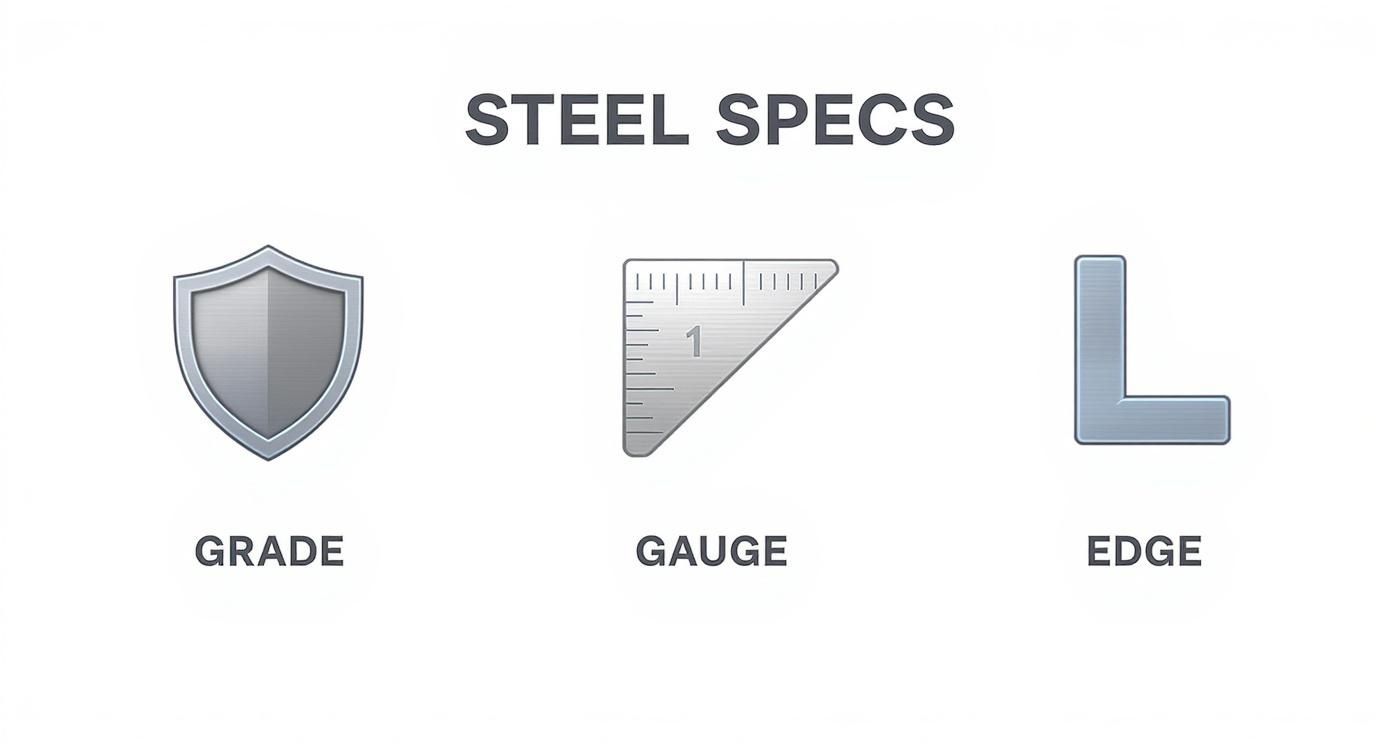
Getting a handle on these three things is the key to matching the right table to the job, which ensures it will last and meet all the food safety standards.
Integrated and Heavy-Duty Options
Beyond the refrigerated units, other specialized tables serve just as important roles in a busy kitchen. The goal is to find a table that doesn't just fill a space but actually makes your workflow better.
Some kitchen stainless steel work tables come with a sink built right in. This creates a seamless prep-and-wash station in one compact unit. It’s a perfect solution for smaller kitchens where every inch of space counts, or for specific stations that need constant rinsing of produce or tools. Moving straight from prep to cleaning cuts down on steps and saves precious time during a rush.
On the other end of the spectrum, you have heavy-duty equipment stands. These are more than just tables; they're beefed-up platforms built with thicker gauge steel and stronger leg supports. Their main job is to safely hold heavy equipment like commercial mixers, meat slicers, or countertop griddles. Using a dedicated stand is a major safety move, as a standard prep table probably isn't rated to handle the weight and vibration from that kind of machinery.
The core idea is simple: match the table's function to your most common and demanding tasks. A well-chosen table doesn't just sit there; it becomes an active part of your kitchen's rhythm, turning what could be a chaotic process into a smooth, efficient flow.
By really thinking about your daily operations, you can pick a mix of standard and specialized tables that creates a custom, high-output workspace. The right equipment gives your team the power to work faster, safer, and more consistently, which ultimately makes every dish that leaves your kitchen better.
Why NSF Certification Is Non-Negotiable
When a health inspector walks into your kitchen, one of the first things they'll look for is that small, circular NSF logo on your equipment. This isn't just a friendly suggestion; it's a hard requirement for any serious food service operation. Buying an NSF-certified kitchen stainless steel work table is one of the most basic, yet crucial, steps you can take to build a safe and legitimate business.
Think of NSF certification as a passport for your equipment, proving it meets strict food safety standards. It’s an independent, third-party guarantee that your work table was designed and built specifically to prevent foodborne illness. It’s not just about being made of stainless steel—it’s about how that steel is fabricated into a finished product.
What NSF Certification Guarantees
The NSF standard digs into the nitty-gritty design details that make a table truly hygienic and easy to clean. Certified equipment has to meet a long list of criteria that directly impacts your daily operations.
- Non-Porous and Smooth Surfaces: The tabletop must be perfectly smooth, with no pits, cracks, or tiny crevices where bacteria and food bits can get stuck. This makes a world of difference when it's time to clean up.
- Coved Corners and Sealed Seams: Instead of sharp 90-degree corners where gunk loves to build up, NSF tables often have coved, or curved, corners. Every seam and joint must be completely sealed, leaving no place for germs to hide.
- Safe and Durable Materials: This certification confirms all materials are non-toxic and tough enough to resist corrosion, chipping, and pitting from heavy use and strong cleaning chemicals.
You can dive deeper into the details of this vital standard by reading our guide on what is NSF certification and why it's so important for everything in your kitchen.
The Risks of Non-Certified Equipment
Trying to save a few bucks on a cheaper, non-certified table might seem tempting, but it can backfire spectacularly. Putting unapproved equipment in a commercial kitchen is a huge gamble.
The consequences are real, ranging from instant health code violations and steep fines to having your doors shut by the health department. Even worse, a non-certified table can put your customers' health at risk, destroying your business's reputation in the process. Quality is everything, which is why the stainless steel tables market is projected to grow from USD 1.2 billion to USD 1.8 billion. It just shows how vital these tables are in professional settings. You can learn more about the growth of the steel table market and how it’s shaping industry standards.
An NSF-certified table isn't just about passing an inspection; it's about making a commitment. It tells your staff, customers, and inspectors that you put food safety first. It’s a non-negotiable investment in the health of your customers and the future of your business.
Customizing Your Workstation for Peak Efficiency
A basic kitchen stainless steel work table is just a starting point. To really boost your kitchen's productivity, you need to think of it as a fully customized workstation. Transforming that simple surface into a high-performance hub all comes down to smart choices in sizing and accessories. When you build a table that fits your space and workflow perfectly, you'll see a huge improvement in organization and speed.
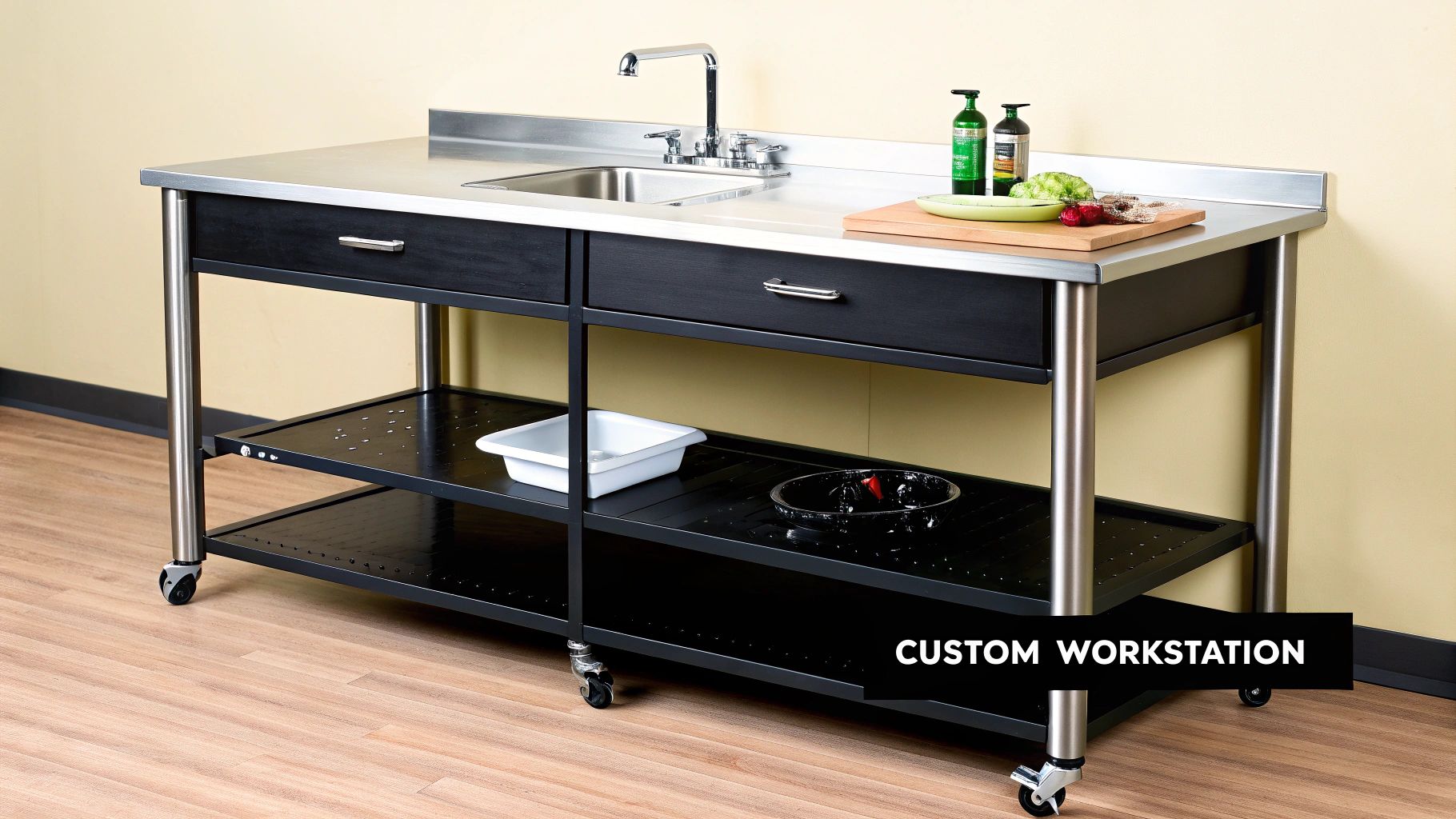
It all starts with getting the size right. Before you even think about bells and whistles, get out the tape measure and map out your available kitchen footprint. Don't just measure for the table itself; you need to leave plenty of clearance—at least 36 to 48 inches—so staff can move around safely, even during a chaotic dinner rush.
This kind of planning prevents bottlenecks and makes for a safer, less stressful kitchen. A well-sized table should slide right into your kitchen's flow, not get in the way of it.
Essential Accessories That Boost Functionality
Once you've nailed down the dimensions, it's time to add some real capability with accessories. These add-ons are designed to solve everyday kitchen problems, like not having enough storage or dealing with messy prep.
- Undershelves: This is the quickest win for storage. An undershelf, whether it’s solid or wire-frame, gives you a dedicated spot for containers, small appliances, and bulk ingredients, keeping your main work surface clear.
- Backsplashes: A simple backsplash is an absolute lifesaver. That little raised edge at the back stops ingredients and liquids from splattering all over the wall, which makes cleanup way easier and keeps the whole kitchen more hygienic.
- Casters: Putting wheels on your table gives you incredible flexibility. Casters turn a stationary table into a mobile workstation you can easily move for deep cleaning or reconfigure on the fly as your menu changes.
Building a Truly Mobile and Efficient Workstation
In a busy commercial kitchen, mobility is a massive advantage. A kitchen stainless steel work table on casters can be rolled to different stations as needed, serving as a temporary landing zone for plated dishes or an extra prep surface when you're slammed.
Just make sure to get lockable casters. This is a non-negotiable feature that keeps the table securely in place once you’ve positioned it. That stability is critical for safety when someone is chopping, mixing, or doing any other prep work.
The demand for this kind of adaptable, durable equipment is clear from market trends. The metal furniture market, which includes these essential tables, was valued at USD 92.8 billion and is projected to keep growing. This trend shows just how critical customized, high-quality workstations are to modern commercial kitchens. You can discover insights on the metal furniture market and see how the industry is evolving.
Think of your work table not as a single piece of furniture, but as the foundation of a modular system. Each accessory you add—from a shelf for storage to wheels for mobility—is a deliberate step toward building a more organized, efficient, and productive culinary hub.
By strategically combining the right size with the right add-ons, you can create a workstation that is perfectly suited to your kitchen's unique needs. This isn't just about saving space; it's about saving time, cutting down on stress, and letting your culinary team do their best work. A well-designed workstation is a direct investment in your kitchen's performance.
Essential Cleaning and Maintenance Practices
A stainless steel work table is a serious investment, built to withstand the chaos of a busy kitchen. But even the toughest gear needs a little TLC. Proper care isn't just about keeping it shiny; it's a critical part of food safety and protecting the steel's invisible shield—the passive layer that fights off rust and corrosion.
You don’t need an elaborate plan. The secret is consistency. Daily cleanings are non-negotiable, while a weekly deep clean and quick action on spills will keep your table looking and performing like new for years. It's not about back-breaking work, just smart habits.
Daily and Weekly Cleaning Routines
The bedrock of good maintenance is a simple daily wipe-down. At the end of every shift, a quick wash with mild soap and warm water on a soft cloth or sponge is usually all it takes to handle food residue and grease. This one small step prevents buildup that becomes a nightmare to remove later.
Once a week, you can go a bit deeper with a gentle, non-abrasive cleaner made specifically for stainless steel.
- Always Wipe with the Grain: This is the golden rule. Look closely and you'll see fine lines in the metal—that's the "grain." Wiping in the same direction as the grain prevents tiny scratches that can dull the surface.
- Rinse Thoroughly: After you clean, always rinse the table with clean water. You don't want any leftover cleaning agents hanging around.
- Dry Completely: Don't let it air dry. Grab a soft, clean towel and wipe it down immediately. Air drying leaves behind water spots and mineral deposits that ruin that clean, professional finish.
What to Avoid at All Costs
Stainless steel is tough, but it's not invincible. The wrong chemicals or cleaning tools can strip away its protective layer, leading to rust, pitting, and permanent damage.
Never, ever use abrasive stuff like steel wool or scouring pads. They will absolutely scratch the surface and can even embed tiny iron particles that will start to rust. Also, stay far away from cleaners with chlorine bleach, chlorides, or other harsh chemicals—they will permanently ruin your table.
For a more detailed look at the best techniques, check out our full guide on how to properly clean stainless steel. Stick to these simple rules, and your table will remain a hygienic, reliable, and great-looking asset in your kitchen for the long haul.
Frequently Asked Questions
Even after you've done your research on stainless steel work tables, a few practical questions always seem to pop up. Getting those final details ironed out can be the difference between a good purchase and a great one. Let's tackle some of the most common queries we hear from chefs and kitchen managers.
Practical Use and Care
A big one we get is about thickness. What’s the right gauge for a busy commercial kitchen? For most day-to-day prep work, chopping, and holding equipment, 16-gauge stainless steel is the sweet spot. It offers a great balance of toughness and value. If your table will be handling heavy-duty butchering or supporting massive mixers, stepping up to a thicker 14-gauge is a smart investment. For lighter tasks like plating or assembling salads, an 18-gauge table is a perfectly fine, budget-friendly choice.
Another common question: can you cut directly on the tabletop? While you can, you really shouldn't. Using a knife right on the steel will kill your blade's edge in no time. More importantly, it carves tiny scratches into the surface. These little grooves are a nightmare to sanitize and can become a perfect hiding spot for bacteria, which is a major food safety no-go. The rule of thumb is simple: always use an NSF-certified cutting board.
What about rust spots? It can happen, but it's usually easy to fix. Rust often appears when the table comes into contact with other iron items or from residue left by harsh cleaning chemicals. For minor spots, a simple paste of baking soda and water works wonders. Just apply it with a soft cloth and rub gently with the grain of the steel. For anything more stubborn, a dedicated stainless steel cleaner will do the trick. No matter what, always rinse the area well with clean water and dry it completely afterward. This helps the steel's natural protective layer to reform.
A key takeaway is that the primary difference between a 304 and 430 grade table lies in corrosion resistance. Grade 304 contains nickel, making it highly resistant to rust and the go-to choice for wet environments. Grade 430 is a more economical, nickel-free option perfect for dry storage or equipment stands but is more susceptible to rust if consistently exposed to moisture.
Ready to find the perfect foundation for your culinary workflow? Explore a wide selection of durable, NSF-certified PrepTables.com kitchen stainless steel work tables and build a workstation that’s built to last. Visit https://preptables.com to find the right fit for your kitchen today.