

Undercounter Refrigerator Dimensions Explained
When you're fitting an undercounter refrigerator into your space, getting the dimensions right is everything. These units are specifically designed to tuck away neatly, and manufacturers have largely standardized their sizes to make the process easier. The goal is to slide them perfectly under a standard 36-inch countertop, leaving just enough room for proper ventilation.
Defining Standard Undercounter Refrigerator Dimensions
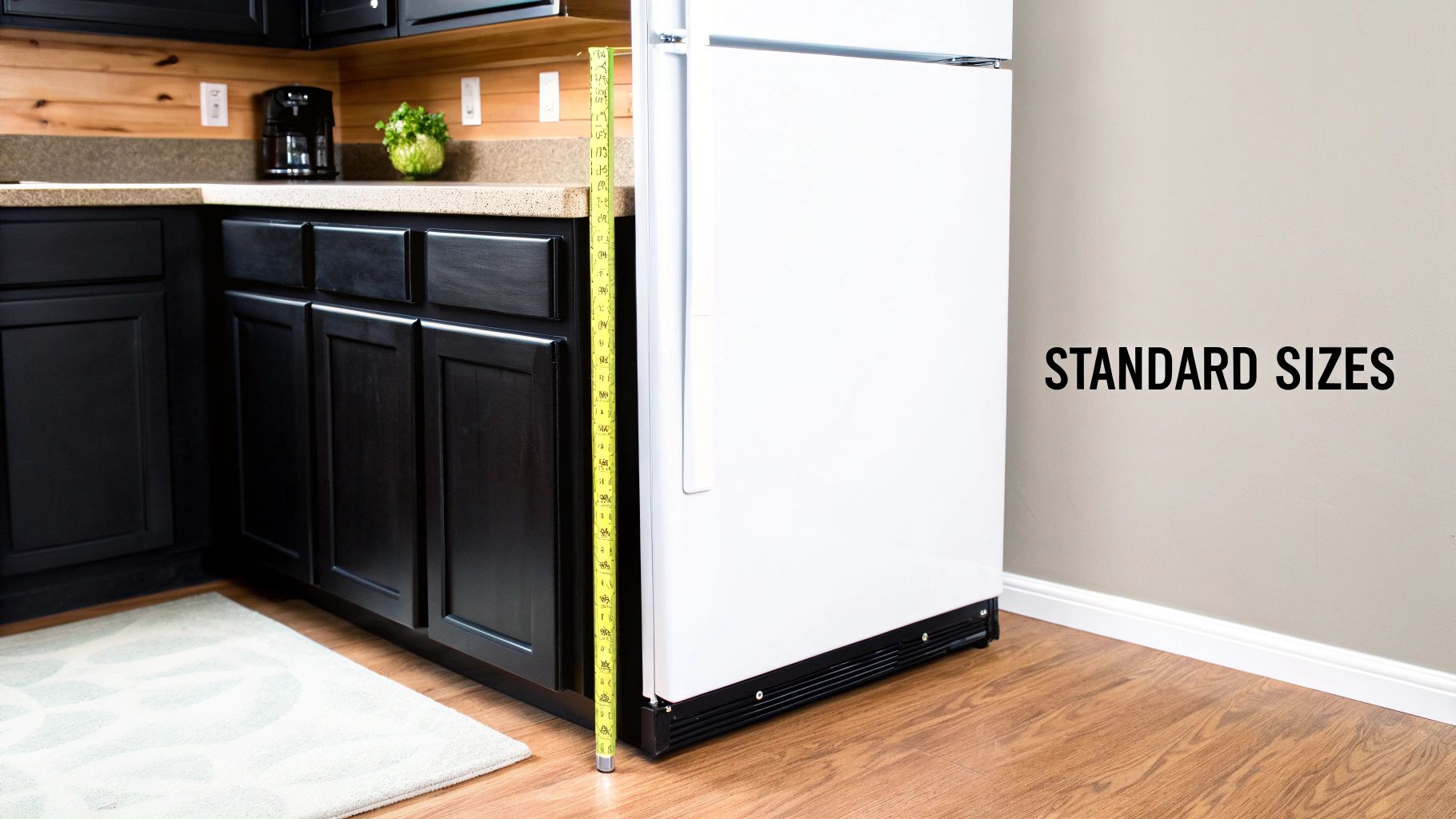
Knowing the typical measurements of these compact refrigerators is the crucial first step, whether you're outfitting a busy restaurant line, a home bar, or a specialized lab. Because the industry has settled on common sizing, you can spend less time worrying if a unit will fit and more time focusing on the features you actually need.
Think about it: most countertops, both commercial and residential, sit at 36 inches off the floor. To accommodate this, undercounter refrigerators are built just a bit shorter to ensure there's enough clearance for a smooth installation and, just as importantly, for air to circulate.
Key Dimension Ranges
You'll find that the most popular models, which usually offer between 5 to 10 cubic feet of storage, stick to a very predictable set of dimensions. This consistency is a huge advantage for anyone designing a kitchen or bar space.
If you're looking for more general advice on measuring for new equipment, a good appliance sizing guide can provide some great foundational knowledge. But for undercounter units, here's what you really need to know:
- Height: The magic number here is between 32" and 34.5". This is the single most important measurement to ensure your unit will slide under the counter.
- Width: You’ll typically see standard options at 15", 18", and 24". Of course, larger commercial models can stretch to 48" or even wider for high-volume needs.
- Depth: Most units have a depth between 22" and 24", which allows them to sit flush with standard-depth cabinetry for that clean, built-in look.
Once you’ve got these core measurements down, you're in a much better position to browse through a collection of undercounter refrigerator models and confidently pick the right one for your setup.
Exploring Different Undercounter Refrigerator Types and Sizes
It's not just about a simple refrigerated box. Undercounter refrigerators come in all sorts of designs, each built for specific jobs and kitchen workflows. Getting to know the different types is the first step in picking a model with the right undercounter refrigerator dimensions and features for your business. The choice between a solid door, a glass door, or a set of drawers can make a huge difference in your kitchen's efficiency or a bar's visual appeal.
Each style has its purpose. Solid door models are insulation champs, making them the best bet for keeping perishable foods safe and sound. Glass door units, which you'll often see called beverage centers or merchandisers, put your products on full display—perfect for helping staff move faster in a packed bar.
Single Door vs. Double Door Configurations
The most common decision you'll face is whether to go with a single or double-door unit. A single-door refrigerator is compact and a great fit for tighter spaces.
- Single-Door Units: These are the versatile workhorses of the kitchen, typically ranging from 24 to 36 inches wide. They're perfect for tucking into individual prep stations, sliding under a bar counter, or serving a small café.
- Double-Door Units: These bigger models stretch from 36 to 48 inches wide, sometimes even more. They give you a ton more storage, making them a solid choice for busy prep lines or as a central cold storage spot in a larger kitchen.
This one choice really shapes your layout and how your team works. A 48-inch double-door unit gives you a lot of consolidated storage, but two separate 24-inch single-door units could offer more freedom in where you place them. If you want a deeper dive into all the different models, our complete undercounter refrigerator guide has you covered.
Drawers, Beverage Centers, and Specialized Units
Drawer-style refrigerators offer a whole different level of convenience. They let your staff grab ingredients in a flash without having to swing a whole door open. You'll find these in two, three, or sometimes even four-drawer setups, and they generally have similar width profiles to the door models.
Beverage centers and wine coolers are more specialized, built for your front-of-house areas. Their dimensions are usually standardized to slide right into common bar and home cabinetry sizes. In fact, market data shows these units tend to fall into 15-inch, 24-inch, and 34-inch width categories. Glass doors are the clear favorite for showing off drinks, while tough stainless steel is still the go-to for kitchen durability.
For a commercial kitchen, the most valuable specialized units are refrigerated prep tables. These are the ultimate multi-taskers, combining a refrigerated base—with either doors or drawers—with a heavy-duty stainless steel worktop. They are absolutely essential for building out an efficient sandwich, salad, or pizza station where all your cold ingredients are right at your fingertips.
A Guide to Commercial Prep Table Refrigerator Dimensions
In any busy commercial kitchen, refrigerated prep tables are the undisputed workhorses. These stainless steel units are brilliant pieces of engineering, combining cold storage and a tough workspace into a single, efficient station. The undercounter refrigerator dimensions for these tables are driven by their job, which splits them into two main types: sandwich/salad prep tables and pizza prep tables. Knowing the difference is crucial for a smooth kitchen workflow and making the most of your floor plan.
These aren't just refrigerators with a fancy stainless steel top. They are specifically designed to keep ingredients at safe temperatures while being right at a chef's fingertips. This is exactly why their dimensions are so tied to their purpose—a sandwich station has very different requirements than a pizza line, and the design reflects that.
Sandwich and Salad Prep Tables
Sandwich and salad prep tables are all about speed and organization, built to hold smaller, easy-to-grab ingredient pans. The workspace itself usually features a cutting board that’s about 10 to 12 inches deep, giving you just enough room for assembly without hogging precious kitchen real estate.
The top refrigerated section is set up to hold a bunch of standard food pans, like sixth or ninth-size pans, perfect for toppings, dressings, and veggies. Because these ingredients are smaller, the unit's overall depth stays pretty compact.
- Standard Widths: You'll typically find these in 27", 48", 60", and 72" widths.
- Depth: The depth usually lands somewhere between 30" to 34", which lets them slide into most kitchen lines without sticking out too much.
- Height: Just like other undercounter units, they stand at a comfortable working height of around 36 inches.
A smaller 27-inch model might just have one door, whereas a 48-inch unit will have two. The bigger 60-inch and 72-inch versions often come with two or three doors, and sometimes a mix of doors and drawers for more versatile storage.
Pizza Prep Tables
Pizza prep tables, on the other hand, are built for a completely different kind of production. They have to accommodate big dough trays, bulky ingredient pans, and the need for a much larger assembly area. All of this has a direct impact on their dimensions, making them quite a bit deeper than their sandwich prep cousins.
Their most distinct feature is the raised pan rail. It’s elevated to fit deeper, full-size food pans for things like cheese, sauce, and pepperoni. This design keeps those ingredients perfectly chilled without accidentally freezing the dough on the work surface just below.
The cutting board on a pizza prep table is a huge differentiator. It’s often much deeper, typically ranging from 16 to over 19 inches, to give chefs plenty of room to stretch and top large pizza crusts.
That extra depth is a game-changer for functionality, but it also means the unit takes up a bigger footprint. The overall depth of a pizza prep table can be anywhere from 32" to 36" or even more. The width options are similar to sandwich tables—commonly 48", 60", 72", and even massive 93" models for high-volume pizzerias. As you'd expect, the number of doors or drawers grows with the width, ensuring you have plenty of refrigerated storage underneath for dough boxes, extra sauce, and cheese.
How to Properly Measure for Your Undercounter Refrigerator
Before you even think about sliding a new undercounter refrigerator into place, grabbing a tape measure is the single most important thing you'll do. Getting the numbers wrong can lead to a world of frustration and unexpected costs, from a unit that just won't fit to one that burns itself out from poor airflow. A few minutes of careful measuring saves you a massive headache down the road.
The trick is to measure the cutout—the empty spot where the unit will live—not just once, but a few times. I can't tell you how many times I've seen floors and cabinet walls that look perfectly straight but are actually off. Taking a few readings gives you the real-world dimensions you have to work with.
The Three-Point Measurement Technique
There's a tried-and-true method for getting an accurate read on your space that accounts for any imperfections in the cabinetry or floor: the three-point technique.
-
Height: Measure the vertical space from the floor up to the bottom of the countertop. Do this on the left side, then in the center, and again on the right side. Always use the smallest of these three numbers as your final height measurement.
-
Width: Now, measure the horizontal distance from one side of the cabinet opening to the other. Just like with the height, measure at the top, in the middle, and at the bottom. And again, the smallest measurement is the one you'll use. This guarantees the unit will actually slide in.
-
Depth: Finally, measure the depth from the back wall to the front edge of the cabinet opening. Check this on both the left and right sides to catch any weird angles or pipes that might be sticking out in the back.
Don't Forget Essential Clearances
Getting the cutout dimensions is only half the battle. You also have to plan for the space around the refrigerator, which is just as crucial for installation and performance. Before you lock in a purchase, it's a good idea to have a basic understanding of how to plan a room layout to make sure your new appliance fits into the kitchen's workflow.
-
Door Swing: Go ahead and open your existing cabinet doors. Is there enough room for the new refrigerator door to swing open completely without banging into a handle or another appliance? A door that can only open 90 degrees makes it a real pain to pull out shelves or drawers.
-
Utility Connections: Find your electrical outlet and water lines (if you're getting an ice maker). You need to leave at least an inch or two of extra depth behind the unit for the plug and hoses. Pushing the fridge flush against them is a recipe for kinked lines and damaged cords.
-
Ventilation Space: This is the big one. Built-in, front-venting models are the easiest, designed for "zero clearance" so they can sit flush with your cabinets. But if you get a freestanding or rear-venting unit, it absolutely needs room to breathe—often 1-2 inches on the back and sides. Without that airflow, the compressor will constantly overwork itself and eventually die an early death.
Pro Tip: Always, always pull up the manufacturer's spec sheet for the specific model you're considering. That document is your bible. It will list the exact cutout dimensions and clearance requirements, taking all the guesswork out of the process.
Understanding Ventilation and Installation Clearance
Figuring out an undercounter refrigerator's dimensions tells you if it will physically slide into a space, but its ventilation needs are what determine if it will actually work there. Proper airflow isn't just a suggestion; it's non-negotiable. Without it, the unit’s compressor is forced to work overtime, which leads to wasted energy, poor cooling, and a much shorter lifespan for your equipment.
The most important thing to understand is the difference between front-venting and rear-venting models. This one design feature dictates exactly where and how you can install the unit. Ignoring this is easily one of the most common and costly mistakes people make.
Front-Venting for True Built-In Applications
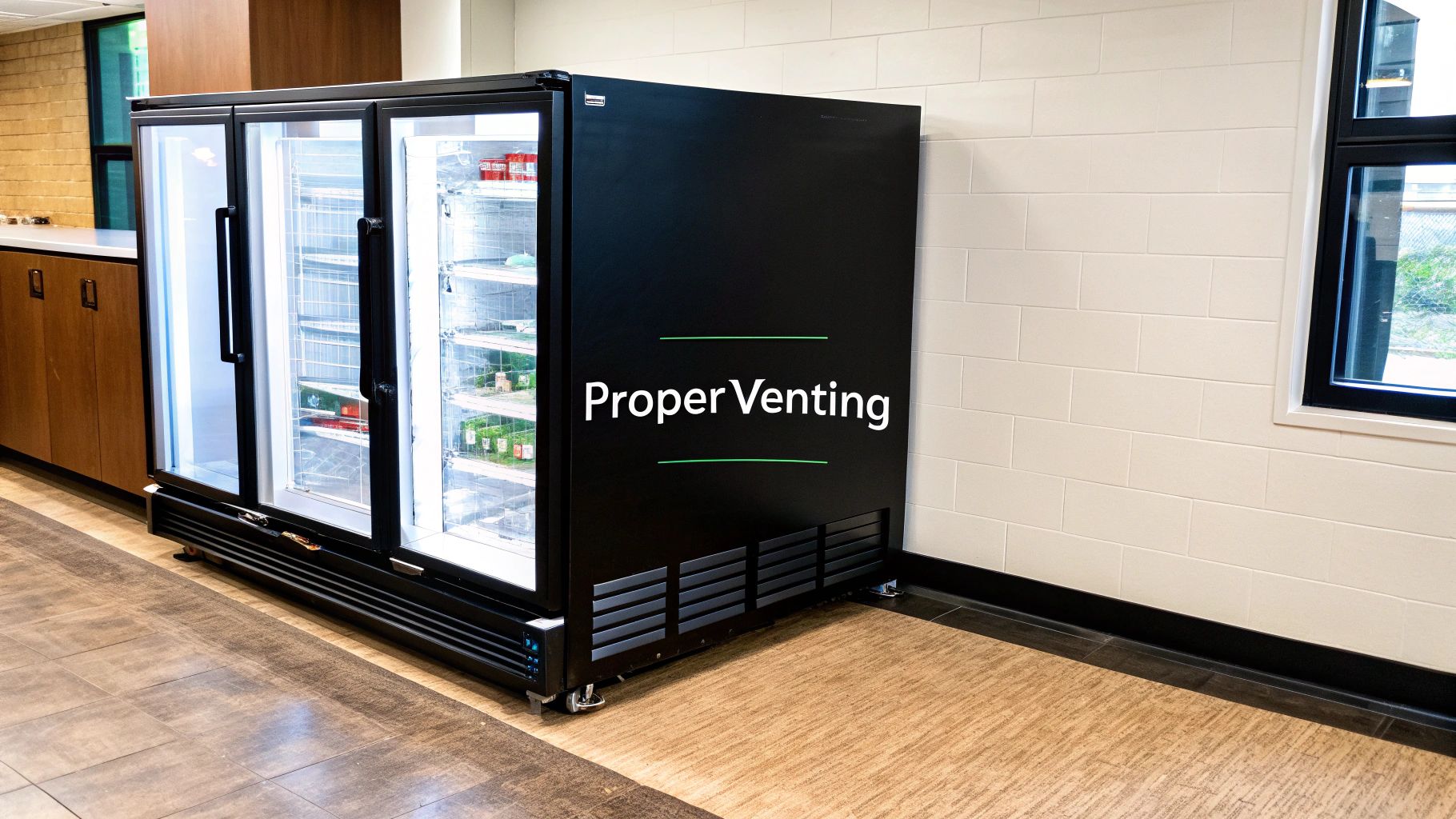
Front-venting units are the champions of seamless, integrated design. They are engineered to pull in cool air and push out hot air through a grille right at the front base of the appliance, usually just below the door.
This smart design is what allows them to be installed completely flush with the surrounding cabinetry. It’s what we call a "zero clearance" installation. Since they breathe from the front, they don’t need any extra breathing room at the back or on the sides, making them the only real choice for a true built-in look where the unit is fully enclosed.
Rear-Venting and Required Clearance Space
On the other hand, rear-venting models—which are often designed as freestanding or compact units—get rid of heat from the back and sometimes the sides. These refrigerators absolutely cannot be installed flush inside cabinetry without leaving very specific gaps for airflow.
If you don't provide that space, you're essentially trapping all the heat. This forces the compressor to run constantly just to try and cool down, which not only sends your energy bills through the roof but also leads to the machine breaking down way too soon.
- Back Clearance: These units typically need at least 1 to 2 inches of open space between the back of the refrigerator and the wall.
- Side Clearance: You’ll need to plan for another 1 to 2 inches of clearance on both sides so air can move freely around the unit.
- Top Clearance: An open space of at least 1 inch at the top is also a common requirement to let hot air escape.
Always, always check the manufacturer's spec sheet for the exact clearance requirements. These documents give you the precise numbers and diagrams you need to guide your installation, ensuring the unit performs correctly and keeping your warranty valid.
Proper ventilation is a cornerstone of any functional kitchen, and it goes beyond just refrigeration. To get a bigger picture, exploring commercial kitchen ventilation requirements can offer some great insights into keeping your whole operation efficient and safe. At the end of the day, respecting these clearance guidelines is what makes sure your undercounter refrigerator works reliably for years.
Comparing External Dimensions to Usable Internal Capacity
When you're sizing up an undercounter refrigerator, it’s easy to get fixated on the external dimensions.A refrigerator’s external dimensions tell you if the unit will fit in your designated space, but its true utility is defined by the usable internal capacity. It’s a classic case of what you see on the outside isn't always what you get on the inside. Understanding the factors that bridge this gap is essential for making an informed choice based on your actual storage needs.
The difference between the listed cubic footage and the practical storage area comes down to crucial design elements. Things like the thickness of the insulation, the placement of the compressor, and the layout of shelving and drawers all take up valuable interior space.
Why Stated Capacity Can Be Deceiving
A manufacturer's capacity rating, measured in cubic feet, represents the total empty volume inside the unit. However, this number doesn't account for the space consumed by internal components or the specific shapes of items you need to store.
For example, a unit with a bulky, bottom-mounted compressor might have a raised internal floor, limiting the height of items you can place there. Similarly, thick, energy-efficient walls are great for insulation but directly reduce the internal width and depth compared to the external footprint.
The most significant factor is often the cooling system's location. A rear-mounted compressor may push the unit further from the wall, affecting its flush fit, while an internal system eats directly into your usable storage area.
Maximizing Your Internal Layout
When evaluating the undercounter refrigerator dimensions, look beyond the total cubic feet and examine the internal layout. The configuration of shelves and drawers plays a massive role in how efficiently you can use the space.
- Adjustable Shelving: This feature offers the flexibility to accommodate items of various heights, from tall bottles to short food pans. A unit with fixed shelves might look spacious but can be surprisingly restrictive.
- Door Storage: Integrated door bins are perfect for condiments and small items, freeing up main shelf space. However, they can also limit how far the main shelves extend.
- Drawer Dividers: In drawer models, dividers help organize contents, but they also consume space. Consider if you need fixed organization or the open capacity of an undivided drawer.
By carefully comparing the external size to the practical internal configuration, you can select a refrigerator that not only fits your space but also effectively holds everything you need it to. This ensures your investment is based on real-world utility, not just a number on a spec sheet.
Answering Your Questions About Undercounter Refrigerator Dimensions
When you're zeroing in on the right undercounter refrigerator, a few last-minute questions always seem to pop up. Getting those details ironed out is the difference between a perfect fit and a major headache. Let's tackle the most common questions to clear things up and help you buy with confidence.
Getting these specifics right helps you dodge common mistakes, bridging that gap between your floor plan and a successful, seamless installation.
What Is the Standard Height of an Undercounter Refrigerator?
Most commercial undercounter refrigerators have a standard height that falls between 32 and 34.5 inches. This isn't an accident—it's designed that way so the unit can slide right under a standard 36-inch countertop.
That little bit of extra space is crucial. It gives you just enough room for proper ventilation and makes the installation process much smoother.
How Much Clearance Do I Need for an Undercounter Refrigerator?
This all comes down to where the unit breathes. The ventilation design is everything here.
- Front-venting models are your "built-in" or "zero-clearance" units. They're engineered to be fully enclosed in cabinetry and don't need any extra breathing room on the top or sides.
- Rear-venting models are a different story. They need space for air to circulate, typically 1-2 inches at the back and sides, plus at least one inch on top to keep from overheating.
Can Any Small Refrigerator Be Used as an Undercounter Model?
Absolutely not. You can't just shove any compact fridge under a counter and call it a day. Only models specifically built with front-facing ventilation can be safely installed inside cabinetry.
If you try to enclose a standard rear-venting fridge without proper clearance, it's guaranteed to overheat. That means poor cooling performance and, eventually, a dead compressor.
A quick note: Just because a unit is made of stainless steel doesn't mean it's the same as a refrigerated prep table. A standard undercounter unit is purely for cold storage. A prep table, like a sandwich or pizza prep unit, combines that storage with a food-safe work surface on top.
How Do ADA-Compliant Undercounter Refrigerator Dimensions Differ?
ADA-compliant units are all about accessibility. To fit under compliant countertops, their maximum height is capped at 34 inches, which often makes them a bit shorter than standard models.
Beyond height, their controls have to be easy to reach and operate with one hand, without needing to grip or twist tightly.
For professional-grade equipment that meets precise specifications, PrepTables.com offers a wide selection of undercounter refrigerators and specialized prep units to optimize any commercial kitchen. Find the perfect fit for your workflow at https://preptables.com.