

Your Essential Guide to Food Safe Sanitizer
So, what exactly is a food-safe sanitizer? Think of it as a specialized chemical agent designed to knock down the population of harmful bacteria on surfaces that touch food, bringing them to a level that's considered safe. These aren't your all-purpose cleaners. They're heavily regulated to make sure they get the job done without leaving nasty chemical residues that could spoil food or make a customer sick.
Defining Food Safe in a Commercial Kitchen
In a professional kitchen, "food safe" isn't just a casual term—it's a promise and a legal standard. It means a product has passed rigorous public health tests designed to stop foodborne illness in its tracks. To really get it, you have to understand the difference between cleaning, sanitizing, and disinfecting.
I like to use a hospital operating room analogy. Cleaning is like tidying up the room—you've removed the visible mess, but it's far from sterile. Sanitizing is the next critical step, like wiping down every single surface with a specific solution to kill off the vast majority of microscopic germs. Disinfecting? That’s the most extreme level, meant to obliterate nearly all pathogens, which is why you use those powerful chemicals on a bathroom floor, not your cutting board.
Before we go any further, grasping this hierarchy is essential. A great first step is understanding the difference between cleaning and sanitizing. The bottom line is that you always have to clean first. Wiping away grease and food particles is what allows the sanitizer to make direct contact with the bacteria and do its job effectively.
Decoding Regulatory Labels and Certifications
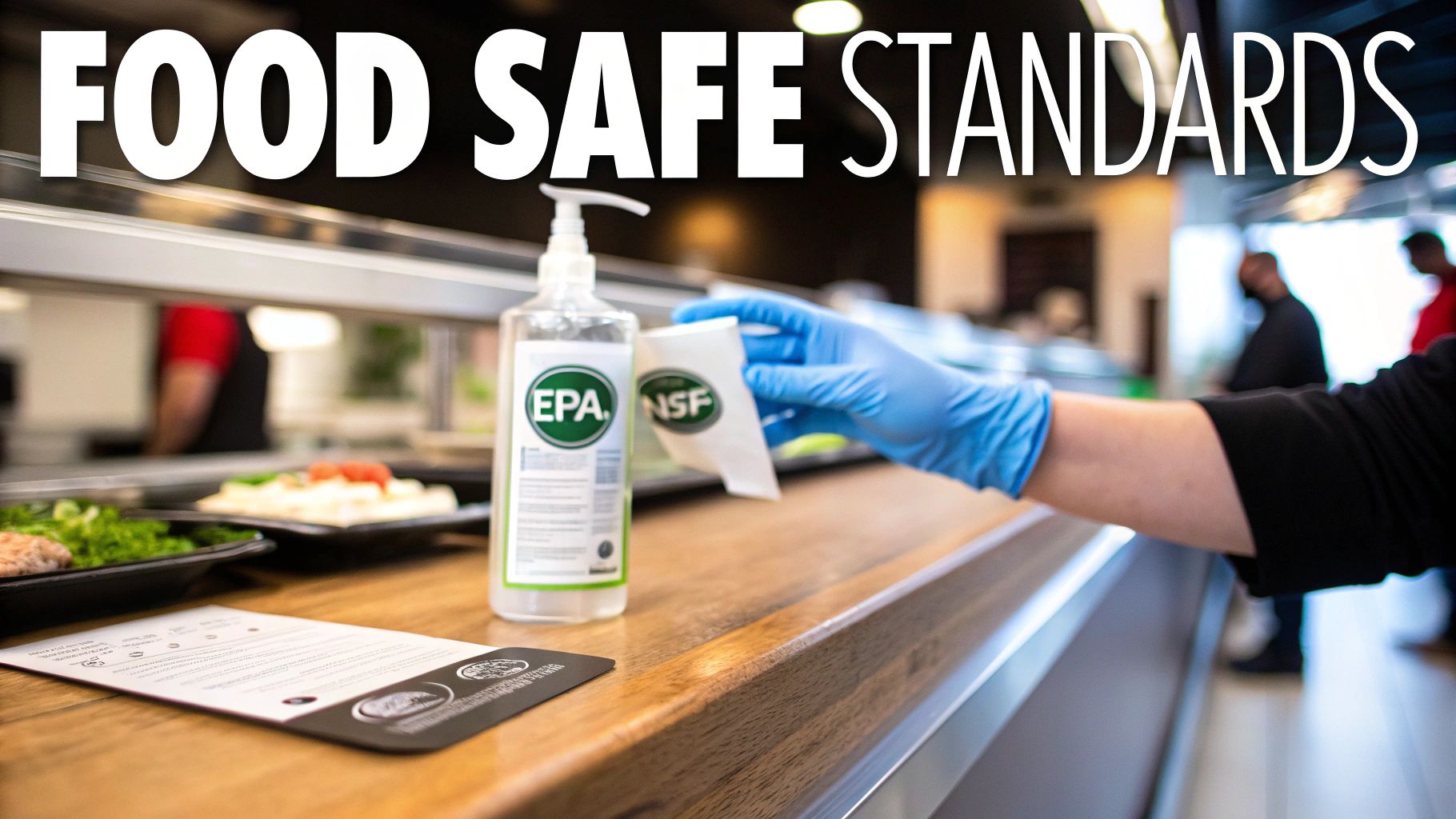
A product can't just call itself a food-safe sanitizer. It has to prove it. When you're stocking your kitchen, there are two non-negotiable seals of approval you need to look for on the label:
- EPA Registration Number: The U.S. Environmental Protection Agency (EPA) puts these products through the wringer, testing them for both safety and efficacy. An EPA registration number is your proof that the product is legit and actually kills the germs it claims to kill.
- NSF Certification: While the EPA is focused on the chemical's germ-killing power, NSF International confirms that the product is safe to use in a food environment. Seeing the NSF mark means everything from its chemical formula to its label meets strict public health standards.
Don't ever skip checking for these. If you want to dig a bit deeper into what this certification entails, you can learn more about what is NSF certification and why it's so vital for all your kitchen gear.
To meet official public health standards, a sanitizer has to reduce harmful microorganisms by 99.999% within 30 seconds on a food-contact surface. That incredibly fast, high-kill rate is what separates a true food-safe sanitizer from a simple cleaner.
Understanding Food Contact Surfaces
The whole point of a food-safe sanitizer is for use on food-contact surfaces. This is simply any surface that food will touch, either during prep or when it's being served.
In a typical commercial kitchen, this includes things like:
- Stainless steel prep tables
- Cutting boards
- Utensils and knives
- Pots, pans, and mixing bowls
- The inside of a prep fridge or salad bar
These surfaces are ground zero for cross-contamination. Bacteria like E. coli and Salmonella can easily transfer from a surface to the food you're about to serve. Using a properly certified food-safe sanitizer isn't just a good idea—it’s your most important line of defense for keeping your customers safe and your kitchen compliant.
Choosing the Right Chemical Sanitizer for Your Kitchen
Picking the right chemical sanitizer for your kitchen is about more than just grabbing a bottle from the storeroom. It's a decision that touches everything—staff safety, the lifespan of your expensive equipment, your budget, and most critically, the health of your customers. This choice is only getting more important. The global food safe sanitizer market, valued at around $1.2 billion, is expected to skyrocket to roughly $2.37 billion by 2032. This boom shows just how serious the industry is getting about effective sanitation. You can read the full research about food safe sanitizer trends to see how quickly demand is growing.
Let's walk through the four main types of chemical sanitizers—the real workhorses in any professional kitchen—so you can figure out which one makes the most sense for your operation.
Chlorine: The Cost-Effective Standard
Chlorine-based sanitizers, usually sodium hypochlorite (your basic bleach), are a kitchen staple for a reason. They're incredibly cheap, they act fast, and they knock out a huge range of germs, from bacteria and viruses to fungi.
But chlorine isn't perfect. It can be corrosive to metals like stainless steel if you mix it too strong or leave it on for too long. It also has that unmistakable smell, can irritate skin and lungs, and loses its punch quickly when it comes in contact with food scraps or hot water.
Quaternary Ammonium Compounds: The Versatile Option
You'll often hear these called "Quats." They've become a popular alternative to chlorine because they get the job done without the harsh side effects. They are non-corrosive, which makes them a fantastic choice for your stainless steel prep tables and other metal gear. Quats also leave behind a thin antimicrobial film, giving you longer-lasting protection.
On top of that, they're typically odorless, won't stain surfaces, and are effective across a wider range of temperatures and pH levels. The main thing to watch out for is that they can struggle against certain viruses and might not work as well in very hard water unless specifically formulated for it.
One of the biggest wins for Quats is their stability. Chlorine solutions have to be mixed fresh every single day to stay effective. Many Quat-based sanitizers, on the other hand, hold their potency for much longer, which means less waste and more consistent results.
Iodine: The Visual Indicator
Iodine-based sanitizers, or iodophors, aren't as common, but they have some really cool perks. They are great against a wide array of bacteria and are much kinder to surfaces than chlorine. One of their most helpful features is their color—usually amber or yellowish.
This color is like a built-in fuel gauge for the sanitizer. If you can still see the color, you know it's still working. When the color fades, its sanitizing power is gone. The downsides? Iodine can stain some plastics and is generally pricier than chlorine.
Peracetic Acid: The Powerful Performer
Peracetic acid (PAA) is a beast. This powerful sanitizer is extremely effective against just about any pathogen you can throw at it, including tough ones like spores and viruses. It works quickly even in cold water and breaks down into harmless stuff—basically vinegar and water—making it a great choice for the environment.
PAA is an excellent option for sanitizing equipment where you can't risk any chemical residue. The main drawbacks are its higher price tag and its potential to corrode softer metals like copper and brass if you're not careful. It also has a strong, sharp, vinegar-like smell that some people find unpleasant.
Comparing Common Food Safe Sanitizers
To help you see it all at a glance, we've put together a side-by-side comparison of these four common chemical sanitizers. This table breaks down their key features, benefits, and drawbacks for a busy commercial kitchen.
| Sanitizer Type | Effectiveness | Contact Time | Pros | Cons |
|---|---|---|---|---|
| Chlorine | Broad-spectrum (bacteria, viruses, fungi) | Typically 30-60 seconds | Very inexpensive, fast-acting, widely available. | Corrosive to metals, strong odor, inactivated by organic soil. |
| Quats | Good against bacteria, less effective on some viruses | 1-2 minutes | Non-corrosive, leaves a protective film, odorless. | Less effective in hard water, can be more expensive than bleach. |
| Iodine | Broad-spectrum (bacteria) | 1-2 minutes | Color indicates effectiveness, less corrosive than chlorine. | Can stain plastics, more expensive, temperature sensitive. |
| Peracetic Acid | Very broad-spectrum (bacteria, viruses, spores) | 30-60 seconds | Fast-acting, eco-friendly byproducts, effective at low temps. | Higher cost, strong odor, can be corrosive to soft metals. |
Ultimately, the best food safe sanitizer for you will come down to what your kitchen needs. Think about your budget, the types of surfaces you clean most, and your operational priorities to make the right call.
Mastering Dilution Ratios and Contact Times
Picking the right food-safe sanitizer is only step one. The real test is using it correctly, and that’s where two critical details come into play: dilution ratios and contact times. If you get these wrong, your sanitizer might not work at all, or worse, it could leave behind dangerous chemical residues on your surfaces.
The whole process comes down to a simple, repeatable workflow: evaluate your needs, select the right chemical, and then verify it’s being used correctly every single time.
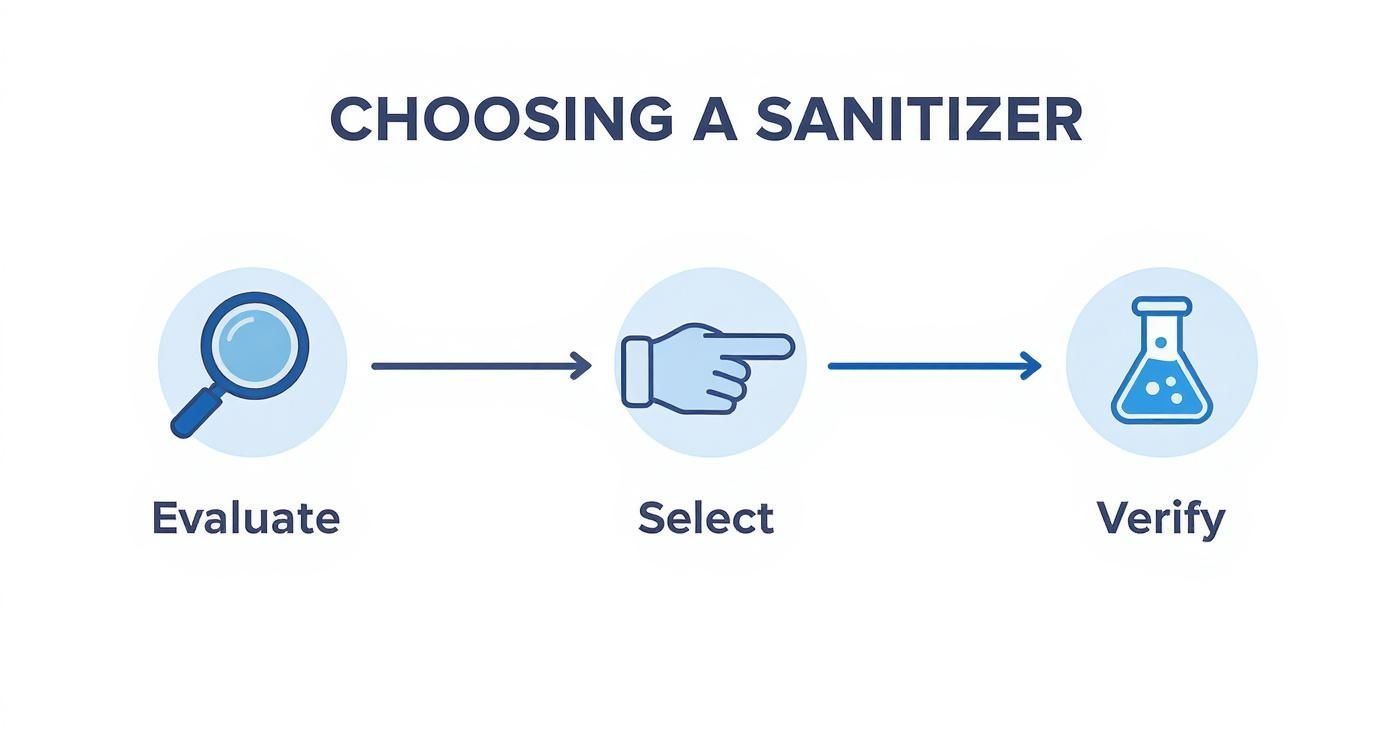
This workflow shows your job isn't finished once you've bought the sanitizer. You have to constantly make sure it’s being used exactly as intended.
Why More Is Not Better: The Science of Dilution
It’s a common mistake to think that adding an extra splash of sanitizer concentrate will make the solution more powerful. In reality, you're likely doing the opposite. Sanitizers are engineered to be effective at a very specific concentration, which is measured in parts per million (PPM).
Using a solution that’s too strong is a major risk. It can leave a toxic film that gets into food, cause corrosion on your expensive stainless steel equipment, and even irritate your staff’s skin. But a solution that’s too weak is just as bad—it won't kill pathogens effectively, giving you a false sense of safety.
Always follow the manufacturer's label. If the instructions specify 200 PPM, that’s your target. More isn’t better; it’s a hazard.
Reading Labels and Using Test Strips
The product label is your rulebook. It tells you the exact PPM needed for food-contact surfaces and how to mix it. But how can you be sure you’ve hit that target?
That's what sanitizer test strips are for. Think of them as your insurance policy.
- Mix Your Solution: Follow the label's instructions to dilute the concentrate.
- Dip the Strip: Dunk a test strip into your sanitizer bucket for a second or two.
- Compare the Color: Pull the strip out and match its color to the chart that came with the strips.
This simple test tells you instantly if your mix is right. Too weak? Add a little more sanitizer. Too strong? Add more water. It's a non-negotiable step in any professional kitchen. If you're exploring different chemical options, our guide on the 3 types of sanitizer solutions can help you compare.
The Critical Role of Contact Time
Once your sanitizer is mixed perfectly, there's one last piece to the puzzle: contact time. This is the minimum amount of time a surface has to stay visibly wet for the sanitizer to kill the germs. For most food-safe sanitizers, this is between 30 and 60 seconds.
A sanitizer doesn't work instantly. If you just spray and wipe, you're wiping away the chemical before it has a chance to do its job. The surface needs to remain wet for the full time listed on the label. This is why you should let sanitized surfaces air-dry. When you make these rules a daily habit, you can trust your sanitation process is actually keeping people safe.
Protecting Your Stainless Steel Prep Tables
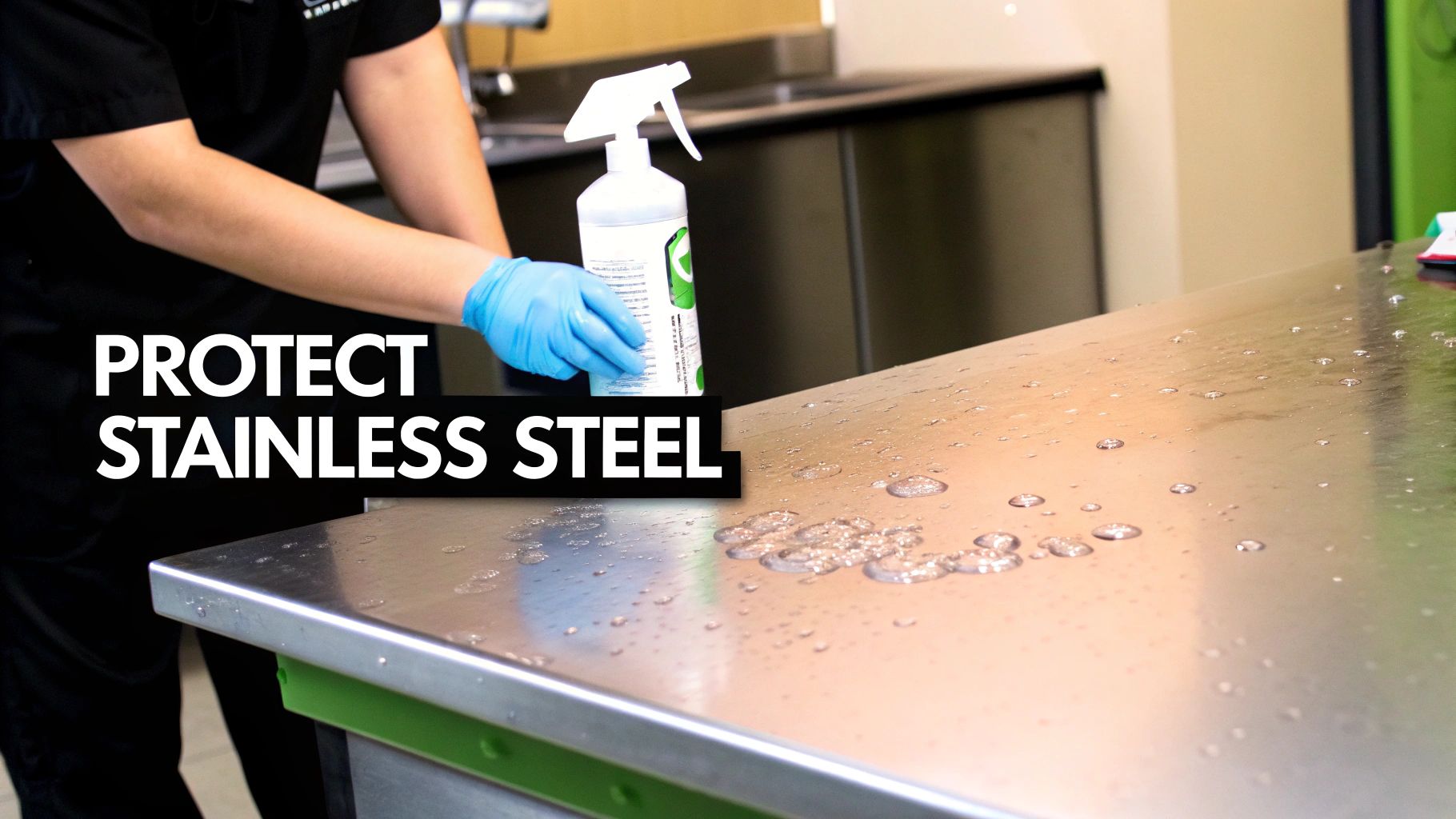
Think of your stainless steel prep tables as the foundation of your kitchen. They're the workhorses, the unsung heroes where every dish begins. So, choosing the right food-safe sanitizer isn't just about passing a health inspection—it's about protecting that critical investment. The wrong chemical can turn a gleaming, pristine surface into a pitted, corroded mess, compromising both its lifespan and its safety.
This relationship between chemicals and equipment is a massive deal in the professional food world. The market for food and beverage disinfection, which includes these sanitizers, was valued at nearly $10 billion and is expected to climb to $13.65 billion by 2032. That growth is fueled by ever-stricter regulations aimed at stopping foodborne illness, which makes your sanitizer choice more important than ever.
Choosing a Sanitizer That Protects Your Steel
When it comes to stainless steel, not all sanitizers are created equal. You're looking for something that knocks out pathogens without declaring war on the metal itself.
- Quaternary Ammonium (Quats): This is usually the go-to for stainless steel. Quats are non-corrosive, so you don't have to worry about the pitting or rusting that harsher chemicals can cause. They get the job done while being gentle on your gear.
- Peracetic Acid (PAA): Another fantastic, steel-safe option. PAA is a powerful killer that breaks down into harmless stuff like vinegar and water, leaving no damaging residue behind.
- Chlorine (Bleach): Tread very, very carefully here. While it's effective and cheap, chlorine is notoriously corrosive to stainless steel, especially if your mixture is too strong or it's left on the surface too long. Over time, it creates tiny pits where bacteria can hide, defeating the whole purpose of sanitizing.
If you absolutely must use chlorine, follow the dilution instructions to the letter. And always, always finish with a potable water rinse to wash away any corrosive residue. For a deeper dive, check out our complete guide on how to clean stainless steel the right way.
Types of Stainless Steel Prep Tables
To sanitize effectively, you first need to understand the different types of prep tables in your kitchen, as each presents unique challenges.
- Standard Work Tables: These are the most common: simple, flat-top surfaces often with an open base and an undershelf. Their straightforward design makes them easy to clean and sanitize thoroughly.
- Tables with Backsplashes: Many tables feature a raised lip at the back to prevent spills from hitting the wall. When sanitizing, pay special attention to the crease where the flat surface meets the backsplash, as this is a prime spot for bacteria to collect.
- Enclosed Base Tables: Tables with cabinet bases provide excellent storage but also create more surfaces to clean. Doors, handles, and interior shelving all require regular sanitizing.
- Specialized Prep Tables: This category includes refrigerated units like sandwich prep tables and pizza prep tables. These combine a stainless steel work surface with refrigerated wells for ingredients, creating a more complex environment with many nooks, crannies, and different materials (like rubber gaskets) that need careful attention.
Sanitizing Different Prep Table Styles
Your sanitizing method should adapt to the type of table you're cleaning.
For standard tables, the process is straightforward:
- Clean First: Scrub with soap and water to remove all food debris and grease.
- Apply Sanitizer: Spray or wipe the entire surface, including legs and undershelves, with a steel-safe sanitizer.
- Respect Contact Time: Let the sanitizer sit and remain wet for the full required time (usually 30-60 seconds).
- Air Dry: Allow the surface to air dry completely.
For specialized pizza and sandwich prep tables, the process requires more detail:
- Gaskets and Seals: Carefully wipe the rubber or plastic seals around lids and doors with a cloth soaked in sanitizer. Avoid abrasive tools that could cause damage.
- Food Wells and Inserts: Remove all food pans and sanitize them separately. Thoroughly clean and sanitize the refrigerated wells, paying close attention to corners and drains.
- Integrated Cutting Boards: These high-contact surfaces must be sanitized frequently, especially when switching between different types of food (e.g., raw meat to fresh vegetables) to prevent cross-contamination.
- Cooling Elements: Never spray sanitizer directly onto fans or cooling elements. Apply sanitizer to a cloth first, then wipe down the surrounding surfaces to avoid electrical damage or corrosion.
By tailoring your sanitizing process to the specific type of prep table, you’re not just keeping your kitchen safe—you’re protecting the longevity and performance of your most essential equipment.
Implementing Safe Handling and Storage Protocols
The chemicals that keep your customers safe should never, ever be a threat to your staff. Using a food‑safe sanitizer the right way is only half the battle; knowing how to handle and store it is just as important. Building a rock-solid safety culture around these chemicals is what prevents accidents, keeps you compliant, and protects your team from harm.
This isn't just about common sense. It’s about creating clear, repeatable steps that everyone on your team knows by heart and follows every single time.
Equipping Your Team with Personal Protective Equipment
Before anyone even thinks about opening a sanitizer concentrate, they need to be wearing the right Personal Protective Equipment (PPE). Concentrated chemicals are no joke—they can cause nasty skin irritation, serious eye damage, or breathing problems if you're not careful.
Your absolute must-have PPE checklist for handling sanitizers should include:
- Gloves: Always use chemical-resistant gloves, like nitrile or rubber, to keep the chemicals off your skin.
- Safety Glasses or Goggles: You need to protect your eyes from accidental splashes, which can happen in a split second when you're pouring or mixing.
- Apron: A simple waterproof apron adds a crucial layer of protection for your clothes and skin against spills.
Think of PPE as the seatbelt for chemical handling. You hope you never need it, but you have to wear it every time to avoid a serious injury.
The Importance of Labeling and Safety Data Sheets
The moment a sanitizer is diluted and poured from its original jug into a spray bottle or bucket, it’s now in a secondary container. Every single one of these bottles and buckets must be clearly labeled with the chemical's name. An unlabeled spray bottle is a huge safety violation and an accident waiting to happen.
Just as important as labels, you must have the Safety Data Sheet (SDS) for every chemical you use. The SDS is your emergency playbook. It gives you all the critical info you need:
- Health hazards and first-aid instructions
- Proper handling and storage rules
- What PPE is required
- How to clean up a spill safely
Your entire team needs to know exactly where to find the SDS binder at a moment's notice. It should be in a central spot where anyone can grab it—not locked away in an office.
An accessible SDS isn't just a good idea; it's a legal requirement from the Occupational Safety and Health Administration (OSHA). In an emergency, getting your hands on that information immediately can make all the difference.
Proper Storage and Disposal Protocols
Where and how you store sanitizers has a direct impact on their safety and how well they work. Chemicals must be kept in a designated, secure area that is cool, dry, and has good airflow. Never store sanitizers near food, above prep areas, or anywhere near a heat source like an oven or water heater. High temperatures can break down the chemicals or even cause dangerous reactions.
For businesses that handle larger quantities of chemicals, knowing how to store them safely is key, which includes choosing the right chemical storage tank to fit your operation.
Finally, getting rid of old or unused chemicals has to be done responsibly. Never pour concentrated chemicals straight down the drain unless the SDS specifically says it's okay. Always follow your local health and environmental regulations for chemical waste to protect the community’s water supply and avoid some pretty hefty fines.
Making the Smartest Sanitizer Choice for Your Business
You’ve got the basics down on the different sanitizers, why dilution matters, and how to keep your gear in top shape. Now, let’s tie it all together. Picking the right food safe sanitizer for your kitchen isn't about finding some magical "best" product. It’s about finding the one that perfectly slots into your daily operations.
This choice is a strategic one, looking at your specific needs, your budget, and how your team actually works. It's a decision that's becoming more important every day. The food sanitizer market is already valued at around $183 million and is expected to grow by about 5.1% each year through 2033 as everyone doubles down on preventing foodborne illness. You can discover more insights about the food sanitizer market to see how new regulations are pushing the industry forward.
Key Factors in Your Decision
To get this right, you need to weigh four critical factors. Think of these as the legs of your sanitation stool—get one wrong, and the whole thing wobbles.
-
Surface and Equipment Compatibility
What are you cleaning day in and day out? If your kitchen is full of stainless steel prep tables, using a non-corrosive sanitizer like Quats or Peracetic Acid is a smart move that will protect your investment. For more general use across different surfaces like plastics and laminates, chlorine can be a great, cost-effective choice when handled correctly. -
Local Water Hardness
This is the factor everyone forgets, but it can make your sanitizer completely useless. Hard water is packed with minerals that react with certain chemicals, especially Quats, and stop them from working. Get your hands on a local water quality report or just use a simple test kit. If your water is hard, you absolutely need a sanitizer that’s made to work in those conditions. -
Ease of Staff Training
Your sanitation plan is only as good as the people doing the work. A product with a simple, forgiving dilution ratio and crystal-clear instructions makes training a breeze. Some sanitizers, like iodine, even have built-in color indicators that help cut down on human error.
A complicated, multi-step sanitizing process is more likely to be skipped or done incorrectly during a busy dinner rush. Choose a system that is straightforward and easy for your team to master and repeat consistently.
Calculating the True Cost
Finally, you have to look past the price tag on the jug. The total cost of ownership is what really matters, giving you a much clearer idea of what you’ll be spending long-term.
Think about these points:
- Dilution Ratio: A highly concentrated product might look pricey at first, but if a tiny amount makes gallons of solution, it could save you a lot of money over time.
- Required PPE: Does the sanitizer demand special gloves, goggles, or other protective gear? That’s an ongoing supply cost you need to factor in.
- Shelf Life: How long does the concentrate last before it expires? A product with a longer shelf life means less waste from old stock you have to throw out.
By carefully weighing these factors—from what you’re cleaning to the true cost—you can confidently pick a food safe sanitizer that doesn't just check the regulatory boxes but also fits your kitchen’s real-world needs and budget.
Common Questions About Food Sanitizers
When it comes to keeping a commercial kitchen spotless, a few questions always pop up. Let's tackle some of the most common queries managers have about food-safe sanitizers to help you nail down your cleaning routine with confidence.
What Are the Different Kinds of Stainless Steel Prep Tables?
Your prep table is the heart of the kitchen, so knowing what you're working with is the first step to keeping it clean. Most stainless steel tables fall into a few common categories, and each has its own quirks when it's time to sanitize.
- Standard Work Tables: These are your basic, all-purpose flat-top tables. With a simple, open design, they're the easiest to wipe down and sanitize quickly.
- Tables with Backsplashes: That little lip at the back is a lifesaver for catching spills and splatters before they hit the wall. The key is to get right into the corner where the surface meets the backsplash—that’s where gunk loves to hide.
- Enclosed Base Tables: Tables with cabinets or shelves underneath are fantastic for storage. Just remember that those doors and interior spaces need regular cleaning to stop germs from setting up shop.
How Do I Sanitize Specialized Prep Tables?
Things get a bit more complex with units like pizza and sandwich prep tables. These combine that classic stainless steel surface with refrigerated wells, which means more nooks and crannies to worry about.
These tables have multiple food pans, gaskets, and often a built-in cutting board that all demand close attention. You'll need to pull out all the food pans to clean the wells properly. Be extra careful with the rubber gaskets around the lids; wipe them down gently so you don't cause any damage. And that cutting board? It needs to be sanitized constantly, especially when you're switching from raw meats to veggies, to keep cross-contamination in check.
For durable, NSF-certified equipment that makes sanitation easier, trust the experts at PrepTables.com. Explore our wide selection of stainless steel prep tables, including specialized pizza and sandwich units designed for safety and efficiency, by visiting us at https://preptables.com.